
July 3, 2026
Why Thinking Less Might Be The Answer To Everything With Dr. Srini Pillay
Sound bites
To really solve complex problems, you actually need to unfocus.
In this episode
Dr. Srini Pillay talks with Mens Anonymous about why less conscious focusing can improve complex problem solving, creativity, resilience, and reinvention.
- Strategic unfocusing can activate the brain’s default mode network and help integrate information for complex problems.
- Best ideas often arrive during walks or in the shower, when attention is not locked onto one task.
- Midlife and career plateaus can trigger a need to reinvent yourself instead of simply pushing harder.
- Creative work can relieve internal turmoil and stress by giving those feelings a different outlet.
- Psychological factors and mindsets can support healthier aging and longer life without drugs.
Transcript
ShowHide
Automatic captions of the conversation. They can contain errors and do not name who is speaking.
Welcome to Men's Anonymous, the podcast where men can be vulnerable and open without fear of judgment. Your host, Daniel Weinberg, leads authentic and unfiltered discussions that explore the challenges and triumphs of modern manhood. Join us as we break down barriers, challenge stereotypes and redefine masculinity. Men's Anonymous, a safe space for men to lower their shields and share their inner world without judgment. Hi, on this week's show, we have Harvard trained Dr. Pillay talking about why thinking less might be the answer to everything.
Men's Anonymous. Dr. Pillay, so great to have you on the show. Thanks so much for having me, Daniel. I'm looking forward to this conversation. And where are you right now in the world? Right now, I'm in New Jersey. I moved between New York and New Jersey. Amazing. Okay, so you're a Harvard-trained professor. Why don't you give just a little intro on your story and how you got into this particular field or specialty. So my background is in medicine. I trained in psychiatry at Harvard, and also trained in brain imaging.
I ran the anxiety disorder service, and also ran a part of the brain imaging center. And while I was doing this, I was also working in biotechnology, looking at drugs in early stage development for cancer, heart disease, neurodegenerative disease. And so my real interest right now is in what I call psychogenic longevity, which is what are the psychological factors and mindsets that can help you live more healthily into old age, and they can also help you live longer. This is no drugs. This is what you can do to yourself without drugs.
That's exactly right. And in addition to that, I'm an executive coach. I work with organizations globally, helping them build more resilient, agile, and creative teams. Right now, organizations are asking me to help them think more complexly because so many things are changing. I'm a think tank at McKinsey, and I taught at Harvard Business School as well. I'm also a musician. I just finished writing a musical, and I started an AI music company, and then I've co-founded a few technology companies that are related to enhancing psychogenic longevity.
One of them is Roulet, where I'm chief medical officer and co-founder, and the other has to do with a platform that's a more extensive platform, where I'm building a platform to track and understand linear and non-linear variables related to psychological health and the way it impacts your physical well-being as well. So it's fair to say that you're a smart guy. Yes. Did you say it's fair to say that I'm a smart guy? I think it's fair to say that you're a smart guy. Well, I don't know. I think credentials are one thing.
You're an intelligent man. Let's jump into the brain here. What's one thing you believe about the brain that most high-performing men get completely wrong? Well, I think when people are trying to solve problems, whether it's related to their personal lives, their professional lives, or if they're sports people, how to solve a particular problem, they tend to focus on what they need to solve, and then they tend to problem solve. The problem is that if you only focus, you are using a part of the thinking brain that we call the prefrontal cortex that's connected to the parietal lobe, and that gives you a certain amount of access to your intelligence.
But to really solve complex problems, you actually need to unfocus. And in my book Tinker Dabble Doodle Try, Unlock the Power of the Unfocused Mind, I talk about ways in which you can strategically unfocus to turn on the unfocused network in the brain, which is the default mode network. Now you might say, well, come on, I already don't focus well enough. Now I've got to unfocus strategically. And the answer is yes, because when you focus, you turn off the part of your brain that can solve complex problems. You have to unfocus to turn on the brain that can integrate information.
Which is why people sometimes say they have their best ideas on a walk or in the shower, because they're not sitting down looking at something specifically. So you're saying, just so I understand, when you're focusing that we're going to, here's the problem, let's focus on solving this problem. So when you're really consciously focusing on the problem, that unlocks a certain capacity to solve a problem. But what you're suggesting, just so I understand, is that to solve a very complex problem, like putting rockets into space, for example, you actually need to unfocus first, to switch off the mechanism which does the focusing in your brain, and unlock a different part of your brain that is able to do complex problem solving.
And is it in the front lobe as well? It's called a default mode network, and it's a number of different parts of the brain. The medial prefrontal cortex, the middle of the frontal cortex, parts of the parietal lobe. So it's a different circuit altogether. I remember listening to an interview where Elon Musk, for example, you were talking about launching rockets. That's what I was thinking about. Someone like that who has clearly solved some very complicated problems. He would have only been able to do that if he...
He particularly has the ability to unlock that default mode network. Yeah, and he has said in an interview that some of his best ideas come in the shower. Jeff Bezos, for example, has said he likes to begin his morning puttering around, reading the newspaper, but puttering before he takes on his high intensity meetings. And obviously, all of these people focus intensely as well. But what I'm saying is rather than saying, focus, focus, focus, fatigue, you have to refuel your brain. Focus, unfocus, focus, unfocus, so that you can give your brain a chance to put together complex variables to problem solve.
And I think high performers know this. High performers know that if they stay in lockdown mode all the time, they're not going to be able to do well. They have to take their minds off to be able to unlock their greatest performer. So interesting. Okay. So when did you realize that your brain doesn't work the way that people think the brain should work? Like you obviously went deep into this, you know, this domain. So when did you realize that? Well, so I think intuitively in myself, I would growing up before I even got exposed to medicine, I think I was, I recognized that I loved mathematics as much as I loved music, and that I was training in music, but I also liked physics.
I liked a lot of logic, but I also liked the arts. And so people would often say things like, well, you know, you've got to choose. And I'm sort of like, well, maybe to a certain extent, although when it, when the time came to choose a career, and I had to choose between being a professional musician and going to medicine. The reason I chose medicine was not really that scientific. It's because I was really motivated to understand the human body. There was something in me that was like, I don't think I want to go through the rest of my life without spending some amount of time understanding the human body.
And I think that I also found out at medical school, there was a time in my second year where I was focusing intensely, and I just wasn't getting the results that I wanted. And so in my third year, my brother actually said to me, you should practice this thing called Transcendental Meditation. And I said, that sounds dumb. And he said, what do you mean? I said, this is stupid. I'm not going to sit in a chair and say a mantra over and over again. That sounds absurd. And so he said, well, I mean, you're a scientist. Why don't you try it out for a few months and see if it changes?
And so I did. And I built in these regular periods where I would meditate. And all of a sudden, I shot to the top of my class. And I was like, wait a minute. I was focusing all this time. I was doing okay. But by building this unfold, it's changing my actual performance, and things started happening. But did you connect those dots? Yes, because it was the one material change that I made. And I think as I began to learn more about the brain, and as I began to see more about how things are solved, I realized that logical solutions are only the stories that we come up with.
Because something is happening in the unconscious brain, what people generally call the subconscious. Something is happening that is directing things completely differently. And then I started to understand, as I read more and more about the brain, you know, there was a guy named Lebet, who discovered that intentions are, you can see an intention in the brain before you realize you have an intention, which means your brain has already decided what you want to do before you realize what you said. And part of that is that more recently, in fact, last month, April of this year, Lisa Feldman Barrett published a study in which she said that category is already baked into the brain, meaning a lot of times we think we're making a decision, but the decision has already been made because we fed our brain.
Can you give me an example? Can you just give me like a small example of that? Let's say you say, do I want to stay with this person or do I want to not stay with this person? You might say, well, I thought about it deeply and I realized I'm compatible with them, I'm not compatible with them, but your brain often has already decided. So, it will only look for evidence to support the decision that's already been made, which is why you have to take a step back and you have to ask yourself, okay, well, and same thing with life.
Say you want to make more money. You know, a lot of people say, I just hit a ceiling, and they use that limit as a way to define what's possible for them. But if you reconfigure your prediction brain and you say, wait a minute, I got to change some things here, limits are not my thing. I need to start increasing possibilities. I need to entertain the idea that maybe I will be happier with that. I need to entertain the idea that I'm not at some specific disadvantage. Then your brain starts working with you to confirm that reality.
So a lot of people live from an already pre-programmed reality, where they passively, life has just taught them to do things. And what I often do when I'm working with people is help them reprogram their reality, so that the brain will actually direct them toward what this new vision that they have, rather than the preconceived notion that they've essentially been conditioned to believe. So what you're suggesting is there are those, let's say, segments of society that might feel like they're less advantaged or have less opportunities, etc.
What you're suggesting is that if you were able to teach them some of the techniques that you teach, that relative to their situation, you could improve it by working with them, to help them change just their mindset. That's your thesis, right? Yes. And there's a lot of research to support that. For example, growth mindset. Carol Dweck has studied this intensely and has found that a growth mindset, where you believe that even if you get something wrong, you can pick yourself up again and get better at something, allows people to have superior academic performance.
A long time ago, people would say, men are really good at math and women are really not good at math. And women would do poorly at math. But then, when they did an experiment where they primed the women to say that they could be as good as anyone, they started to do as well. So I think that a lot of times, we don't realize that just the way we view the world is creating the world that we encounter. So a lot of men fall into the trap of what we kicked off with. Which is, solving a problem means you got to work harder, focus harder, put more time in, etc.
Which is what you're highlighting isn't the way. But men really fall into that particular trap. When they do that, why does focusing harder actually make anxiety in your body worse? So focusing harder can make anxiety worse for a couple of different reasons. One is what we call prefrontal cortex depletion. So if you overly focus without taking those breaks, you are draining your energy, and the brain is a very sort of energy intensive organ. So not taking those breaks means you don't have the energy, and something in you knows that your energy is waning, right?
It's getting less and less. And all of a sudden, you start feeling anxious because you realize you don't have the fuel you need, you might be running on empty. So focus on the one hand can also improve anxiety. So there's no sort of one way relationship here. But if you are using only pragmatism, you are not allowing yourself to understand your full intelligence. And if you just stick to this focused routine, you also don't have the energy to change your mental set to solve problems. So there's a term that I've come up with called psychological Halloweenism, which is a term that is based on a study that showed that if you give someone a creative problem to solve, they are statistically significantly less likely to solve that problem if they act like a rigid librarian rather than an eccentric poet.
So the same person, if they act like an eccentric poet, somehow the brain starts looking for more creative solutions. But if they act like a rigid librarian, then the brain is like, well, let me just be more close-minded about what I'm doing to follow that stereotype. Now, when you are overly focused, if you don't have the energy to switch cognitive sets, it's going to make you anxious because you're going to realize the likelihood of solving that problem is less and less. I also think that the thinking brain and the feeling brain are connected.
And a lot of times when you're anxious, when the first anxiety sets in, you get these earthquakes in the emotional center in the brain, and you get these aftershocks in the thinking brain. So the anxiety makes the decision-making even more difficult, and it makes the thinking even more difficult, and it becomes a vicious cycle. So focus can improve anxiety, or it can make anxiety worse when it drains the brain, and when the anxiety is worse, it makes the focus even more difficult. So I'm going to speak from my own personal experience, and I want to reframe it back to a question about men, and that is that I have been able to learn the skill, I call it a skill, or the ability to practice dolce fariniente, which means the sweetness of doing nothing.
Okay. And it took me a little bit to learn how to do that. Firstly, fortunate enough from a career-wise I do not have to be too stressed about my life and my family's life. So that obviously takes some stress and anxiety off the plate and gave me some capacity to experiment with this. What you did with the transcendental, I call it actually just learning to do nothing. And for me, it's not trying to achieve happiness. I am shooting for what I call POM, peace of mind. I'm shooting for quiet. Like you talk about the focus-unfocus, I guess unfocus is turning off the mind, okay?
Like you said, to give it, and I've realized in doing that, how much less anxiety you experience, how much less stress you experience, and the retention of energy, obviously, okay? Now, my question is, most, if I tell mates that or men that, they think I'm a little bit, you know, kukulamunya, right? Why do men find it so hard to resist, or what I had to do, or to resist completely unfocusing? Well, the wandering mind can be very helpful in improving problem-solving, complex problem-solving, and can be very helpful in creating the sense of relaxation you're talking about.
But studies also show, that's why this book is about strategic unfocus. It's not just like sit down and daydream, doing whatever. It's because studies show that mind wandering can actually increase depression and anxiety. Because a lot of times, when your mind is in wandering state, it naturally goes to all the negative stuff. Did I mess up my life? Is this relationship really the right relationship for me? Why am I sticking in this job that I don't really love? Do I have enough friends? And then suddenly, you become more anxious.
So I think men don't want to experience that negative state. They'd rather be distracted by TV, or distracted by the sport that they're watching, because the mind left on its own can be unruly. Now, that's not just for men. I think it's for women as well. This is a generalization, but it takes a while for men to be open to understanding the complexity of who they are. I think there are kind of extremes in the world, right? There are these male stereotypes. Like if you scroll on Instagram, you'll see every person with huge muscles, and eating this, and taking this latest peptide, and having this beautiful partner, and so you have this idea that somehow you don't fall within that.
You compare yourself to other people. And people who are caught in the stereotype actually have more psychiatric disorders. So they have more depression, more anxiety because they're constantly comparing themselves with other people. I think though that when men begin to understand their complexity, and they begin to accept that you can still be male, you can still be masculine, and still have lots of gray areas that you can't quite define. It makes them super anxious. And in my therapy practice, I have found that, and it just so happens that I've had some decent, what I would call successes in terms of people meeting their goals recently.
In the last few years, three of the people I've worked with have ended up selling their companies for $100 million. And all three of those people are such atypical men on the inside. On the outside, they look like regular dudes. You know, they carry themselves like that. They have a mask. But when they're contemplating things, you know, one of them was like, really loved his wife, like more than anyone, and really wanted to have an affair with the woman he was with at work, and didn't know how to reconcile those feelings.
But when he came to that realization, he was like, I don't even, how am I even saying this out loud? Like, what is happening here? Like, I know most people would say, make up your mind. Like, you either stay with your wife, stay with your wife. You want to have an affair, have an affair. He was like, no, I think I want to have an affair while I'm with my wife, but I also feel badly about it. But I also feel badly if I don't have that. Just saying that kind of stuff, I could see how when he was saying that, he was beginning to own himself and his thought processes about his business.
Actually changed, because he was, there was something about relaxing into... Letting go. Actually, maybe his brain does work in this impossible to understand way, you know? There was another person that I worked with who was a very eccentric dresser, who was someone who had all these habits that he had been criticized for early on in his life. Even his kids would be like, dad, stop doing this goofy thing in public. But once he got to understand, once he, I think, honestly, once he felt loved in the session, just we met online, he would feel this connection, and he understood what that acceptance was.
That, I think, released him to think more freely about other things in his life. Now, oftentimes people feel like you've got to resolve something. You know, like the guy with the affair, he's going to decide, does he want his wife or does he want the affair? The other person, the person who's acting in a childish way, should he stop doing that or should he start doing that? Well, neither of them resolved anything. They were constantly in a state of ecstasy and turmoil, and they started to understand that that state released them more to the authenticity of who they were, and it's not for everyone.
You know, like a lot of people would be like, I don't want that chaos in my life. I don't want to examine myself in this way. And so I think at a deeper level, men are reticent to examine their own complexities because their complexities don't necessarily match the stereotype or the social norm. So why do high performers often feel the most trapped? Well, in part, it's because they're... So let's take examples of people, right? I mean, most... If you think about most people who have been successful in their lives, there's always been some kind of complexity in their lives.
You know, you never know the truth of what's being reported online. So anything that I'm saying about what's online is not necessarily a fact. But, you know, if you think about the 10 richest people in the world, you go through that, and a fair number of them have been divorced because they had to leave a state of safety and they had to be in some other place. For high performers, there is a call to consistency. Like, you have to be conscientious. You have to make sure you stay at that level. And they have what we call the summit syndrome.
In the business world, the world of business coaching, there is a summit syndrome. And a lot of times, they are always pushing on the gas to get higher. Push on the gas, they get higher. They suddenly realize at a certain point in their careers, they push on the gas and nothing is happening. And then they are like, what? I've reached my plateau, like there is nothing more. Nothing more personally, there is nothing more professionally. And that makes them freak out. So when people have written about this in the business literature, there is a great article about it in Harvard Business Review.
They end up disabling themselves, disabling the organizations, because they've reached the summit. They call this crisis at the summit. And so what you have to do is recognize that you have to figure out at those points, how you want to reinvent yourself. Kazimierz Dobrowski, who is a Polish psychiatrist and psychologist, found that gifted students are constantly reinventing themselves. And when they reinvent themselves, they use what he calls positive disintegration. And positive disintegration is essentially coming to terms with yourself, saying, I've got to reinvent myself in some way because life's not working out.
Now, Dobrowski believed at the lowest level that most people live there. They eat, they sleep, they reproduce. That's their lives. And there's not a whole lot of anything going on. At the second level, maybe a little bit of anxiety. But then they push that down to, I'm too busy to be anxious. I just have to move on. At the third level, they realize that who they are and who they want to be, completely different people. And that's where they realize, okay, now I have to figure out how to change that. Now- Does that happen at a particular age range or time in life or, like how does that work?
Different for different people. I think commonly people would say somewhere between 45 and 55 is where a lot of people start having that. You're talking about really like midlife crisis here effectively. Yeah, but you know, because age expectations have changed. I mean, if you like myself, I think I've had midlife crisis from the forever way before. What does that mean? What does that mean? Have you ever ever know, but in all seriousness, have you not ever been in crisis where you are mega depressed, where you don't want to socialize with anyone, where you can't sleep well, you must have had periods like that in your life.
No? No. So I've not had, my personality is such that I'm pretty upbeat. So my crisis come in the form of internal turmoil and stress, but not in the form of depression. And when I am that stressed out, then I'm like, okay. What does that mean, internal turmoil and distress? How does that practically present itself? Well, how do you behave any differently when you're in that state? How do I behave differently? I think I tend to, so I'm usually aware of it. So I tend to contemplate it quite deeply. So I might think to myself, write, take a course, make a course, get productive in a particular way to manage those feelings.
So myself, when I'm in that stressed state, when I do some kind of creative work, it actually alleviates what that is. So I've learned over time that being creative can help me feel very different. But in those states, I would say that I'm in a similar state right now. So I could maybe speak to it more immediately. I feel like the world is changing so much. AI has taken over what's going on. The online conversations are mostly completely nonsensical, in my opinion, as it relates to health. For a while, I was thinking to myself...
When you say that, you mean like stuff that's getting posted on social media or you're relating to health, you're saying it's pretty much nonsense. Is that what you're saying? Well, even in the scientific literature, if you look at the studies in the scientific literature, the number of incorrect citations in scientific articles has catapulted in the last three to five years. How and why? And the number of fake papers has also catapulted. So one of the reasons with regard to fake papers is that they found that over 40% of medical students in China are using paper mills to publish because of the pressure to publish.
So they're just getting these papers put together. Sometimes they were able to find diagrams that are not even real diagrams, the pictures of scans that were taken from other papers. So it's hard enough to track what's going on in the scientific literature. You know, Amasha Angel has spoken about this. She was the editor of the New England Medical Journal, a very well-established medical journal. She was at Harvard for a while. She said, I honestly, I don't know whether a trusted physician exists, because people live by the standards that are related to what's published.
And what's published is so complex that it never makes it into the complexity of the standards. I give you a good example of this from my perspective. Look, bad cholesterol. You go to your doctor, your doctor will tell you lower your bad cholesterol. So, that sounds like a good idea, if it is, in fact, bad. However, there's a large body of studies that show that when you lower bad cholesterol, you have a greater chance of dying. So, when I called my brother, who's a physician, he said, I'm thinking I should be on a statin.
And I was like, well, why? That's right. I know this very argument. Because my cholesterol is high. And I said, okay, now, I'm just going to share two papers with you from the American Journal of Cardiology and the British Medical Journal, very prestigious journals. He reads them, he goes, oh, these people died faster when they lowered the cholesterol. I said, yeah. I said, so what are you going to do? He goes, I'm still going to take the statin. I said, what is going on in your head? Yes. He said, you know, honestly, I'm reading this, but it's not the standard of care, so I'm just going to follow the standard of care.
I've had these same arguments with different people who are close to me, one of which has decided to throw out all the pills, hasn't told his doctor, and the doctor thinks he's doing a great job. And he's like, I'm not going to upset the relationship. You give me, I'll put in the bin. I don't care. And I've got another really close person in my life who is doing like, you can show him that, what you're just talking about, but he'll just go, it's the standard practice. Right. And so I think we live at a time of incredible complexity, but also this thing about separating out the brain from other parts of your body, it's like so insane to me on so many levels.
Like so many platforms are measuring biomarkers, they're measuring, they're not paying attention to anything in what we call the exposome, the outer environment and how it impacts health. And they're not paying attention to mindset, because mindset is not like that much of a business. It may be a little bit in psychiatry, but it's not a business like turning out drugs. So telling someone they should go do some transcendental meditations is not exactly going to pay the bills. Right. And so I believe in taking drugs if they can be helpful.
I don't think you should not take them. But I think, just take one risk factor. If you look at hypertension, high blood pressure confers a 25 percent higher risk of mortality. Poor social relationships confer a 50 percent higher risk of mortality. Why is anybody not addressing the importance of social relationships at the same level as blood pressure? That money is. Right. So for me, the crisis is it's impossible to feel included in what's going on online because I'm seeing so much nonsense. Part of me is like, if I say what I'm saying, people are like, oh yeah, that Harvard guy, he has all these odd ideas.
So I have to now figure out how do I commercialize what I'm doing? Because I do want to make more money, but I want to do it in a way that I think is ethical, that I think recognizes the non-linear complexity of human physiology, recognizes that mindset is not the only factor, but it is an important factor as it relates to the rest of your health. So when I'm in that state, you're asking, do I ever feel stressed? I feel stressed. And then I think I've got to figure out how to reinvent myself using this positive disintegration principle.
And one way in which this can be helpful is I have a free download of an ideal self-guide on nas.com, nas.com. nas.com? Yeah. If someone looks it up, they will be able to see an ideal self-guide. And there, I walk you through questions. What are your values? What are your values at work? So it's an intensive thing. At the end, I say, take the PDF, feed it into ChatGPT or whatever large language model you're using, get a summary and then use that as your compass. Because this ideal self is what you want to guide you.
Most people just, this is a mistake a lot of men make, they problem solve, right? There's the problem, they have to solve it. But if you say, if you look in the brain, what you see is that people who are just putting out fires are actually, they're creating brain conflict. Rather than putting out fires, you can put out the fires, but first understand who your ideal self is. What is the gap? What's the website, you said? It's nas.com. NAS. Yeah, I'll give it to you for the show notes. Yes, please do. And I want for the listeners, what's a practical, like when we go back to the skill or the ability to unfocus, given how important it can be and how much value it can add.
If you could give like a high level daily protocol that you would suggest to, you know, men who are listening to this or all the listeners. But I'm a father with kids in school. I'm running, you know, I'm running a business and I am very time poor. Okay. And there's a lot going on. And I'm obviously capping out my capacity to deal with a lot of these things because I'm not applying the unfocused protocol. What would you suggest in that sort of circumstance, what would be a good protocol to start with or to experiment with?
So, the highest level protocol, and then I would have like a more detailed protocol. So, by example, when I trained at Harvard, it was sort of the old style of training. But one of the goals was by the time you get to your final year, if you have not learned how to create a life where you do not have to work on Mondays and Fridays, you get marked down. And so when we graded people who were junior to us, if they were like, oh yeah, I've got this schedule on Monday and Friday, we'd be like, mm-mm. A smart person must prioritize having these large chunks of time to do nothing so they have the flexibility to do something.
So the first high-level thing I would say to anybody is try this out. First, maybe it's impossible for you to imagine taking out two entire days. Take one half day and say, in this half day, I'm going to figure out a way for this to carve out these two to three hours for myself. So that's the high-level thing. And then build it up to making Monday and Fridays flexible. The second thing is, in any particular day, start out with just creating one period, one 20-minute period in the morning, and then one 20-minute period in the afternoon for strategic unfocus, during which you do one of the following.
You either doodle for 20 minutes to use on a piece of paper. You go on a brisk walk, or you use what we call positive, constructive daydreaming. And positive, constructive daydreaming was discovered by Jerome Singer. What you do with this is, you have to be doing something low-key, but something that you can do, like knitting, gardening, walking. And then, while you're doing that, you take your attention, the whole day we're looking outwards, right? You walk in a safe area, but you turn your attention inward. And you imagine something wishful or joyful, like lying on a yacht, or running through the woods with your dog.
And just allow your mind to do that, and then come back to the focus world. And I would recommend that you start by doing this once in the morning and once in the afternoon, and build it up to at least twice in the morning and twice in the afternoon. You're taking like a quiet, quiet space to do this? Like, where are you doing this? Well, wherever you feel comfortable. So walking in the woods, a quiet space, in a room in your house that's dedicated to this. Or you schedule it. The reality is that I find people will never take this time if they don't schedule it.
You actually have to schedule the unfocused time, the way you schedule an appointment. And you say, and there's no, in the same way that ideally there should be no compromise for gym time, there should be no compromise for this unfocused time. It's a necessary requirement for your brain to function optimally. And leading on from that, why do you believe that this all leads to longevity, longer lifespan, more positive life experience? Like, explain the neurological benefits or what's going on inside that is resulting in that longer lifespan.
So, again, I want to emphasize, I think focus is important. I don't think you should... No, no, it's not a mutually exclusive situation. It's more, you're saying that most of the time, we're doing the focus bit, that we should be allocating some of that time to introduce the unfocused, because that will help to unleash the capacity you have in other parts of your brain, which are able to solve more complex problems. So, it's just like unleashing a superpower you don't realize you have by the unfocused part is the only way you can do that.
So, you're just saying, don't eliminate that. It's got to be part of your whole portfolio or the whole menu, basically. Right. So, again, I'll answer your question about, why do I think mindset shifts have something to do with healthspan and longevity? And at a high level, it's very curious that when you look at the default mode network, which comes on when you unfocus, it's interesting that regulation of that network is, that poor regulation of that network is associated with higher states of inflammation, with cardiac disease, so, and really a lot of illnesses, and that inflammation, that poor regulation of that network is associated with depression, with anxiety, with psychotic states.
So, clearly at a high level, this unfocused, interacting with the unfocused network is important. At a very fundamental level, it goes back to what you were saying about peace of mind. When you have that peace of mind, you're more likely to feel optimistic. You know, optimists have 11 to 15% longer lifespan. You're more likely to feel confident. Uncertainty and anxiety is associated with heightened mortality. You're more likely to experience states of awe. When you have states of awe, it actually protects you at the level of inflammation.
You're more likely to feel socially connected. Social connection confers a 50% protection on mortality. When you feel this peace of mind, you're more likely to feel autonomy. You're like, you know, I'm my own person. I run my own life. When you feel that, it was a nun study that showed that there's a much higher degree, that there's a much higher chance of living longer. And then you become more resilient and more empowered. So each of those mindsets I mentioned is associated with greater health span and in some instances, longevity.
So paying attention to what's going on in how you view the world matters, not just because you're going to feel better, but because feeling better correlates with better physical health in the instances that I just mentioned. Can I ask you, given the world we live in and you see the people that surround us on a daily basis, is getting on, and this is for the younger generation, is getting on TikTok, TikTok, Instagram, or any of these platforms where people seem to be switching off in a way and just death scrolling.
Does that fall into the bucket of unfocusing? I think with anything, even any of these techniques, there's a whole lot of subtleties built into them. I think the answer to that question is maybe. And the reason I say maybe is that some studies have shown that use of social media is associated with the brain getting more tired and having a really difficult time focusing, and your attention gets consumed. Some studies have shown that creativity can be enhanced. So part of it is, when you're scrolling, are you staying away from comparing yourself with other people?
Are you aware of your state? Do you stop when you start feeling on edge? Because some people get addicted to the feeling of feeling on edge. And then they're like, oh my God, oh my God. It's so true. That's why you get all that stuff that, you know, when people see like, let's say, violence or sex or whatever, it's like the edgiest stuff is what people, like the rage-banging, all that sort of stuff, that's getting people a bit more addicted. They're like, what's going on? And you know, I think it's, you know, I'm human, and so I understand if people do that from time to time.
But if you get caught in that, and you also have to ask yourself, how you want to live your life, I was once very inspired by the fact that Coca-Cola, I don't know if they're still doing this, but they had implemented this new rule, which is that there were just people, there was going to be no phone call. Phones were going to be no more part of the conversation. And I thought... What do you mean? That's a great meaning. People used to communicate, you know, via everything, text, email, phone. But actually calling someone became, they just closed off that portal, so you could no longer contact anybody.
And I was like, this is kind of cool. I think I'm going to do that. So if you call my phone, my phone will say, this is me, please do not leave a message. I do not check my messages, nor do I answer my phone. I will only answer my phone if I know who it is. If I see a random number, I will never answer my phone. Me too. And what I've done is, I feel like there are too many ways to take over... The short-term memory bank in the brain, this part of the brain we call the dorsolateral prefrontal cortex, it's like a cup.
You can't be pouring in things from email, from text, from phone calls, from personal conversations. It just keeps on getting displaced. So I told myself, if I can cut off one form of communication, I think my life will be significantly better. I did email. I cut off email. I got thousands of unread emails. I say to people, I need to email something. If you're going to email me, you got to WhatsApp me first and just say, I've just sent you an email. Can you check? Otherwise, you're not in... That is such a healthy idea.
And you know why I think that? Like, I would love to get to the stage where I can do that. Right now, it's not possible. But I think of email like Russian roulette. And I feel like email is the same thing we had before, which is a post box. It's full of junk mail. And it's like, there might be a bill in there from the electricity company, but you've got to sift through all the other shit that they've shoved into your box. It's like, why would I do that? Just cut it off. Just no junk mail. But the problem is you can't stop people sending you junk.
Right. Well, I always tell people from a brain perspective, the one thing that should always help you, whether you're having a fight with someone, whether you're having difficulty at your job, your brain is not a trash can. Do not accept trash into your brain. That's how I look at social media. You're effectively accepting trash into the can. One last question, which is, you've suggested all the things we should do. If we had to tell the audience one thing that they shouldn't stop immediately, because it's not giving them the, you know, the benefits that they could be getting otherwise, what is something you tell them to stop doing?
Tell them to stop doing or...? Yeah, yeah. Is there anything you tell them? Because you're basically saying, focus to a point, learn to unfocus, unlock, etc. Is there anything that we do today that you think is negatively affecting lifespan, mindset, etc.? Well, so from a purely technical standpoint, one thing you can stop doing is the way you talk to yourself matters. If you tell yourself, I must not spend money, I must not eat food. There's a thing called ironic process theory, which Daniel Wegener discovered, and he found that under stress, when you tell your brain not to do something, it does the exact opposite.
So rather than saying, I must not spend money, say, I must save money. Rather than saying, I must not eat this unhealthy food, say, I must eat this healthy food. But using the word not, under stress... You're saying negative framing is something that has a negative impact on your mind. There you go. Negative framing. That's interesting. So all in all, it sounds like the answer isn't doing more. Maybe it's just thinking differently and less. Absolutely. You know, when you told me the Dolce Farnese, I was thinking my book Tinker Dabble Doodle Try is published...
What's the book say? Say it slowly so the audience can hear. It's Tinker Dabble Doodle Try, Unlock the Power of the Unfocused Mind. And when the Italian publishers wrote to me, they were like, we don't want to offend you, but we think we have a catchier title that we'd like to translate into. And I said, well, sure. And they said, tell me what it is. And they said, it's Il Potere del Cazzeggio. And Il Potere del Cazzeggio basically means the power of effing around. That's cool. And I was like, yeah, actually, that's good.
They said, we don't mean any disrespect. They said, if you think it will sell books, and people will actually want to know about it. The power of fucking around. But I think that it is a very, what's the word, undervalued activity. Yeah. Speaking from experience. Yeah. Okay, I close off every interview with five rapid questions. So I'm going to ask you and just give me whatever comes to mind first. Who would you like to say sorry to, given the chance? Probably my father for not understanding until later in life, that he really gave me everything that he had.
Wow. What are you proud of being or doing in your life? Loving. I have access to loving people in a way that I find very satisfying. That's nice. When did you receive kindness while needing it most and expecting it least? The first thing that comes to my mind is at my mother's funeral, I had not seen two of my cousins for the longest time. But when I was there and they knew how upset I was going to be, when as the proceedings went on, they both happened to be female cousins, but they came up to me and just without looking at me, trying to comfort me, just put their arms around me.
I think having that tenderness was something that really made me understand that we grew up together, and even though I hadn't seen them for so long, that they were there. So nice. Speaking about your mother, what did your mother or father teach you that you frequently remind yourself of? My mother was a big believer in a single god. And when I went to school, and I came back and I said, Mom, you told me I was Hindu. Then how come we eat steak? And how come we eat pork? My friend said, You're not Hindu. You're like a fake Hindu.
And I said, So what? It's okay. She said, Do you like bacon? I said, Yeah. And she said, Do you like the steak? I said, Yeah. She said, Well, you think there's a god up there saying you can eat bacon, but you can't eat bacon, you can eat steak, but you can't eat it. I said, No, probably not. She said, Well, I want you to realize that whatever people choose in their religions, value that, respect it, but don't feel like you have to take direction from anyone else about what you choose in life. Very good. And finally, what's Dr.
Pillay's superpower? Love, I think. Wow. Good one. I think love and having a lot of fun. I have to say, I was in France last week, and I was in my own hotel. There were all these things closed up because of the Cannes Film Festival. And one evening, I went to the bar, and I just started dancing by myself. And the manager came up to me, and she said, excuse me, and I said, yes. She said, you can come back here any time. Yeah. Good one. Good one. Dr. Pillay, thank you so much. Really appreciate your time. It was a fascinating discussion.
I took a lot away from it, and really appreciate the work you're doing. So thank you. Thanks so much for having me, Daniel. I appreciate it. That's it for this episode of Men's Anonymous. Thank you for listening. For more information on the Men's Anonymous podcast, including resources discussed in the show, visit mensanonymous.com. Join us next time as host Daniel Weinberg provides a non-judgmental space for men to voice their innermost feelings and thoughts.
About Dr. Srini Pillay
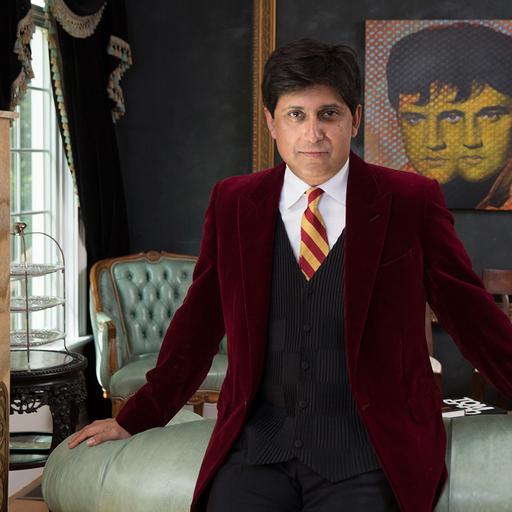
Harvard-Trained Psychiatrist, Author, Brain Researcher & Co-Founder of Reulay Digital Therapeutics.
17 years Federally funded brain researchTop 20 Leadership development mover & shaker6 Books authoredHarvard Medical School Assistant Professor of Psychiatry
Dr. Srini Pillay is a Harvard-trained psychiatrist, neuroscientist, entrepreneur, and author exploring one of the defining questions of our time: What makes us uniquely human—and how can we develop those capacities in an age increasingly shaped by AI?
Trained as a physician in South Africa, where he graduated at the top of his medical school class, Srini earned a Medical Research Council fellowship in neurochemistry before completing his psychiatry residency at McLean Hospital through Harvard Medical School. He became the institution's most awarded resident and went on to direct its Outpatient Anxiety Disorders Program and Panic Disorders Research Program in Brain Imaging. For 17 years, he conducted federally funded brain research while serving as an Assistant Professor of Psychiatry at Harvard Medical School.
Today, Srini brings that scientific foundation to questions extending far beyond traditional medicine. His work explores how belief, attention, emotion, creativity, and human connection influence the way we think, perform, adapt, and potentially age. Through his work on psychogenic longevity, he examines the relationship between psychological experience and physical health, expanding the conversation about longevity beyond biology alone.
As AI transforms the workplace, Srini is developing a powerful new perspective on human potential. He argues that our greatest advantage may not be faster thinking or tighter control, but our capacity for insight, imagination, unexpected connections, and reinvention.
More from Dr. Srini Pillay
All episodes → Sustaining Creativity PodcastLiving a Creative Life with Dr. Srini PillayOct 2026Play episode →
 The Communicative LeaderReclaiming Cognitive Capacity: Neuroscience, Uncertainty, and Intentional UnfocusOct 2026Play episode →
 Confidence Through HealthThe Importance of Integrating Thought, Emotion, and Body w/ Dr. Srini PillayOct 2026Play episode →
 The Conscious Man 7 PodcastEpisode #154 - He's Building VR to Replace Psychedelics | Dr Srini PillayOct 2026Play episode →
 Mindset BoosterRewire Your Brain for Confidence, Creativity and BreakthroughSep 2026Play episode →
 The Deep Wealth Podcast - Unlock Your Deep Wealth In Business and LifeHarvard-Trained Psychiatrist Dr. Srini Pillay: Relentless Focus Is Robbing Your Profits, Success & Health (#579)Sep 2026Play episode →
 Peak Performance Life PodcastEPI 269: Harvard Trained Psychiatrist On How Your Mindset And Other Mental Factors Impact Inflammation, Immunity, Healthspan, & Longevity. With Dr. Srini PillaySep 2026Play episode →
 Mirror Talk: Soulful ConversationsReinvent Yourself: Neuroscience, Spirituality & the Power of Possibility (with Dr. Srini Pillay)Sep 2026Play episode →
 MadPo3t Podcast| Art|Life| Creative explorationInto the Abyss| Ft Dr. Srini PillayAug 2026Play episode →