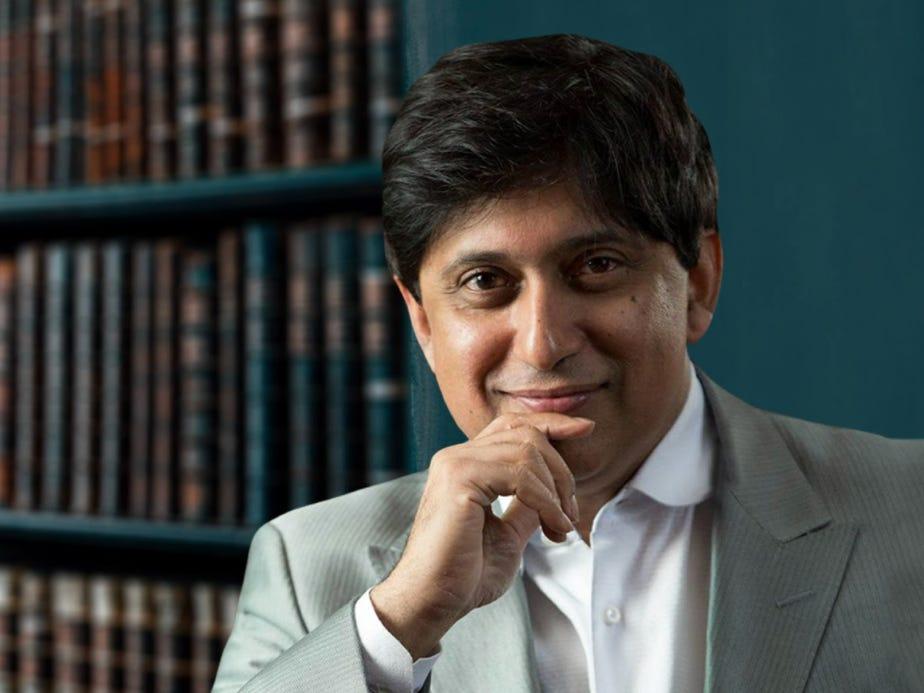

Meet Dr. Srini Pillay
Dr. Srini Pillay is a Harvard-trained psychiatrist, neuroscientist, entrepreneur, and author exploring one of the defining questions of our time: What makes us uniquely human—and how can we develop those capacities in an age increasingly shaped by AI?
Trained as a physician in South Africa, where he graduated at the top of his medical school class, Srini earned a Medical Research Council fellowship in neurochemistry before completing his psychiatry residency at McLean Hospital through Harvard Medical School. He became the institution's most awarded resident and went on to direct its Outpatient Anxiety Disorders Program and Panic Disorders Research Program in Brain Imaging. For 17 years, he conducted federally funded brain research while serving as an Assistant Professor of Psychiatry at Harvard Medical School.
Today, Srini brings that scientific foundation to questions extending far beyond traditional medicine. His work explores how belief, attention, emotion, creativity, and human connection influence the way we think, perform, adapt, and potentially age. Through his work on psychogenic longevity, he examines the relationship between psychological experience and physical health, expanding the conversation about longevity beyond biology alone.
As AI transforms the workplace, Srini is developing a powerful new perspective on human potential. He argues that our greatest advantage may not be faster thinking or tighter control, but our capacity for insight, imagination, unexpected connections, and reinvention. His work challenges the assumption that greater productivity always requires greater focus, showing why the brain's unfocused states can be essential to creativity and complex problem-solving.
Srini is Chief Medical Officer and Co-Founder of Reulay, an AI-driven digital therapeutics company focused on science-based mindset interventions, and Co-Founder of MindForm Sanctuaries, which integrates neuroscience-informed digital art into physical environments. He is also developing The Illuminated Human, a vision centered on cultivating human capabilities and creating a more hopeful future alongside technological progress.
The author of three books, including Tinker Dabble Doodle Try, Srini bridges neuroscience, psychology, leadership, and the science of belief. His work also explores how our memories can constrain our identities, why self-belief is more complex than positive thinking, and how changing our expectations can open new possibilities for action.
A member of the Group for the Advancement of Psychiatry and McKinsey's Consortium for Learning Innovation, and recognized among the world's Top 20 movers and shakers in leadership development, Srini advises leaders and organizations on human performance, creativity, and reinvention.
As a podcast guest, Srini brings scientific depth and provocative, practical ideas to conversations about the human advantage over AI, the neuroscience of belief, the future of work, strategic unfocus, and the psychological dimensions of longevity. He offers audiences a fresh way to think about what the brain can do-and what becomes possible when we stop trying to control every aspect of it.
Awards and recognition
- Business Book of the YearSlovak Spectator · 2012
- Books for a Better Life AwardMultiple Sclerosis Society · 2010
- Best Books of 2010Men's Health · 2010
- Psychiatry Resident of the YearJanssen / American Psychiatric Association · 1999


