
April 29, 2024
Episode 131 - Change is Constant, Play to Your Strengths with Russell Harvey
Listen
In this episode
Russell Harvey joins The Resilient Journey to explore change, VUCA, and how leaders can build resilience by playing to their strengths.
- VUCA as volatile, uncertain, complex, and ambiguous, with vision, understanding, clarity, and agility as the counterbalance.
- Change as constant, with resilience giving people skills and mindsets to face it rather than just name the problem.
- Situational awareness as a leadership habit, including looking up, looking out, and noticing what is brewing before a crisis hits.
- A resilience wheel built around attitude, purpose, confidence, adaptability, support network, meaning, and energy.
- Shifting people from coping and surviving toward thriving, by doing more of the things they love and using their strengths.
Transcript
ShowHide
Automatic captions of the conversation. They can contain errors and do not name who is speaking.
John F Kennedy said, Change is the law of life, and those who look only to the past or present are certain to miss the future. Today's guest puts it this way, change is constant. So how does this apply to us? Stick around and find out. Hello everyone, and welcome to Episode 131 of The Resilient Journey Podcast, presented by The Resilience Think Tank. This week, Mark isn't joined by a resilience coach, he is joined by the resilience coach, Russell Harvey. Russell and Mark talk about VUCA, and how our world is volatile, uncertain, complex, and ambiguous, but that we need to have vision, understanding, clarity, and agility.
Russell encourages us to play to our strengths, and he says that our homework coming out of this will be to go away and do more of the things we love. This episode is full of curiosity and optimism. Russell, welcome to The Resilient Journey. Happy to have you here, man. So kick off this episode just by introducing yourself, if you don't mind. Yes, thank you, Mark, very much. Glad to be here. So, Russell, the resilience coach. That's important. Not any old resilience coach, the resilience coach. That is who I am. So yeah, the company, it will be nine years old in a couple of months' time.
And the birth of it essentially, my whole life being fascinated by human behavior and that eventually materialized into a career in leadership, learning, organizational development and becoming a coach. And then the resilience coach was born out of my last permanent role at a business in the UK called the Co-op Group. Fabulous business, lovely values. And it got itself into a pickle not long after I joined. Nothing to do with me. I had nothing to do with me. It all happened before I was there. I see. And everybody that I was supporting, all the leaders were literally coming to me with their head in the hands and going, Russell, what on earth to do?
I said, well, there's this work called resilience, and there's this an acronym called VUCA. And I went, our solutions are in there. So I spent sort of 13 years now, resilience and VUCA. How to lead yourself and others well in a full on mad bonkers crazy world is my specialism, essentially. I like that. We're gonna talk about your resilience coaching, but I do want to jump into this whole world of VUCA. Just take a minute and explain what you mean by that. Yeah. So I think the best way for people who are listening that aren't familiar with it is for me, it's a much better way of building upon the sentence of change is constant.
So we've heard for some time, change is constant, and you go, you know, you might go on a change workshop, and sometimes it feels like we're just saying this sentence of change is constant and going, and then sort of tumbleweeds, nothing more after that, essentially. So for me personally, then doing a deep dive into what on earth does this VUCA an acronym mean, brings to life for people far better what we actually mean by actually, actually it's always going to be changing somewhere at some time, always, it'll never stop.
However, these are the multitude of skills and capabilities and mindsets that you can utilize to face into it. So it's an awful lot of business buzzwords to start with. So if people aren't familiar with, it's like there's eight business buzzwords, which are to start with the world we live in, volatile, uncertain, complex and ambiguous. That's the start bit. And each of those has got a definition behind them. And then you go, okay, we don't just sort of say those four words and leave it. We go, right, there's a counteract, there's a counterbalance to it, which is nicely the same an acronym, which is be able to counteract that.
You need a vision, understanding, clarity and agility. And there's peak performance skills, leadership capabilities, and all of how you become a resilient person. For me, has got heavy links and connected to all of this. A lot of the skills and capabilities and leadership training that you can do around VUCA are heavily linked to how you can be a resilient leader, in my opinion. So I hope that helps. It's a lot of buzzwords, but each one's got a particular sort of definition to it. And when you unpick each one, you could start to build a picture for people and leaders to start to wrap their head and their hearts around it, and actually give them sort of lots of ideas about what they can actually do to deal with the fact that change is constant.
I really like what you did there because as resilience professionals, as leaders in general, we're always taught that, okay, you can come up with or identify a problem, but if you're gonna take that problem to a senior leader, you also better come up with a solution. And so what you've done is you've spelled out VUCA with the problem words, but then you've also spelled out VUCA with the appropriate positive approach to those problem words. I can't take credit for those. It's other people's work and models that exist.
And so they're all out there, you know? Yes, that's how I explain it. Now, your timing for this podcast, and I've actually shifted some things around to get you into this slot, because you're coming just on the heels of a two-part Polycrisis Podcast event, where we spoke to industry leaders about the complexity of threats in today's business world and the overlap of things like climate change and aging infrastructure and supply chain and cyber and all of these things that are just bombarding us all the time. So it seems like the world in 2024 is a perfect environment really for the concepts that you just described.
It is, it is. And I was also thinking this as well, because people often sort of say, when it gets back to normal or this is just the next phase of these different things. And I sort of go, well, no, not to sort of depress you. It's like, actually, once we have found ways to face into all of the things that you've just described, there'll be something else, okay? It won't ever rest. So if you also think back to, I don't know, the industrial revolution, people at that time would have literally gone, oh my God, how do we deal with this and that and this and oh my God, all of this?
So, once again, you can learn from history. And yes, absolutely. For each generation, each set of people, each set of leaders, it will feel like that they're in a uniqueness. Of a multitude of factors. And most, you know, suites of people have dealt with it. So the information is there to learn from as well. You know, you can, as ever, use the past to inform the present and the future, which I still think we're not great at, essentially. One of the things I think we get stuck in, and I've been talking, I've been harping with my colleagues in the resilience industry is you cannot, you just cannot continue to look at business continuity and resilience the way we did even two or three years ago, even pre-COVID.
I mean, there's so many things that are changing all the time. Yeah, and that's part of the reason why I harp on about, I would like, when I define resilience, I like people to think about it as springing forward with learning. I absolutely, I'm not a fan of bouncing back, bouncing back as a word. I appreciate I'm doing a play on words, but there is the risk when we talk about bouncing back is that we'll face into an event and then we'll go, yeah, I'll subconsciously, I'll go back to how I was before. And I go, no, you can't, you know, if you've got to take the learnings with you.
So we've got to be brilliant at reflection. And also I've really noticed as well in the, you know, what makes a resilient organization, it's fantastic, and it's not my specialism about business continuity management and dealing with cyber attacks, I get it. But I've also noticed in that community, they seem to be missing the human side. So I always go on to different things and harp on about, yeah, but resilient humans equals a resilient organization, doesn't it? Question mark, you know? And people sort of go in the chat and go, oh yeah, that's a good comment.
Yeah, we're not, oh, we need to do something more about that. Yeah, let's turn that negative for a second and say it's very, very difficult for humans who are not resilient to build a culture or even a process where resilience is foremost. I mean, it's just gonna be very, very difficult. It is, it really is. And I suppose it is understanding, it is about, resilience is about human nature. So it is the massive opportunity for organizations at this moment in time with, you know, the the polycrisis episode that you're talking about, is as much as you're doing thinking about your organization, are you doing equal amounts to understand what are we doing to genuinely support our human beings to be at their best in the organization?
I think there's still a massive opportunity there. And yeah, there's not a one size fits all, but there's just the really simple thing of, if I went round as a stranger to your organization and I asked all of your people individually and collectively, do you feel like you're playing to your strengths? Do you feel like actually most times you come to work that actually what you're really good at is being tapped into? And I would be fascinated by the answers, but I think a leadership team at that moment in time should be sitting here and going, ah, ah, right.
So if we get our structures and our systems and our people-y stuff a little more aligned in that way, I think they would make a big difference. You know, when you described your background, you were talking about how you developed into not just any resilience coach, but the resilience coach. I feel like that's when you found out that you tapped into your strength, into what you're good at. Because I know when I got into this, I just felt like something clicked and it was sort of an aha moment for me. I would be interested to see your opinion of this.
So the four letters of VUCA, we talked about the C, we talked about the complexity. But it seems to me that the V, the volatility could be most concerning. At least it is for me. Before I get to the real question here that I wanna ask you, I'm wondering what are the hot buttons for people? Like what is it? Is it volatility? Is it complexity? What is it that seems to alarm people the most? I do think it's just on the complexity side because it feels an awful lot more with clients. It's about the decision making. So they're feeling overwhelmed with the volume things, the volatility and the speed and the reproducibility.
They're feeling overwhelmed with that. So I think they're absolutely, they're sort of interconnected, but then that's what's stopping them from doing is making a decision. And the complexity piece is multiple decision factors. So it just feels like an awful lot at the time that, yes, we know there's a lot of change going on and I've got to do something, but I don't, I don't, I feel hampered about making a decision because it feels too difficult. So when you have improved your personal resilience, and actually what you're supposed to be doing as a resilient leader, the comments that my clients make, resilient leaders make is, right, I actually have got a better understanding of what my priorities are.
Right, I've actually got a better understanding of what I'm actually supposed to be doing in this role right now. Okay, I've got a better understanding actually of the decision, the first decision that I need to make next. So I think they are hampered by the V, so they can't do the C. Yeah. It's where they're at, essentially. I hope that answers your question. No, it does, and it's really interesting because we talk about sort of the unstable nature of things and just the fact that, well, you said change is constant, but I'm looking at it more from the perspective of not just change, but negative change, right?
Some negative incident or event that has interrupted business as usual. And using that resilient training that you do and setting those priorities has got to be key to that. Yeah, it has, it has completely. So, and that's also all of the things that I talk about around resilience. So if anybody asked me the question, I'd be like, so Russell, how do I build my resilience? I go, well, starting point is a resilience wheel. It's got seven bits to it. Heart of resilience is your attitude. And then you got purpose, confidence, adaptability, support network, meaning and energy, you know?
And it's like work with individuals and people around that. You get your wheel into a decent place, and then you'll be able to, as a leader, you can support all of your team to be working on their individual and collective resilience wheels themselves. Then absolutely completely, of each change that comes along, they'll think and feel differently about it. Absolutely, the opinion that change is negative will start to diminish. They'll start to think about change in a slightly different way. So an awful lot of the time when I walk into a room and go, right, stick your hand up, who likes change?
The vast majority of people will go, well, it depends, Russell. I like some of them, but I don't like others. Well, it actually depends what day of the week you ask me. So we have to put all of these different types of change that they like, dislike, OK with, not OK with. We have to put it all into context for them about which ones are they OK with and which ones are they not, and how come that's the case, and how do we shift you into a place where you can see all change, not all change. You could see the majority of change as something that you would like to face into.
That's the place that you shift them to. So you've just helped me develop a question that I hadn't planned on asking, but I find it interesting, and hopefully others do as well. So you start off your workshops by saying who likes change, and I was sort of picturing my answer to that question. And if I'm honest, I like change that I have some control over. When we think about resilience professionals, business continuity, crisis management, resilience professionals, if we accept the premise that I just laid out there, that we will be more accepting to change that we had some input on or that we saw coming, how important is it for us to get our heads around the different threats that are out there so that yes, if our organization gets hit with a cyber attack or some kind of a supply chain disruption, we're not in that, oh, I didn't see that coming mode.
We're more in that, oh, yes, I was aware that this is a possibility and I'm prepared for it. Does that make sense? Totally, yes. So for what's spinning tonight to me is you just described situational awareness to me. So that's the V on the VUCA prime, you know, so we need vision. So to deal with the volatility, the counteraction to that is, the volatility is vision, supplemented by this thing called situational awareness, which absolutely then is about how much is it a cultural behavioral habit of the people in your organization to be chatting about what's going on over here, sort of what are you working upon, you know?
Who's noticed that this is happening in this particular situation? Another one that was a colleague of mine at the co-op called Richard Sullivan. He was another good one. He said, actually, as a leader, when everything feels sort of quiet and calm, that's when it's literally something's brewing somewhere. So go walk around and go find what it is. If you suddenly ever sit there as a leader and go, well, it's just feeling all right. I think we're okay. It's like, no, no, literally, something is brewing somewhere. So go walk around and start being curious and asking questions.
So yeah, it's incredibly important. And that for me is, how are you putting the behavioral habitual norm into your people about they're doing this thing called situational awareness, which is looking up, looking out, openness, curiosity. So yes, I would concur how important that is. I love what you said there because now that's two guests in a row that have used the term situational awareness and encouraged us to be curious. So thank you for that. It proves to me that I placed you in the sequence of events properly.
Yes, it is. You mentioned in your media profile that you want to impact 100,000 people by 2025. So what do you mean by impact and what does that look like? Yeah, so impact, positively affect. So it goes all the way back to 1996 in Hong Kong. So I was teaching in Hong Kong and I didn't know, you know, I was traveling the world for a year with my lovely girlfriend, who's now my wife, and I was just teaching English to people off the street, local Hong Kong people off the street. And magic was happening in the room, which is, you know, something about the fact that some learning was going on.
But I didn't know that at the time. They just thought there's something magical at the end, not quite what this is. And came back to the UK and thought about what I want to do for a living. I thought, I don't want to be a teacher in a school, but I think I want to be a trainer. So people having light bulb moments, aha moments, realization moments. So when clients work with me and they go from, they come to see me to go, you know, I'm overwhelmed, waiting to tree call, there's so much going on, I don't know what I'm supposed to be doing as a leader, you know, I just need to take some step backs and do some thinking and reflecting.
And after working with me, they come out the other side and say all those things that I mentioned before about, right, I've got a much better idea what my strengths are and how I'm supposed to be doing things, what my priorities are, what I'm supposed to be saying to my people, the behaviors I'm supposed to be doing, the openness and the curiosity that I need to be, you know, role modeling. So when they are having their light bulb and realization and their aha moments and go, I get what I can go and do now, that for me just like is like gold dust to me.
It gives me a warm fuzzy feeling inside my heart and my chest. And out of the 100,000, right now as of today, we're up to 44,512-ish. It's a very precise number. Anybody listening now, if you want to get added to the list, because there's something that I've said, then let us know. Well, you can make it to 413 because you've impacted me and you've taught me some things and we're not done yet. So let's keep going to solidify that number. We've been talking, we're going to tie some things together here. We're talking about resilient people and resilient leaders.
And your whole premise, your whole business is based on the fact that you can develop, that leaders can develop resilience. I want to ask you, I want to challenge you a little bit to say, well, how much of a resilient mindset is learned versus sort of, this is who I am and this is how I think? Huge swathes of it is about, it can be learnable and teachable. Huge swathes of it. So it is about the nature nurture debate. So there's a number of factors involved around, unfortunately, a lot of the time, we don't know how resilient we are until something unpleasant happens to us.
So I'm of the view, why wait? So I'm also about actually, life might be good, but let's make sure that you are working upon, engaging with your resilience right now to make it even better. And so unfortunately, when the unpleasant thing happens to you, you're far better equipped for it. So get your resilience wheel into a good place. The other thing that is some good research that's shown, linked to the strength-based approach that I've mentioned before. So there's a few different studies that have been about younger people, children that have had actually pretty unpleasant sort of backgrounds.
When somebody, either a parent or a guardian, or a responsible adult or a teacher or just some form of local mentor, spots that there's something that this individual enjoys doing and actually just comes along every now and again and go, oh, you seem to like doing that. Do you want to punch you doing a bit more of it over here? When those individuals, even though they've got some really difficult, challenging sort of backgrounds, if they have been enabled to play to their strengths as much as possible over their lifetime, they are far more resilient as an individual that hasn't.
So that's why I'm just so much an advocate of find the things that you naturally enjoy doing and harness those. And I mean that as a leader as well. So think about what are the natural things that you enjoy doing as a leader and do more of those in the first instance. And that will give you natural confidence and natural resilience. So it's completely teachable and completely learnable, Mark. How about that? You've mentioned playing to your strengths a number of times already. That's an interesting focal point. Now, I don't want you to give away your trade secrets or your intellectual property or anything, but if you could take a minute and talk about leadership coaching, the way you provide it, maybe a little bit about the process.
And like, is there a specific standard that you're working against? You talked about the resilience wheel. How does that all kind of come together for you? So it is. So, you know, we'll do all the usual classics of chemistry calls and can we, you know, work together and support each other and, you know, start to tease out the questions of like, what does a resilient leader mean to you? And then it is about, I've got a psychometric that I utilize. So it's called Strength Scope, essentially. It's a company separate to me, and, you know, just buy reports of them.
But clever people and I have identified 24 strengths, things that naturally energize you. And then you take your self-assessment and you identify your significant seven of those. So a number of my significant seven are strategic mindedness, collaboration and empathy, you know, out of, I think so. How I naturally work and developing others is one of my significant ones as well. So whenever anything comes in front of me, where my natural energies go are, oh, what's the end game here? What's the direction of travel? Strategic mindedness.
How can we do this together? Collaboration. And actually, how can I coach you along the way? Developing others, understanding your point of view, empathy. So that's my natural energizers. So we help each individual understand what's your natural energies. And then the first instance is like, go do more of what your natural energizers are. And people so often turn around and go, yeah, but I've got this score here that's low. Surely you want me to go develop that? And I go, well, do you like doing that? And they go, no, no, not at all.
I go, don't do it then. It's like they go, what? My homework is to go away and do more of the things I love. And I go, yes. And they go, my mind is blown. That's ridiculous. Isn't that incredible? So there, once we've done that, we get them to look at their resilience wheel, seven aspects to it. And each of those seven has got plenty of tips, tools and ideas and techniques that they can utilize in all of that. So the strength scope and the resilience wheel are some of the tools that we use. And I've got umpteen other coaching qualifications, which I can build upon around that.
Do you coach just within organizations or do you coach individuals? How does that all work? Yeah, individuals and organizations, yeah. So anybody can get in touch. I specialize in a resilient leader, essentially, you know, ideal clients, people who have got the job title of head of, or director, you know? Head of staples, head of filing cabinets, head of marketing, head of something, you know, director of. Those are the ideal clients. I'm wondering generationally how techniques resonate maybe with, you know, boomers versus Gen Y versus Gen Z, millennials.
Is the approach basically the same, or does it shift based on the age group of the people you're training? So the approach is the same, but then it's like how will they be receiving it based upon the generation that they are? So you have to find where you're coming from in the meat in the middle. So nicely, you know, generation said sort of millennials, they're talking a lot more about well-being, which is good, which is good. However, at the same time, falling into the trap of actually if I just go for, or if my organization provides massage chairs once a month, or I can access a gym, what would you do on being resilient?
And you go, well, no, the job role that you're doing, you're not actually enjoying it, and your organization isn't enabling you to play to your strengths and your job role. So they can fall into the trap of actually, I'm looking after my well-being in a certain way, I'm eating a little bit more healthily, but actually I still fundamentally come to work each day and not being playing to my strengths. So when they click that, that's great. Slightly different generations are less, they're going to be thinking more about, you know, I'm in my, anywhere from 40s to 60s, and you know, I'll be responding to the things that you're talking to me about Russell based upon my generation's worth of time on this earth, essentially.
So it's getting everybody of any generation to truly understand actually what we mean by resilience. And it is about this opportunity to be able to be open, curious, optimistic first, rather than positive, optimistic first, and generally understand actually that they can thrive far more rather than coping and surviving. So we're wanting to shift people away from, I've just got to be on the treadmill and I'm being resilient because I stay on the treadmill. It's like, no, that is not resilience. Resilience will be actually finding a different way to be on the treadmill or to get off the treadmill altogether and find something else that you go on.
So yeah, it's about the thrive piece for me. All right, I'm going to push you here a little bit. So if you had an opportunity to have a song played when you're walking to the podium to speak, you know, your walk up music, you got a big smile on your face. What song are you going to pick? So my favorite artist of all time is David Bowie. So I've been, yeah, there's many that I could have chosen, but here and now, right now, I'm going for the Gene Genie. There's a guitar riff and an opening bit that would work well for a walk-on.
It's uplifting, it's rocky, and it's got a beat to it, and you could step to it. So Gene Genie would be it. You said David Bowie. I started writing down a song title because based on everything you said at the beginning, I knew you were going to say changes. I knew you were going to say changes. And you crossed me up. You threw me a googly. It was almost as if we planned it. It's like, I know what he's going to say. I know what he's going to say. Yeah. So yeah, it's changed. However, today is the Gene Genie. All right.
Hey, listen, you're an interesting guy. You got a really good business model. How can people connect with you? Thank you, Mark. That's very kind. So yes, website is alltherw.theresiliencecoach.co.uk. Email Russell at theresiliencecoach.co.uk and I'm on LinkedIn as well. So you can find me on there. When this goes up, of course, we will tag you on LinkedIn. So people will have you right there as well. So Russell, thank you for this. I appreciate you being here. That's very kind of you to ask me. Thank you so much. We want to thank Russell Harvey for being our guest this week and encouraging us to do more of the things we love.
And that's two guests in a row who have encouraged us to be more curious. The Resilient Journey is a Resilience Think Tank production. Next week, we'll be joined by Chad Rollins from CL Digital. So join us, won't you, as we continue our Resilient Journey.
About Russell Harvey
The Resilience Coach | Resilient Leadership Expert
100,000+ People positively affected6,000+ Executive coaching hours£12M+ ROI delivered by RWE npower leadership programme20+ years Learning, leadership and organisational development
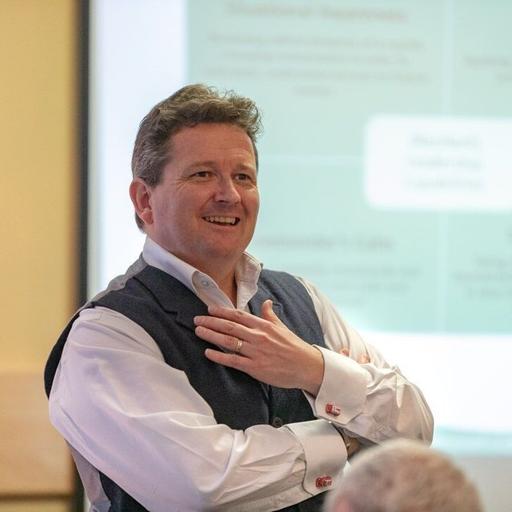
Russell Harvey is The Resilience Coach - a resilient leadership expert, executive coach, facilitator and keynote speaker who helps leaders and organisations perform at their best when the world refuses to stand still.
With more than 20 years in Learning, Leadership and Organisational Development, 6,000+ hours of executive coaching and over 70 published podcast appearances, Russell is an experienced and engaging voice on resilience, leadership and navigating persistent change. He has worked with leaders across organisations including Novartis, the NHS, AB World Foods, Kerry Group and The Co-operative Group.
Russell’s work goes beyond helping people simply cope with pressure. He believes true resilience isn’t about “bouncing back”, being tougher or pretending everything is fine - it’s about springing forward with learning and becoming better equipped to lead because of the challenges you’ve faced.
His approach connects the human side of leadership directly to what matters to organisations: engaged people, stronger cultures, better decisions and improved performance. His work has delivered measurable results, including a leadership programme that returned £12 million to the business and a Resilient Leader Programme that achieved more than 1,100% ROI.
In August 2025, Russell achieved his long-held purpose of positively affecting 100,000 people.
More from Russell Harvey
All episodes → Living the Dream with CurveballSpringing Forward: Russell Harvey's Insights on Building Resilience and Embracing ChangeNov 2026Play episode →
 Transformation Station Leadership PodcastTSLP Season 5 Ep. 26- Thriving Is A VerbNov 2026Play episode →
 An Evolving Man PodcastReal Resilience: Why Pushing Through Isn’t Enough | Russell Harvey | AEM #172Oct 2026Play episode →
 Leadership From The Heart | Transformational Leadership InsightsResilience Without the Rebound | Leadership Mindset ShiftAug 2026Play episode →
 Burnout Proof Leadership: Identify Shift and Leadership Skills for Midlife Women EntrepreneursEssential Leadership Skills You Must Have If You Want to Build Resilience & Avoid Burnout When Your Business Gets Hard - with Russell HarveyJul 2026Play episode →
 Your Career JourneyHow to Build Resilience at Work: Leadership, Change & Thriving in Uncertain TimesJul 2026Play episode →
 The ThriveWell Journey | Entrepreneurship, Leadership & Life After DisruptionHow to Build Real Resilience Under Pressure | Russell HarveyJul 2026Play episode →
 Future Fit LeadershipThe 2030 Leader: Why Resilience is Your Most Vital Skill with Russell HarveyJun 2026Play episode →
 Different thinking for Different Time - Mindset Change and Thought LeadershipDifferent Thinking for Different Times - 7 Keys to Building Resilience with Russell Harvey How to Nurture a Resilient Mindset in Business and LifeMay 2026Play episode →