
July 22, 2026
Essential Leadership Skills You Must Have If You Want to Build Resilience & Avoid Burnout When Your Business Gets Hard - with Russell Harvey
Listen
Sound bites
I never want anybody to view this word resilience in a toxic way. So I absolutely, my intention is never to think about toxic resilience or toxic positivity.
In this episode
Russell Harvey talks about resilience, leadership, and practical ways to avoid burnout when business gets hard.
- Role modeling resilience by practicing the same tools he teaches clients
- The resilience wheel as a way to ask how well you're building resilience
- Context matters, but resilience is a whole life question, not a separate work self and home self
- Pausing to review behavior, notice what helps or hinders, and change what you do next
- Optimism grounded in reality, supported by emotional intelligence, empathy, compassion, and coaching skills
Transcript
ShowHide
Automatic captions of the conversation. They can contain errors and do not name who is speaking.
In this episode, you'll discover the essential leadership skills you must have to keep going when your business gets hard. Welcome to Burnout Proof Leadership, a podcast for midlife women in online business who fit a revenue ceiling and are ready to stop doing it all, to step into your true leader identity and build a business that can grow without you running everything from the middle. Hey, this is Tracy. Before we jump into today's episode, we have a quick reminder for you. Starting Wednesday, July 29th, we are now going to be from Doer to Leader Podcast.
Super excited about that. If you missed that special announcement on Friday, July 17th, be sure to go back and give it a listen, because we talk all about why we're making this change and what this new exciting chapter means for you as a listener. It's still Michelle and Tracy bringing you the same practical leadership insights you know and love. Now with an even clearer focus on helping midlife women entrepreneurs make the identity shift from doer to leader so they can scale their business. Now let's jump into today's episode.
Welcome to Burnout Proof Leadership. This is Michelle and Tracy. And in this episode, you'll discover what it actually takes to keep going when running a business gets hard. You'll also learn a simple tool you can start using today to be more resilient and avoid burnout and how to leverage learning to spring forward rather than bounce back. And what a lovely interview we had today. So much fun. You're going to have a great time and learn how to look at resilience in a whole new way. And today our guest was Russell Harvey.
He's known as the Resilience Coach, and he is a leadership coach, facilitator, speaker, podcaster, and radio host with over 20 years experience in learning, leadership, and organizational development. Without further ado, here's our interview with Russell. Well, hello Russell. We've been waiting for this moment. Welcome to the show. Thank you very much. It's very nice to be here. I appreciate it. Well, we appreciate you taking the time to spend with us. So I am going to start our podcast episode with you, and I'm going to just start with the first question that we are so curious about.
It's about resilience, and we hear about resilience all the time. But what does it actually look like for you as a business owner today? Yeah, so for me, it is really aiming to role model it as much as simply possible, essentially. That's what it looks like for me. And intentionally sharing examples of how I put in to practice the things that I share with people. So when I engage with clients a lot, and I know we'll talk about this a little bit later, I have the resilience wheel, which is the answer to the question, to Russell, how do I build my resilience?
And there's seven bits to it. So what it looks like for me is me reflecting on how well I am doing that, how well I am building it, essentially, and really trying to make sure that I play to my strengths and I understand the things that I'm not energized by and can sometimes get into trouble with if I try and do the things that don't energize me in running a business. So I think that was one of the, so the resilience coach will be 11 years old in July. And when I was thinking about, you know, people ask, who are you?
Tell us about yourself. And I've always answered with, so I'm a coach and I'm a facilitator. And then it took me a while, a couple of years into running the business before I said, Ashley, do you know what? I'm a coach and I'm a facilitator and I'm a managing director, which made me have to stop and pause and think to myself, oh, good God, what does that mean to me? Can I do it? What's a managing director supposed to do? What's involved in that, essentially? That's what it looks like. And then finally, what it really looks like in terms of running the business is really interesting.
The inquiries that I get, I still get a huge amount of inquiries where the prospective client essentially does a version of, okay, Russell, I've got some time with my team. We're going to do a bit of an away day. We're going to talk about all of our KPIs. We've either got 10 minutes or half an hour or 45 minutes spare. Can you come and make us resilient in 45 minutes? That is what it looks like as the resilience coach, a lot of the time as well, essentially. Then I have to either smile or cry or take a deep breath and decide where to go from there.
Yeah. The resilient Superman. Yeah. Yeah. Coming in to save the day in 45 minutes. Exactly. Well, I love that you said role model because I think that's so important that one of our core values is walking our talk and even with the work we do, holding ourselves accountable, holding each other accountable because people are always watching you, right? Absolutely. I remember from when we first spoke, just how much of a partnership relationship that the two of you is. Yeah, I'm not by myself because one of the dimensions of being resilient is you support network.
I work hard at cultivating my own, but at the same time day to day, I am in my own office on my own a lot of the time, essentially. I suspect with the two of you together, that I do miss that immediacy of having somebody by my side, because I just want to keep turning to somebody and just suddenly ask something. When they're not there, it's like, oh yeah, I need to call somebody. Well, you'll have to get a cardboard cutout or get yourself a little bot to talk to, right? Yeah, absolutely. Yeah. Well, before I ask my next question, I think it would be helpful for our listeners to get your definition of resilience, because a lot of people look at it in different ways.
And so when you say resilience, what do you mean? Yeah. So I define it as springing forward with learning. Okay. That's how I define it immediately. I'm not a fan of the term bounce back, which is talked about in relation to resilience. Because what I've noticed is that a lot of people say, right, there's been a challenging event, I've faced into it, well, whatever levels of resiliency I've got, and then I'll now bounce back to, and then it's sort of a subconscious instruction to go back to how you were before the challenging event.
And I'm sort of there, you're nodding away, and I'm there waving my hands at that moment in time and go, whoa, whoa, whoa, what did you learn? What did you learn? What are you going to keep doing that worked for you? And what are you going to do differently? So, and I think the other challenge around that is, and it even came up yesterday, that too often too many people think that resilience is only about keeping going regardless. Sometimes it is about keeping going through challenging times, but you need to then have the knowledge that that's what you're doing.
You need to have the absolute self-awareness that I'm in a moment where I've just got to get through this, but then you need to make sure you pause and reflect essentially. So, the spring forward learning and the ultimate outcome of that, the measure of when you're doing that well, is that when you ask my clients, when they've worked with me, how are you? They give the answer of, do you know what? There's a lot going on. It's a crazy world and I'm good. And they mean it and they believe in it essentially. And they achieve that by role modeling, springing forward with learning.
Oh, I love that. I love that. Cause it is a crazy world. It's a VUCA world, right? It's volatile. It's a VUCA world. Yes, it is. Everywhere. And it can be happening around you. It doesn't have to suck you in. But when you are impacted by that, you know, that volatility, it's uncertain. There's a lot of complexity, a lot of ambiguity. And when you kind of, you know, have to be in that and you need to be resilient, what are some, what's a simple tool? You mentioned your wheel, right? The resilience wheel. How would somebody use that to help them be resilient in this time or in the situation if it's a VUCA situation?
Yeah, and thank you. And so, yeah, I think building your resilience via the resilience wheel is the simple tool enables you to face well into a VUCA world. And so it is seven aspects of the wheel built on loads of different research. So I'll do a whistle stop tour and just do a quick example. So Heart of Resilience is our attitude, essentially. And I would suggest that you wouldn't necessarily start there. All of aspects of the wheel are interconnected. So when you work on one aspect of it, it has an impact on another.
But immediately trying to develop your attitude is probably too deep a place to start, essentially because it's about your values. And the only thing that I'd say around the attitude piece is the thing that fascinates me is this is about our beliefs. So the dictionary definition of a belief is something we behold to be true without basis in fact. So challenging your beliefs is something to notice in the attitude place. Then it's purpose. So, you know, resilient people have a purpose. You only need one. And I ask people, what's your personal purpose?
I also ask clients, what's your leadership purpose? And if you're a leader of a team, they go ask the team, what's the team's purpose? And as a result of that, some singular version of who you are, what you want to do, what you want to be known for, your legacy will emerge. And then sometimes, which has been really interesting, I can't remember if I came up with this or a delegate on a program did. I sort of say, as you think about the family dinner table, so, you know, fingers crossed, some people are still sitting around dinner tables as a family and eating meals.
But it's a really good, great conversation. I go, what's our family's purpose? And there are some people that come out with some absolutely fascinating things that come up with. So, purpose, then we've got confidence. And one of the sort of questions you may ask later on, I sort of want to come to that. So, there's five ways to build confidence. So, it's understanding which of the five ways work for you. Adaptability is openness change. So as a simple tool, it's revisiting that whole question of, you know, do you like change?
And seeing what happens essentially, and understanding there's difference between adaptable and agile. There's a nuance in there. There's your support network, building, nurturing the most useful and worthwhile support network for you. And then there's meaning, which is our internal storytelling. So this is once again, going back to the question of how are you? It's also thinking about how you answer, how are you? How was the weekend? How was the project going? How was your boss? How was this? How was that? Noticing how you answer it, because how you answer it is the meaning that you are attaching to those situations.
And then that meaning can have an impact about how you see yourself. So reframing your meaning. And finally, it's the word energy, which is all about the strength-based approach. It is absolutely as well around diet and exercise. And I'm not a specialist in that area, but energy is very much the strength-based approach. So there's a psychometric in the UK called Strengthscope. And I think in USA, it is Strengthfinder, is an equivalent of it essentially. So it's literally understanding and nurturing all of your strengths and enhancing those.
And so you can look at the wheel, not plugging, it's on the website. You can just look through those and do a quick self-assessment. And there is also a diagnostic that's about to go on there as well, to just answer some simple questions. So that's the tool. People can literally just start to go, well, where am I? Where am I on this wheel? What's good? What's not so good? And where do you want to start in developing it, essentially? Wow. It's a free tool? Yeah, yeah, yeah, absolutely. Yes. So originally, Roberts and Cooper did all the research on the bit and I've added to it and they put it into the world for free.
So I'm talking about them essentially to go, yes, this is where this came from and I've taken it and I've added to it and yes, it's in the world for free. So yes, there we go. Well, I think that awareness is the first place to start. Right? You can't improve something if you don't know where you're starting from. And so I think it's a great way to see how you're showing up. Now, do you find that it can be different in different contexts? Like I may like or is it like a holistic? You know what I mean? Give me a bit more of an example.
Well, I'm just saying like you might feel really resilient in some regards in your life, in the context of some aspects of your life, but in another score very differently. Would that be possible or not? I think that's where it could get confusing. For me, that's when whenever I do hear people just say, there's a work me and a home me, I'm always really curious about that and positively challenge around that because it's very, very difficult for there to be two versions of ourselves. Essentially, it can get very confusing.
Now, there were absolutely as well you know, we will choose in certain environments, what we will share about ourselves. So most definitely, people in the home life might know a little bit more about you than in certain works of circumstances. So I think if you need to just, you do need to look at it in terms of the whole life because of the resilience wheel is like you as a human essentially. But you might notice actually, once again around this word confidence, that's just at any particular moment in time, what's our belief that we can do something.
So outside of work, there might be certain things we believe we can do, inside of work, there may not be any and vice versa. So the short answer to question is, context absolutely can happen, and the resilience is the same question as actually what does it mean to be human. So you bring your human self into all situations. Yeah, that's helpful. I just thought somebody might wonder about that. Not me, but I take me everywhere I go. Excellent. Okay, Russell, I was really intrigued by your definition of resilience. I want to unpack this learning that you have identified.
It's so critical. So can you share with our listeners how they can actually use learning to spring forward rather than just bouncing back a little bit more detail on that? Yeah, so resilience role modeling is essentially from all of life's events. So, you know, resilience is most definitely about recovery as well, and recovery from adverse events. Now, an adverse event doesn't always need to be negative, essentially. I got a great question from somebody that was running a session. It was a lady, and there's a reason why I'm mentioning gender at this moment in time, because she asked the question, does an adverse event always have to be negative?
And I go, no, how come you're asking? And she said, well, it wasn't in my life plan, but recently I became pregnant and had a baby, and it was not in my life plan, essentially. And so it's lovely, it's wonderful, I'm now glad it's happened. However, I view that as an adverse event. I'm very happy that the child is here. And I went, yeah, that's a perfect example. Yeah, absolutely. So Resilient Role Modeling and Learn Learning is from all of life's events, you need to pause. Now, pause is listening to a podcast. A pause is having a really fantastic conversation with a friend, or your team, or your boss, or going for a walk, or thousands of other things are a pause.
And in those pauses, you ask yourself three questions. What have I been doing behaviorally recently, that has been serving me well against the Resilient Wheel? What have I been doing that's not been serving me well behaviorally, recently against the Resilient Wheel? And how can I do more of the answers to the first question? Essentially, that is Resilient Role Modeling. What have I been doing well behaviorally that's been serving me? What have I not been doing well and right? How can I do more of the stuff that serves me well against the Resilient Wheel?
And in those, you will have some ideas, and then the learning piece is going from knowing what you're doing to then doing something different, essentially. And it's all interconnected because the Resilient individual is more open, is more curious, has more self-confidence, and is more okay putting themselves into maybe a stretching situation to try something new, essentially. Yeah, it kind of reminds me of some work that we do as well, where it's really like thinking about the life that you want, right? Whatever the outcome is that you're striving for, your purpose, if you want to call it that, or could just be a goal.
But it is about aligning who you're being with that outcome. And when you shift, and being is a part of beliefs, right? Your identity, how you see yourself, the stories you tell yourself. And then when you adjust that, then you will take different actions and you'll behave differently to get the outcome. It's the same kind of approach. Reflection, I guess. Yeah, reflection and... Totally. And I think the one that really intrigues me, so when I run workshops around the resiliency piece, it's got something around the wheel.
And the one that the question that, and I understand it, when I get to the purpose piece, and so it just says to the room and go, right, so resilient people have a purpose. I go, so what's yours? The room 99% of the time gives you a blank look. Essentially, but they do also subconsciously have an idea around it. And then, I've had some really powerful pieces of feedback from clients, when they've said, you know, I've really worked out my purpose. And as a consequence of that, I'm much clearer on the decisions that I'm going to make, how I'm going to face it to all of my challenges.
It's actually, you know, things feel simpler, things feel lighter, actually, things feel clearer about actually this is, the challenges haven't changed, but how I'm going to choose to face into them has completely shifted into a different place. Yeah, it's quite magnificent when you see it happen. Yeah, that's really powerful. That clarity. Yeah. I love it when people have those like breakthroughs, right? Those little ah-hahs of they take those steps and it opens up a whole new way of looking at their life and the things that they're doing.
The choices that they're making, right? So they can make more mindful choices. Yeah. Absolutely. Absolutely. Yeah, that's great. Well, you know, since that kind of, you know, springing forward in the learning is so really, so very important, what is one piece of advice you would give a female founder so, you know, that she could, what could she learn that would serve her well in building her business or growing her business? So yeah, absolutely. So the short answer is in this space of confidence. And to clarify, I am never in the space about pointing or labeling about whether somebody does or doesn't have confidence.
But and I'm also curious for a variety of reasons. So many years ago, some time ago, I was working at one of our large retail companies over here. And I was very nicely asked by the head of HR to have a look at their women in business piece. And it was an initial instance, talk to the HR, said, yes, absolutely. You do know that I'm a man, don't you? And she went, yes, I really do. I worked that out, Russell. Yes. She was just, no, just to value your opinion, go and have a look at it. So in that, I revisited some of the research that was done in the UK about, and I'm not sure if it's still valid, but I think it is about the reasons that impact women's careers.
One of them is that they self-deselect themselves from personal development. If there's personal development that's around, they will take a step back. The word confidence comes out in the fact that, and I'm sure you've heard this and seen this hundreds of times, the simple analogy was that when a man looks at a job advert, if there's one thing on the job advert they think they can do, they'll just apply for the whole job, essentially, and a woman will look at an advert, if she believes she can't do everything on the advert, won't apply for it, essentially.
That was what the research showed. I just want to have a good conversation about the terminology of imposter syndrome. I'm not entirely sure that it is out there in the world in the way it was originally intended, essentially. I think if you look at the original research, it's not about labeling somebody as the imposter syndrome. It's not helpful for people's identity. For me, when I've looked at what is denoted as imposter syndrome, it feels to me it's just simply in this space of confidence. So my single piece of idea, advice for female leaders is there are five ways in which you build your confidence from Albert Bandura and James Maddox.
I would encourage each person, each woman to just go work out which are the five ways work for them to actually improve their self-belief about the things that they can do. So just continue to really understand what it is that grows your self-belief. I think that is potentially one of the most useful things essentially. Really puts them back in their power. Yeah. Yeah. Right. Helps them to or to see their power maybe even. Yes. Yeah. Absolutely. As a person. Yeah. And I think then my intention behind that is there's a lot of, so I don't know what it feels like clearly, but there's a lot of noise around actually women in business.
And I think when you have actually nurtured your confidence, you could probably quieten a lot of that noise. Yeah. Yeah. Good night. You know, I always think back about how I really admire women in business or women founders, entrepreneurs. They are the ones that have a, they exude confidence. Yeah. So. Yeah. Do you have a resource? Well, externally they do. But they may not feel it internally. Well, maybe not. I'm just saying, you know, I think, we put on that armor at time. Some do put on that armor. Like, look, I'm tough.
I'm resilient. I can handle this. But inside, they're quaking in their boots, you know, like they're not they're not really sure they can do it, but they're not ever going to let anybody see that they can't. So I'm not I'm not always there are some that, you know, it's just deep in their bones. But there are some that are exuding confidence that I don't know that they really feel it. You know, we're both right. So absolutely my intention of talking about, sorry, apologies, apologies. My intention of talking about the word confidence is to give more women the opportunity that when they, when others look at them to go, oh, you seem to be sure of yourself, it's real.
Yeah. That that's my intention behind it, that there is an internal bedrock behind it because they've continued to work out what is it enables them to believe in themselves and their capabilities and their abilities. Yeah. Yeah. Yeah. Is that resource on your website? Yeah, it is. Yeah. So it's in the confidence element of the wheel. And if anybody looks up Albert Bandura and James Maddox, Five Ways to Confidence. Okay. This is funny thing called the Internet and search engines. If you go on there and I don't know if you've ever heard of it, but yeah, there we go.
Yeah. That's how it is. It's magic. Yes. It's also on the website. Oh, that's great. Because if someone's listening and they're really curious about that, we want to make sure they can get their hands on it. So thank you so much. Yeah. You're welcome. For sure. All right. Well, we're at that time in our show, Russell, where we get to ask you some mystery questions, and we're very excited to do this today. How's your confidence? Just teasing. It was just a little tiny moment there. I remember seeing that as well in the preparation notes.
Oh yeah. Okay. Okay. It's nothing hard. I'll take a deep breath. Nothing hard. I'm going to ask you the first one. Tracy is going to come at you with the second one. So here we go. Okay. Okay. You have been invited to be a guest on the Graham Norton Show. Who is on the couch with you? And you know what? You get to pick. Who's on the couch with you? The couch and me, Jürgen Klopp, essentially, who is the ex Liverpool manager. Oh, okay. Awesome. That's who's on. Okay. I'd love an opportunity to just sit down with him, essentially.
Well, because as soon as he turned up at Liverpool, which was about 11 years ago, he immediately sort of coined the phrase, he's going to turn Liverpool Football Club and its supporters from doubters into believers. And just every time I saw him at a press conference and every time he answered a question, he seemed to be sort of a lot of the things that I was thinking in my head about, strength-based approach, this is how you do things. He was answering in that way. And I'm going, I just want to sit and have a chat with you and just see where that, where did that come from?
How come? Yeah. So Jürgen Klopp. Oh, awesome. Great. That's a great response. Yeah, I think that's awesome. Love it when you kind of have a synchronicity with somebody, but you haven't met them, right? And you just want to be in their presence and, and see what you have in common and what you can learn from them. So that's awesome. All right. Question number two, you did good on that one. Are you ready for the second one? I hope so. Okay. You've already been seen on the Graham Norton show. And guess what? A major network wants you to have your own show.
What's the name of your show? What's my show called? Well, I did for a while. I had a radio show called Russell's Resilience Radio Show. So, yeah, Russell's Resilience TV show. Okay! All right! Yeah. All right. I'm trying to get the alliteration in there. Is there another way? So Russell's Resilience. If there's another way of saying TV show with an R in it. Yeah. We'll figure that out. You got a little time, I think. Yeah. Absolutely. Yeah. That's good. That's really good. I like that. It's not about my ego. It really isn't.
It's about the alliteration of it. That's right. That's right. That's cool. That's really cool. Wow. Well, it's just been such a pleasure to talk with you. I just love your perspective on resilience. The word is everywhere. Yes. And we need it. And we need to understand what it is, and we need to know how to cultivate it. And I think you've brought a lot of wisdom and a lot of different ways to look at it and some tools. And so thank you so much. It's really been a great conversation with you. I've learned a lot and I appreciate what you've been bringing.
I love your perspectives on it. Yeah. Very helpful. Yeah. Very refreshing. Thank you. That's wonderful. Is there anything you'd like to share before we wrap up? I think in addition to what we've talked about, I never want anybody to view this word resilience in a toxic way. So I absolutely, my intention is never to think about toxic resilience or toxic positivity. So I love talking about the word optimism, essentially, as a means to feeling hopeful and positive about the world. And it takes a level of resiliency. So to hold an optimistic conversation well, it requires emotional intelligence, empathy, compassion, and coaching skills.
Because optimism, as well, you know, is grounded in reality. So to be able to talk about the reality of a situation that might be really difficult, really challenging, but doing it in a way that doesn't take us into a spiral of despair. And then what also is grounded in reality is what's great about us, what's good about us, what's right about us, our skills, our experiences, our behaviors, our life lessons. And so it's about holding things in two hands. And if you can actually just keep talking more about what's good, great, right, and about us, then humans feel hope and they feel positive.
So whenever I hear people talking about positivity, I just subconsciously, straight away in my head, I'm going, optimism, right? How do we turn this into an optimistic conversation? So a question for anybody that's listening now. I'm curious what their answer is to how optimistic are you today? About the future, about the team you're leading, about the organization you're in, about the challenging that you're facing. So nurture optimism alongside the resiliency piece. Oh, great advice. Yeah, yeah. We will do that. Do you, where can people find you?
Yeah, so it's theresiliencecoach.co.uk. So all the W's and yeah, if you can find us on website, social media, everything, it's the Resilience Coach, Russell the Resilience Coach. That's how you find. Okay, awesome. I'll make sure we have links. In the show notes, so everybody can find you. And just for the listeners, thank you for being here with us today. And it's been a pleasure to be here. And we're grateful every time that you show up and listen to us. So until next time, be safe and stay Burnout Proof.
About Russell Harvey
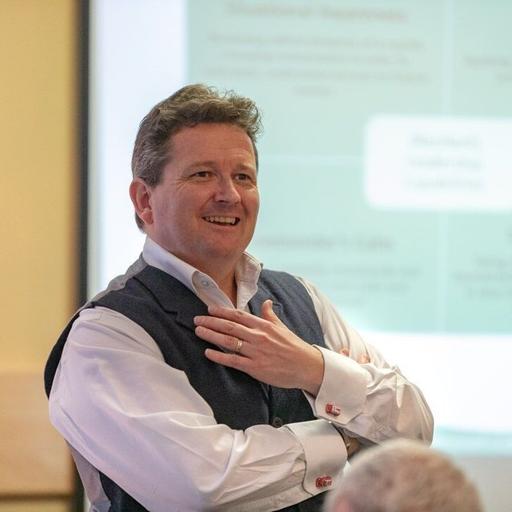
The Resilience Coach | Resilient Leadership Expert
100,000+ People positively affected6,000+ Executive coaching hours£12M+ ROI delivered by RWE npower leadership programme20+ years Learning, leadership and organisational development
Russell Harvey is The Resilience Coach - a resilient leadership expert, executive coach, facilitator and keynote speaker who helps leaders and organisations perform at their best when the world refuses to stand still.
With more than 20 years in Learning, Leadership and Organisational Development, 6,000+ hours of executive coaching and over 70 published podcast appearances, Russell is an experienced and engaging voice on resilience, leadership and navigating persistent change. He has worked with leaders across organisations including Novartis, the NHS, AB World Foods, Kerry Group and The Co-operative Group.
Russell’s work goes beyond helping people simply cope with pressure. He believes true resilience isn’t about “bouncing back”, being tougher or pretending everything is fine - it’s about springing forward with learning and becoming better equipped to lead because of the challenges you’ve faced.
His approach connects the human side of leadership directly to what matters to organisations: engaged people, stronger cultures, better decisions and improved performance. His work has delivered measurable results, including a leadership programme that returned £12 million to the business and a Resilient Leader Programme that achieved more than 1,100% ROI.
In August 2025, Russell achieved his long-held purpose of positively affecting 100,000 people.
More from Russell Harvey
All episodes → Living the Dream with CurveballSpringing Forward: Russell Harvey's Insights on Building Resilience and Embracing ChangeNov 2026Play episode →
 Transformation Station Leadership PodcastTSLP Season 5 Ep. 26- Thriving Is A VerbNov 2026Play episode →
 An Evolving Man PodcastReal Resilience: Why Pushing Through Isn’t Enough | Russell Harvey | AEM #172Oct 2026Play episode →
 Leadership From The Heart | Transformational Leadership InsightsResilience Without the Rebound | Leadership Mindset ShiftAug 2026Play episode →
 Your Career JourneyHow to Build Resilience at Work: Leadership, Change & Thriving in Uncertain TimesJul 2026Play episode →
 The ThriveWell Journey | Entrepreneurship, Leadership & Life After DisruptionHow to Build Real Resilience Under Pressure | Russell HarveyJul 2026Play episode →
 Future Fit LeadershipThe 2030 Leader: Why Resilience is Your Most Vital Skill with Russell HarveyJun 2026Play episode →
 Different thinking for Different Time - Mindset Change and Thought LeadershipDifferent Thinking for Different Times - 7 Keys to Building Resilience with Russell Harvey How to Nurture a Resilient Mindset in Business and LifeMay 2026Play episode →
 The Next Interview ShowRussell Harvey Answers: How Leaders Build Resilience Without Burning OutMay 2026Play episode →