
December 17, 2024
Future-Proof with Resilience
Sound bites
Executive coaching is actually to step away from all of this craziness and all of this full onness and do everything fast, do everything now and actually go and have a really quality, in-depth, reflective, proper conversation.
I define resilience as springing forward with learning. I'm not a fan of the term bounce back because it's a subconscious instruction to our brains that go, we're faced into this and then we're going to go back to how we were and you can't.
In this episode
Russell Harvey joins You in 2042... The Future of Work to explore how resilience, coaching, and adaptability may shape future leaders and organizations.
- Executive coaching as a reflective pause away from constant speed and micro learning
- Resilience as a concrete organizational practice, not a buzzword or quick fix
- Resilient organizations built on well being, engagement, strengths, trust, and psychological safety
- Recovery from adversity, including the pandemic, and learning forward instead of just bouncing back
- Situational awareness, adaptability, and purpose as key skills for future work and career coaching
Chapters
Pick a chapter to play the video from that point.
Transcript
Automatic captions of the conversation. They can contain errors and do not name who is speaking.
Wonder about the future and how you'll be working and learning? Welcome to You in 2042... The Future of Work with your host, Danielle Wallace. Hello, and welcome to You in 2042, The Future of Work. Joining me today is Russell Harvey. So, I am the Resilience Coach, Danielle, not any old Resilience Coach. I am the Resilience Coach. I specialize in leadership coaching and how to lead yourself and others well in a full-on, crazy, mad, bonkers world, essentially. Russell, that is so much fun. And as we think about leading ourself and leading others, as we progress into the future of this crazy, chaotic world, how do you see things like executive coaching evolving to meet these demands of the future leader?
Yes, I was really thinking about this going forward. So in this whole field of learning development, seeing a lot of things out there around, okay, so in this busy, full-on world, we need to fit in micro learning. And then alongside that, in terms of answering your question around executive coaching, the point and purpose of executive coaching is a one-on-one conversation that doesn't have any time scales to it. It is a time to reflect. It is a time to actually think. It is a time to pause. So how I actually believe executive coaching should evolve is actually in pushing back against this idea of having to do micro learning quick, fast, because executive coaching is actually to step away from all of this craziness and all of this full onness and do everything fast, do everything now and actually go and have a really quality, in-depth, reflective, proper conversation about what's going on for me?
How do I think? How do I feel? What am I happy with? What am I not happy with? Where do I need to get to? It needs to evolve so it makes sure that it enables leaders to step off the hamster wheel and then have a great reflective conversation and step back on to the hamster wheel, or even never get back on the hamster wheel. The hamster wheel is something I'm sure many of our listeners, many of us can relate to. In this increasingly complex and predictable world, I've heard so much Russell about this idea of resilience as a key trait for leaders.
How do you think then resilience training will evolve in the future? And what strategies might be essential? Yeah, it really needs to stop being a buzzword, and it needs to be something really concrete and tangible. So I get so many different requests from organizations and people and leaders and teams. Let's just say, we've gotten away day, we're packing all these things in that we need to, we've got 10 minutes, we've got 30 seconds, we've got half an hour. Can you come in and just make us resilient in that time? And so it's literally, I have to go, no, I can't make you resilient in that short period of time.
I can share some things with you. So there's a lot of the time I might say no to that. There's a lot of time if I, with a bit of a chat with a perspective client, if I can get them to see it and go, actually, we could make a start, yet we could put something in for half an hour on your away day. However, let's actually do something absolutely real around it. And I think where resilience training needs to evolve to is actually better conversations with senior leadership teams about what does it actually mean to be a resilient organization.
So I'm concerned that we have well-being strategies. There are heads of well-being that are job titles out there. But I am concerned that an organization will sort of say, our culture is like this. It's not the best culture that it is. We need to put in a well-being strategy to compensate for our poor culture, okay? But actually, you can do away with a well-being strategy. If you make the choice, the decision, as a senior leadership team to go, do you know what? We are truly going to look at what it means to be a resilient organization.
Because a resilient organization, their people are well. They are engaged. They are enthusiastic. They are playing to their strengths. There's trust. There's psychological safety. So you don't need a separate well-being strategy. So going forward, resilience training needs to evolve. So everybody that's in the same sphere as me is actually positively challenging leadership teams and organizations to step away from resilience as a buzzword and a quick fix because it isn't, and actually a tangible concrete, we need to build a resilient organization, and then a resilient organization gives itself the best opportunity to be future-proof because it actually does adapt.
It actually understands how it can adapt and what it needs to do, and it does one of these things called situational awareness, which is forward thinking. Literally, eyesight. It's great at understanding actually what might be happening in the future, understanding actually how it might impact us now, actually understanding how it might impact us in the future. So you use situational awareness to do hindsight, insight, and foresight, essentially. So this idea of a resilient organization can really help organizations have this future view while also better dressing, not just resilience as a band-aid, well-being as a band-aid solution, but getting to the heart of the organizational health and vitality.
Absolutely. Yes. You've nailed it. So they actually achieve what they need to do to be able to lead themselves and others well in a full-on crazy world because change is constant, but it's a much better way of actually looking at that. Rather than just saying it as literally a sentence that we drop into a room and go, change is constant, deal with it, it's actually, do you know what, let's really unpick. What does it really mean to say that change is constant? How does that actually impact us day to day? How does that impact how we behave now?
How we're going to behave tomorrow? What we're going to do next week? How does it inform our strategy consensually? Absolutely. It enables you to be that future organization. Then one of the things I'm seeing a lot as we have this world of change is constant, is even the types of work and where people are working, how people are working. I've seen a lot of this rise of remote work and a good economy. What new career paths do you foresee emerging in the future? Maybe how can career coaching support that? Yeah, absolutely.
Career coaching absolutely does need to support that. It's a variety of ways in which you can do that. Resilience Career Coaching can support that. But there's just an additional bit first about before we think about the future, one of the things we need to understand about resilience is it is about recovery from adverse events. Okay? So that's part of being resilient. Recovery, recuperating, reenergizing. And I define resilience as springing forward with learning. I'm not a fan of the term bounce back because it's a subconscious instruction to our brains that go, we're faced into this and then we're going to go back to how we were and you can't.
Okay? So I'm curious to understand, I have an opinion that actually I don't think the world organizations, enough people have truly recovered from the pandemic. I'm not sure that that's actually the case. We have moved on from it to the next thing, the next problem, the next worry, the next challenge, but actually we need to recover from it. So I just wanted to put that in there as part of my response to question. And then therefore, in terms of future focus, yeah, change is constant. It's going to be driven to some extent, but we don't know yet how by artificial intelligence.
So everything has like a, there's the law of positive unintended consequences and negative unintended consequences essentially. So from the pandemic, some of the positive unintended consequences is actually the way that we work has got better in terms of when an organization does hybrid well, really truly understands actually when is it the right thing to be face to face and when is it the right thing to be remote. So when you truly learn what's worked well for you in terms of working practices as a result of what the pandemic forced you to do, but there's also an awful lot of organizations that keep getting loads and loads of inquiries of like we've fallen into traps of inappropriate behaviors of literally just how to lie manage people remotely.
And I'm going, well, it's no different to lie manage them face to face. But we've forgotten this, essentially. So once again, if you use your situational awareness, your foresight, just keep an eye on what direction of travel is artificial intelligence going in. You have to just keep looking at it and keep seeing that. That will inform actually what some new roles might be that come up. And how career coaching is really going to support this is very much about, and specifically Resilience Career Coaching, is to really support people to do one of the dimensions of resilience, which is their purpose.
So resilient people have a purpose. Mine is to positively affect 100,000 people by the year 2025. And right now I'm up to 76,312-ish. That's my purpose. And that is my head, my heart and my gut in alignment about who I am, what I do and my reason for getting out of bed. So career coaching is going to be supporting individuals with their situation awareness, their hindsight, insight and foresight to go actually what are my strengths? And I said at the top of our conversation, my top three strengths are. So it's really supporting people who understand actually what their strengths are.
And then discovering what might be a role that enables them to play to their strengths and meet their purpose and then they're feeling resilient. Or understanding actually if a role doesn't currently exist that enables them to play to their strengths, they're going to have to create one before themselves. And that's either setting up their own business or it is about actually having a different conversation with your line manager to go, there isn't a job in this organization currently, you know, with everything that's going on or the changes that satisfies me.
So can actually, could I write one down and show it to you and we'll agree a way forward around it. An additional thing about just thinking about how I am observing different generations coming through right now. So I live in Leeds in Yorkshire and it's got a massive university city. There's three universities in it. And I just live close to one of the university campuses, which is all about physical education. Okay. So each year I see students coming through that look phenomenally fit and healthy. So if you imagine students, you know, they're normally going to the pub.
And I would go back to my days as being a student. I never went jogging. I never literally ate healthily. I literally just went to the university student union bar and just spent all day, every day in there, essentially. But I observe the students coming through each year, they look absolutely Instagram gorgeous. Yeah, you know, they've got the bodies and they're running and they're fit and they're healthy. They're also going to the pub. But the research shows that whilst physically they look great, their mental health is poor.
Their mental health is on the floor. OK, now in theory, we have been talking for a long time about physically, exercise, endorphins, serotonin, dopamine. It helps you physically exercise. So they're doing that, but they're also sharing, yeah, mental health is terrible. So we've got a contradiction that's going on there. So the Resilience Career Coaching going forward is really vital to support this next generation coming through to go, actually, let's really genuinely discover how come the traditional sort of wisdom of physically looking after yourself improves your mental health.
Because at the moment, there's a lot of commentary around actually, that's not working. And so with that future generation in mind, it seems like this idea of building resilience skills now become even more critical. Absolutely, absolutely. I know that I'm completely biased on this, but you must find a way to engage with what I call your resilience wheel. So if anybody asks me, so Russell, how do I build my resilience? I go, there's this wheel, it's on the website. It's got seven bits to it. It's built upon research, essentially, about this is what makes a resilient person.
And I mentioned one about purpose, and the other six very quickly are heart resilience is your attitude, there's purpose, there's the word confidence, there's the word adaptability, there's your support network, which is about meaning, which is our internal storytelling, our internal frame of reference, and this word energy, which I predominantly link to, strength based approach, as in your natural energizers. So people in the US may be more familiar with Strengths Finder, and there's one in the UK called Strength Scope, but this is about what your natural energizers are.
So what resilient people do to build their resiliency skills is they make the choice to on a regular basis, engage with their resilience wheel, and understand actually which parts of their resilience wheel are in a good place already, and build upon the good and do more of that, and which parts of their resilience wheel they would actually like to be better and do something around that. And it's a living, breathing thing that you just need to keep looking at. And one of the ones that's more significant around this is the word adaptability.
So research shows that actually those individuals now who can legitimately state that they are thriving, rather than coping and surviving, it's because they spend a third of their time engaging with their adaptability. And adaptability is openness to change. Another tiny little bit of an addition to that is that adaptability is openness to change, but it's not necessarily doing the change. So agile is doing the change quickly. So when you engage with your adaptability, you get better at agility too. So those are all part of the skills.
And that wheel you speak to actually seems like something that might be really useful for many of us. Absolutely, yeah. Absolutely. Russell, with that, where can people learn more about you? So literally, if you put into search engine, theresiliencecoach.co.uk, that's where you'll find me. On all of the socials, it's the Resilience Coach. That's where you'll find me. I've got my own podcast series one on the home page of my website, and that is me actually talking through each of the seven aspects of the wheel. Amazing.
I can't wait to check that out as well as your podcast. Thanks so much for your great insights. I really have a lot to think about that I'll take away. Thank you. Good. That's my intention. So yes, when people are listening, if I've positively affected you, you know, and I can add you into the part of 100,000. Thank you for being a part of the future. Subscribe now to Stay Current.
About Russell Harvey
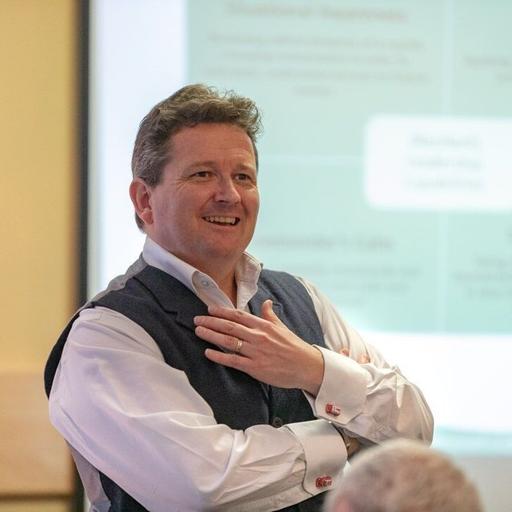
The Resilience Coach | Resilient Leadership Expert
100,000+ People positively affected6,000+ Executive coaching hours£12M+ ROI delivered by RWE npower leadership programme20+ years Learning, leadership and organisational development
Russell Harvey is The Resilience Coach - a resilient leadership expert, executive coach, facilitator and keynote speaker who helps leaders and organisations perform at their best when the world refuses to stand still.
With more than 20 years in Learning, Leadership and Organisational Development, 6,000+ hours of executive coaching and over 70 published podcast appearances, Russell is an experienced and engaging voice on resilience, leadership and navigating persistent change. He has worked with leaders across organisations including Novartis, the NHS, AB World Foods, Kerry Group and The Co-operative Group.
Russell’s work goes beyond helping people simply cope with pressure. He believes true resilience isn’t about “bouncing back”, being tougher or pretending everything is fine - it’s about springing forward with learning and becoming better equipped to lead because of the challenges you’ve faced.
His approach connects the human side of leadership directly to what matters to organisations: engaged people, stronger cultures, better decisions and improved performance. His work has delivered measurable results, including a leadership programme that returned £12 million to the business and a Resilient Leader Programme that achieved more than 1,100% ROI.
In August 2025, Russell achieved his long-held purpose of positively affecting 100,000 people.
More from Russell Harvey
All episodes → Living the Dream with CurveballSpringing Forward: Russell Harvey's Insights on Building Resilience and Embracing ChangeNov 2026Play episode →
 Transformation Station Leadership PodcastTSLP Season 5 Ep. 26- Thriving Is A VerbNov 2026Play episode →
 Embracing Digital TransformationHow to Build a Resilient Team Without Toxic PositivityNov 2026Play episode →
 An Evolving Man PodcastReal Resilience: Why Pushing Through Isn’t Enough | Russell Harvey | AEM #172Oct 2026Play episode →
 Leadership From The Heart | Transformational Leadership InsightsResilience Without the Rebound | Leadership Mindset ShiftAug 2026Play episode →
 Burnout Proof Leadership: Identify Shift and Leadership Skills for Midlife Women EntrepreneursEssential Leadership Skills You Must Have If You Want to Build Resilience & Avoid Burnout When Your Business Gets Hard - with Russell HarveyJul 2026Play episode →
 Your Career JourneyHow to Build Resilience at Work: Leadership, Change & Thriving in Uncertain TimesJul 2026Play episode →
 The ThriveWell Journey | Entrepreneurship, Leadership & Life After DisruptionHow to Build Real Resilience Under Pressure | Russell HarveyJul 2026Play episode →
 Future Fit LeadershipThe 2030 Leader: Why Resilience is Your Most Vital Skill with Russell HarveyJun 2026Play episode →