
March 5, 2026
Are you coping, surviving — or actually thriving?
It’s not about trying to create lots of clarity. Sometimes the only bit of clarity that you have got is that you’ve got very little.
Sound bites
I want you to gain command of your environment first.
In this episode
Russell Harvey and Sue Firth talk about executive coaching, resilience, and how leaders can handle a volatile, uncertain environment.
- Career path from human behaviour interests into learning, development, leadership development, and coaching
- Coaching conversations that create reflection, insight, and lasting behaviour change over months
- VUCA skills: vision, understanding, clarity, and agility as part of resilience
- Moving from trying to control everything to being in command of your environment
- Signals that someone may need support, including change fatigue, loss of normal routines, and running out of energy
Chapters
Written from the transcript. Pick a chapter to play the episode from that point.
Transcript
Automatic captions of the conversation. They can contain errors and do not name who is speaking.
It's The Executive Edge with Sue Firth. The podcast that gives you an edge in life and business, the practical skills that you can apply to achieve and maintain success. Welcome, everyone, to this week's episode of The Executive Edge. Now, this is the podcast for skills in life and business, and I am Sue Firth. Today, I have Russell Harvey. Now, he is an excellent coach with a background of working with the NHS and BT. He's also a speaker, he runs a podcast. I know he's got a lot to tell us. And in particular, I've asked him on so he can talk to us about a VUCA environment, which if you come across before is volatile, uncertain and will unpack the rest.
So it's really good to see you, Russell. Thank you very much for coming on the show. Hello Sue, thank you very much for having me here. I'm looking forward to it. Oh, that's brilliant. Right, so tell me a bit more about you. Run through your background for us. Always been interested in human behaviour, you know, ever since I can remember or just intrigued around, well, come humans do the things that they do and don't do the things that they do. That's fascinated us. At school, you know, when I did the career conversation about, oh, I think Russell, you'll be good at sales or personnel, you know.
But at the time, those responses and whatever I was, 13, 14, 12, made me feel a bit hick. But ironically, you know, I am in personnel because I'm in learning and development. You know, and I have to sell myself, essentially. So, you know, there's some irony in that. Real light bulb moment for me was traveling around the world for the year in 1996. And I was teaching in Hong Kong, doing the thing you do was you pause your traveling and try and get a bit of cash. But it was teaching and I was teaching English language lessons to local Hong Kong Chinese off the street.
But there was magic happening in the room. So there was something beautiful was happening. And I didn't quite know what it was. It turned out later, it was people having learning moments, light bulb moments, realization moments. And I thought, well, I want to, I love that. I want to do that for a living, but I don't want to be a teacher in a school. So came back from traveling. And the only way I could express it was, I think I want to be a business trainer. That's the only job title that I could equate it to at the time in 1997.
And, you know, recruitment agencies will go, well, what are you qualified in and what do you know? And I was like, nothing, not, I just know I want to do it. But then that was my career. I took a sales job, essentially, but then did training at night school, and then went into learning development, then leadership development, then coaching. So today, I describe myself as a coach and a facilitator. And the Resilience Coach was born 10 and a bit years ago, after six redundancies from the corporate world. It was the sixth one that I finally went, do you know what?
I think I'm ready to go by myself, you know? And that was- I'm old enough, Mum. I'm old enough. Yeah, I'm ready. It feels about right, essentially. Exactly. So that's today's answer to the question, essentially. No, that was brilliant. And thanks so much, because I too can remember walking into, you know, whatever it would be, a careers advisory or something similar and saying, if you got any jobs in training and their look at their faces, what are you talking about? You know, what do you mean? Business, business training, training, Excel packaging, what are you talking about?
And I just, I just remember feeling incredibly confused about how I was actually going to sell this. So let's, let's unpack that just for a minute, though. You and I have both been professional trainers in the regard where we stand up and we talk about skills. And this is always the optimum way we find to teach a group of people. But it's entirely different when you're coaching. Let's talk about the benefits of being able to coach somebody. Yeah, yeah. So I think I was having a coaching session this morning with an individual, and we have just had such in-depth, reflective, open, insightful learning conversations for them.
Loads of, oh, gosh, right. That's made a difference to me, responses, you know? Okay, that I can, right, I can see the difference there of like, oh, I, yes, that's different for me. That's, oh, that's a different way of thinking about it. Oh, God, I know what to do now. All of that, essentially. And it, you know, I do struggle with just this general feeling of like, the universe going quicker, faster, shorter, smaller. You know, how can we get there quicker type thing? And in a coaching conversation, it's to go, you know, they are 16, 90 minute conversations that happen over a period of a number of months.
And in that time, you actually get to behaviour change that you, I'm pretty damn sure is actually going to be for life. Yes, yes, that's the distinct difference, I think. Not only have we got the personal opportunity because we make a safe space when somebody is talking to us, which I think is a different environment, to be fair. And I'm not getting at training, because I think it's got its place and it's perfect. And you and I have both got the capacity to do that too, because it's not that dissimilar to the professional speaking bit, because you're still speaking to a volume of people.
But what you can't be sure is what's landed. You don't know where the light bulbs are really going to impact behaviour. And the advantage of coaching, I think, is that you can personalise pretty much every single piece of the topic as you go through it. So what I'm wanting to gently get at is, as you're talking and supporting and you are uncovering, what helps you recognise that somebody needs to be more resilient? So what symptoms or whatever word you'd like to offer, do you pick up that indicates actually this person needs to do something that will help them feel better?
Yeah, so, great question. I, so in my head, I've got a mental blueprint of a human being that's thriving in this spooker world versus coping or surviving. So surviving is hanging on by your fingernails. So I've probably got a, from use of exerience, sort of a subconscious blueprint in my head of like, what they'll say, how they come across, how they behave, how they'll describe the circumstances. And surviving is like hanging on by your fingernails. Coping is any variation of I'm okay. And it might be, I'm okay, but I think I might be just about to tip into surviving.
Or do you know what, I'm okay, but I think actually I might be tipping into thriving. And there are people, so those that are in thriving go, I'm good. And so I know that I've got a mental blueprint of like what it looks like, sounds like and feels like from a human leadership point of view of surviving, coping and thriving. So I'll be picking up clues from like, so just tell me what's going on, tell me about your day, tell me about, you know, we had these coaching outcomes, how's things going? Just describe what's been going on for you since we last met, you know?
And that will give me a sense of where they are on this scale. And then the resilient individual, to continue to answer your question, if anybody asks me the question, so Russell, how do I build my resilience? I go, there's a resilience wheel on my website, built upon research, seven things. That's how you do it, you know, a lifetime thing. And so I've also got that blueprint in my head around, actually, there's probably a part of their wheel that could be in a better place, this resilience wheel. And so that gives me additional things to go, should we explore that a bit?
Because, you know, this part of the wheel, that sounds to be in an okay place, but this part of the wheel, the one listening to what I'm hearing, what I'm sensing is, we could probably make some improvements in that area. Tell me more about that, because if you've got seven aspects, what do they cover? A person's approach or style, or the circumstances they've got, or what's it covering? Yeah, so, I mean, I find that I'm talking about business buzzwords all the time. So, on the wheel itself, so heart resilience is attitude, whole attitude to life.
Then there's purpose, resilient people have one. Then there's the word confidence. So, what is it that an individual needs to do to feel confident? And if we get time to come back to it, I'll feel concerned about the term imposter syndrome. I'm just concerned about it. Then there's adaptability, then there's your support network, then there is meaning, which is our internal storytelling, the meaning we attach to events. And there's this word energy, which is all about the strength-based approach, so the psychometric strength scope.
Okay? So, yeah, so those seven aspects of the wheel, they're all interconnected, and the resilient individual, leader, team and organization is growing and nurturing their resilience wheel, you know. Brilliant. So, I encourage, anybody's listening now, I encourage individuals to make the decision and the choice, and specifically leaders, to make the decision to grow and nurture, engage with their resilience wheel today for the rest of their lives, because then they will get in to thrive, which is, there's a lot going on.
It's a crazy world. It's a VUCA world, and I'm good. Yes. Yeah, yeah. Absolutely. And I love that. Thank you. That's what there is in an individual. Yeah. Because I think you've unpacked a few things there, which are useful for everybody when they think about it. It's not just something deeper, say, psychological, which is you're tripping yourself up, your dialogue in your head is finding fault with yourself all the time. Very high standards, perfectionist, competitive. These are all features of very high achievers.
This is, if you like, it almost comes with the territory. But when you transplant one of those into a VUCA environment, and just to clarify, in case somebody hasn't heard of it, although I think that would be unlikely, but volatile and certain. Yes. I mean, it can be. Even I just ended up looking at complex, because otherwise I would have put the word challenging, but still the thought is the same and ambiguous. And you can have any one of those variables, but when you've potentially got all four, it really does throw people into an absolute melee, or they can feel to some degree like they really have to swim.
Otherwise, there is just a perpetual exhaustion. Absolutely. And are you just checking, are you familiar with the counterbalance that which is VUCA Prime? Because that's the solution to VUCA. I think I've seen it on a continuum. So, for example, if you get, if you're in a volatile environment, look to learn the vision or aim towards a vision, I think if I've understood what you're going for. Yeah, so, four more buzzwords, vision, understanding, clarity and agility is VUCA Prime. And the vision is not like a vision statement, it's your eyes.
It's what can you see, so it's situational awareness. So, it's looking around your organization. So, it's like, you know, observing what is happening in the world about things that might be coming your way. So, it's eyesight, you know. Amazing, thank you. No, and understanding is... Not business vision, yeah. No, not business vision. So, understanding is... Understand you have to feel comfortable feeling uncomfortable. You have to understand that. And the clarity is the fact that in all of this complex, ambiguous world, it's like, what clarity can you get?
And it's not about trying to create lots of clarity. Sometimes the only bit of clarity that you have got is that you've got very little. And so that's what that space is about, to go, what clarity have we got, you know? Just be comfortable with what you can find. Yeah, yeah. And then the agility piece is, you know, you know the course, but you are situationally aware, back to the vision, about when you need to change course, the Agile. And all of these link to the resiliency piece. So VUCA skills to be well in a VUCA environment link to what it means to be resilient.
Brilliant. Thank you. And you actually do a Resilient Leader coaching program. So do you cover all the elements of the seven that you've got in your wheel? And also you start to encourage people to understand how to aim for what they think they can control rather than this dreadful stress over what I can't? Absolutely. Absolutely. And also as well in terms of changing language. So one of the things we discuss is like we need to enable a Resilient Leader to fill in command of their environment rather in control of it.
Nice. And so then anybody that comes in the program is goes, what the heck does that mean? Versus, oh, I understand that. Oh, okay. All right. Which is really interesting. So if anybody, one of the things I say jokingly is like, anybody, any control freaks in the room. And, you know, I go, so you might need some extra layers of support in this space. It's like when you genuinely really get what being in command of the environment means, you actually have strong levels of control. But I don't want us to try and gain more control.
I want you to gain command of your environment first. And so it takes a while for people to start. If they can control freaks, they go, but I want to be, yeah, we'll get there, but we're going to get there via a different route. You know, it's one of those many trust me moments. Yes, and all of this is on the programs that I do, the whole VUCA and Resilience piece. No, I like that very much. Thank you for sharing, because I think what matters is what you've just said. I can find myself talking to lots of people and I'm stood there because they're entrepreneurs, they're execs and they're sitting there and they're all control freaks, Russell.
I mean, I think, to be fair, most of them just are because again, wrapping back to, you know, perhaps just sharing what I've seen is the fact that there are some things that seem to come with the territory. They are natural qualities that drive people and they drive people particularly well. For example, locus of control is that they're often internals and they have the ability to be able to get up in the morning, start the day, continue to get through the day, and do this day after day. And that is by its own measure, I would say, a natural level of resilience.
But I'm not implying for five seconds, they don't struggle, particularly in a virtual environment, but also when they struggle, they're now going to come and find you. Yes, absolutely, absolutely. And so, yeah, the people that come to us, circling back to when you were early, question about how do you know if people sort of need some support, you know, it's words and phrases, so keep thinking about the answer to the question about how are you, you know, how people respond to that, like, oh, there's just too much change, or, you know, when things get back to normal, or, you know, the things I used to do don't work anymore, or actually, I've come to the point where I've run out, you know.
So those are ideal clients, also as well, ideal clients that are already in a good place. It's like they're ideal clients, because so how do we maintain that? How do we make sure that you don't go into a different unhelpful place? Good point. Yeah. Good point. I mean, I think it's very human to enjoy your comfort zone. I think it has its value and its place, although I would say a lot of people who are high achievers spend a great deal of time outside of their comfort zone. But because it's normal and we all need it, the difficulty with VUCA environments is it pushes us out of our comfort zone and we have to perform at that level really for quite prolonged periods of time.
But the misconception I would add is the thought that we can go back in some way. So in other words, the situation is going to go back eventually, isn't it? We say in a pleading tone. And in addition to that, that is why I define resilience as springing forward with learning. Love it. So I'm not a fan of the term bounce back, because as you'll know, there's a subconscious instruction to go, I'll face into this challenging environment and I'll now bounce back. I'll now go back to how it was. And I'm going, what did you learn?
So that resilient individual, because adaptability is, you know, one of the dimensions of being resilient, you are learning about what you're going to keep doing, because it's served you well, you know, in terms of resiliency behaviors around the wheel, and go, actually, what do I now need to do differently? But it's about absolutely trying to get an underlying level of internal resilience, because then you are more open to doing things differently. Love it. And the value of that really is back to, stay aware, but stay aware of the present.
And, of course, one of the things I've spotted, and I'm sure you have too, is if we could split a group of 100 people, and we found a percentage of them were the high achievers or the top execs, we would almost universally, I feel, find that they live somewhere in their heads in the future. Because the future contains the success of their goals, their aspirations, and where they want the business to be. That has its value for obvious reasons. But often, it's the top to middle managers who then have to translate that vision into reality right now.
And they are often the most vulnerable, I feel, to a VUCA environment because they're being pushed from both sides and they have to please both sides. Totally, yeah. So, you know, a lot of my audio clients are people with the job titles of head of and director of. And just about what industry or what comes next, because they're in that space and you ask them, how are you? More of the time, they sort of go, I'm all right. But, yeah. And so you go, okay, all right. So there's probably an opportunity in there. But to further down the line, after they've worked with people like us, when you ask, how are you?
They go, yeah, there's a lot going on and I'm good. That's the change, that's the measurable change, you know. Much better. I talk an awful lot about, sorry, carry on. Sorry. I was going to say, which also brings us back really to the fact that it sounds like both of us are very keen to make sure people understand language is everything. It's how you present it to yourself in your head, which brings us, I think, ninkly into the segue you were saying before that you find you're wary of the idea of imposter syndrome.
By all means, share that if you want to, because I'd be interested in your thoughts. Yeah. So as I understand it, so I'm not energized by details. Don't ask me to quote the... So the original research about where somebody came along and said, oh, there's this thing called imposter syndrome. Let's talk about it and put it out there as a product. That wasn't as it was originally intended. And when I look at what I see people talk about imposter syndrome, for me, it is around this word confidence. So I am of the opinion, so as you know, confidence is our belief in any particular moment about whether we can do something or not.
So every single human being on the planet has confidence. They have a belief they can do something, you know. So, you know, you ask anybody, so can you come over and help me tell my shoelace? Can you come over here and write this report for me? Can you come over here and make me a cup of tea? Can you come over here and present in front of the board? And we will have a belief at that moment in time about whether we can or can't do something, somewhere on with it. So the resilience, the confidence dimension of the resilience wheel is like working with clients to go, what is it that enables you to have belief in yourself that you can do something or not, because then that's a confident you.
And playing to your strength builds natural resilience and natural confidence. So, that's the energy bit of the wheel. So, they're all interconnected. They're all connected, aren't they? And it absolutely sounds like it. And thank you. So, I'm guessing that the first stage when somebody reaches out to talk to you is that they look at or complete the wheel. So, it's graded or they need to think about where they're at on it. Yeah. So, I haven't specifically got like... So, there are a number of different resilience questionnaires.
So, when somebody comes to me, most of the time, we do their strength scope psychometric, which is the energy part of the wheel. And then the wheel is very much a conversational tool. And, but yes, I, you know, podcast episodes of my own on each of the aspects of it. And when I do speeches and da-la-da-da, I go, here's the wheel, I'll talk to you about it. Now, just self-assess yourselves. Just score yourself out of 10. Boo, happy face or not so... Put a color to it, you know? Just which aspects of your wheel are you thinking, actually, that's all right, or actually, they could do some improvement.
So, yes, you self-assess. And then, on a program and on coaching, we go into more depth and we can use some other tools to, if somebody wants to really crystallize the measurement of it for themselves, we can do that for them. Great, thank you. I mean, truthfully, I think, Russell, you and I both know, it's not possible to stabilize life to the point where there's no learning needed anymore. It's not possible to get it to the perfect position, but it helps a great deal if you have tools. I've always been a very strong believer.
I discovered this too when I was much younger, that if I do feel out of my depth, what I need is a tool. And sometimes I think anxiety comes into place when I'm using a tool that is the wrong one for that situation, or let's face it, I just don't know what I need to know. So the advantage of knowing you're out there is coming to find you so that somebody can say, okay, if I don't know this, there's someone I can talk to who's been there before me, and that they're willing to show me what it is that I can apply or use, which is a useful tool.
And I would urge people as you're listening, don't be afraid to use new tools. This is the whole point. You may very well have had a tool in your kit bag that was pertinent when you were a teenager, but it isn't going to work now when you're in your 40s or your 50s. It's just not, it's not applicable. No, and I, and one of the things, interestingly, which is supportive, World Economic Forum has said the most important, one of the most important skill sets for 2030 is resilience. But I'm going, for goodness sake, please don't wait until 2030, do it now.
You know, it's literally, yeah. And so, yeah, engaging and choosing to nurture and grow your resilience wheel is going to improve your life circumstances. Yeah, yeah, yeah. So I would agree. I think it's a life skill. Isn't it? Yeah. Funnily enough, it suits the podcast perfectly because it is a skill in life and business. So well done, Russell. You've done a really brilliant job of telling us all. I couldn't have said it better myself. So well done. It's like I know that I and many others talk about, you say resilience is important, but OK, somebody else is coming along.
So choose what you listen to. But what's it going to take before you sort of go, OK, I'm going to have a check in on my personal understanding of my levels of resilience. Yeah, exactly. And I think even if you say to yourself, my levels of confidence and choose one of your seven pillars, it still makes sense because I think at any one time, one of these can get messed with or eroded. And this is really where we're coming from. Shower it up because when you then need to rely on it, it's going to be there for you as a set of tools.
So the most important thing, Russell, you've got your beautiful descriptions behind you. And when we put this out on a brief snippet, which is visual, we'll be able to pick up that we've got your email address there and your website address there. But just in case people are only listening to this on audio, can you just spell out for me, how do we find you? So if you put in the resilience coach, you know, that will come up, essentially. So the website is theresiliencecoach.co.uk. And if you look for Russell, the Resilience Coach, I will appear on, I think, most, if not all of the social media platforms.
Fantastic. So that's how you find me, essentially. Brilliant. And then just message me. Good. And I'm assuming that like me, you're available globally, so you'll help anyone because you're user friendly online. And an hour a time, is that kind of the typical coaching? Yeah. So I essentially sort of do a length of time in terms of a number of months, you know, for a fee, and then actually how we, whether that turns into an hour or 90 minutes, or we go for a walk, you know, globally, you know, there's only so far I can go.
But it's, you know, a contact, an individual to sort of go, it seems for you that you need six, nine, 12 months, three months, eight months support. And here's a number to that. Great. And how we do it in that period of time is to make sure we get you to achieve your coaching outcomes. Typically, it does turn into like 60 to 90 minute sessions. Yes. However, there are others that go, actually, do you know what, can we actually meet up and, yeah, let's go for a dunder or, yeah, so we can be flexible in how we do it.
Love it. Thank you. And if people want to be able to make your Resilient Leader Coaching Program, which I'm assuming is available to teams and within businesses. I'm saying the same thing, just get in touch. And it's like just, you know, it's a quick check on like, what's the exact circumstances. So what do you need? It's like, yes, it is there off the shelf, but it's also bespoke really. So, you know, it's, so it's all of that. So we can tweak it, essentially. Wonderful. Thank you. So really, our message is don't wait until you're drowning.
Don't wait until the company or the business actually struggle or you're burning people out. Try and see whether or not you can actually reach out to Russell ahead of that, because if your people are better equipped, including yourself, this is going to be better for the business anyway. So it's been an absolute pleasure, Russell. Thank you so much indeed for unpacking this topic for us.
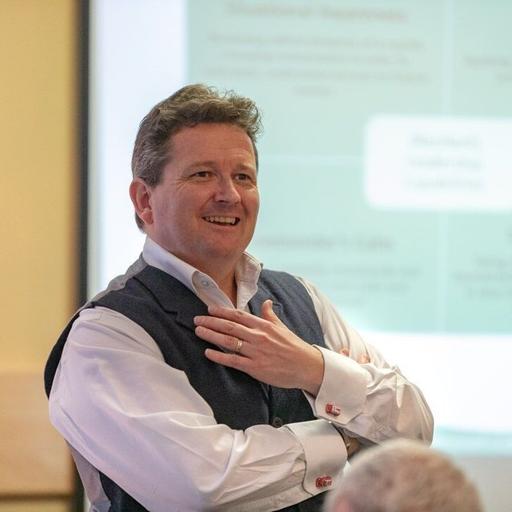
About Russell Harvey
The Resilience Coach | Resilient Leadership Expert
100,000+ People positively affected6,000+ Executive coaching hours£12M+ ROI delivered by RWE npower leadership programme20+ years Learning, leadership and organisational development
Russell Harvey is The Resilience Coach - a resilient leadership expert, executive coach, facilitator and keynote speaker who helps leaders and organisations perform at their best when the world refuses to stand still.
With more than 20 years in Learning, Leadership and Organisational Development, 6,000+ hours of executive coaching and over 70 published podcast appearances, Russell is an experienced and engaging voice on resilience, leadership and navigating persistent change. He has worked with leaders across organisations including Novartis, the NHS, AB World Foods, Kerry Group and The Co-operative Group.
Russell’s work goes beyond helping people simply cope with pressure. He believes true resilience isn’t about “bouncing back”, being tougher or pretending everything is fine - it’s about springing forward with learning and becoming better equipped to lead because of the challenges you’ve faced.
His approach connects the human side of leadership directly to what matters to organisations: engaged people, stronger cultures, better decisions and improved performance. His work has delivered measurable results, including a leadership programme that returned £12 million to the business and a Resilient Leader Programme that achieved more than 1,100% ROI.
In August 2025, Russell achieved his long-held purpose of positively affecting 100,000 people.
More from Russell Harvey
All episodes → Living the Dream with CurveballSpringing Forward: Russell Harvey's Insights on Building Resilience and Embracing ChangeNov 2026Play episode →
 Transformation Station Leadership PodcastTSLP Season 5 Ep. 26- Thriving Is A VerbNov 2026Play episode →
 Embracing Digital TransformationHow to Build a Resilient Team Without Toxic PositivityNov 2026Play episode →
 An Evolving Man PodcastReal Resilience: Why Pushing Through Isn’t Enough | Russell Harvey | AEM #172Oct 2026Play episode →
 Leadership From The Heart | Transformational Leadership InsightsResilience Without the Rebound | Leadership Mindset ShiftAug 2026Play episode →
 Burnout Proof Leadership: Identify Shift and Leadership Skills for Midlife Women EntrepreneursEssential Leadership Skills You Must Have If You Want to Build Resilience & Avoid Burnout When Your Business Gets Hard - with Russell HarveyJul 2026Play episode →
 Your Career JourneyHow to Build Resilience at Work: Leadership, Change & Thriving in Uncertain TimesJul 2026Play episode →
 The ThriveWell Journey | Entrepreneurship, Leadership & Life After DisruptionHow to Build Real Resilience Under Pressure | Russell HarveyJul 2026Play episode →
 Future Fit LeadershipThe 2030 Leader: Why Resilience is Your Most Vital Skill with Russell HarveyJun 2026Play episode →