
March 17, 2026
Episode 250: How to Break Resilience Myths and Spring Forward with Russell Harvey

Listen
In this episode
Russell Harvey and Dr. Ginny Barrow talk about what resilience means for leaders, how to build it, and why it matters for teams and organizations.
- Resilience as springing forward with learning, not bouncing back to where things were before.
- Leaders need to sort themselves out first so they can support other people at work.
- A common misconception is that resilience means keeping going regardless or simply being tough.
- Playing to strengths can build natural resilience and confidence.
- Resilient leaders delegate to strengths, remove blockers, and nurture a resilient team.
Transcript
ShowHide
Automatic captions of the conversation. They can contain errors and do not name who is speaking.
The future of work and leadership always starts with us. Welcome to The Dr. Ginny Show. Let's dive in. Welcome to The Dr. Ginny Show. Today, we have a special guest, Russell Harvey, who is going to be with us. He's a fellow coach and we're going to find out more about him, what he does, what makes him tick, what are the challenges he's seeing out there. But we're going to start off, Russell, by first of all, saying hi. I hope everybody's well. Thank you for having me on. Russell, if people were to pay attention to what we're going to share today, what are they going to learn?
They're going to learn what resilience is and what resilience isn't. That's what they're going to learn and some tips, tools and ideas around what does it really mean to be a resilient leader. So rather than just a buzzword, it's like we're going to bring it to life. Tell us a little bit about your journey. What brought you to leadership coaching and coaching in general? It is very much around a long time ago, 1996. I was teaching in Hong Kong. And when I observed people in the room having light bulb moments, realization moments, aha moments, I went, you know what, I want to do that for a living, essentially.
But I knew I didn't want to be a teacher in a school. And at the time, the only sort of job title I could equate it to was business trainer. And back then, so I came back to the UK and went to recruitment agencies and said, you know, I want to be a business trainer. And they asked the questions of what you qualified in, what you experienced in. And it was like, well, I'm not and nothing, essentially. However, I've always also been fascinated by human behavior, why we do the things we do and why we don't. And so then, as I went into the business world, the corporate world, all of the time, I'm going, do you know what, it's just so important that anybody that's got any form of line management responsibility, i.e.
people that are of course into them and you sign off their holidays or you're supposed to have luck of performance management conversation with them. It's like that needs to be as good as it can be. This individual really needs to understand what leadership means, supporting other human beings in the workplace, because that relationship is key. So that has equated right now up to my purpose being that for 2026 and beyond, I want to champion businesses to be a force for good. I love that. The detail behind that is every single lineman has a relationship everywhere.
If a chairperson is a CEO and everywhere and in between, it's like, right, the resilient leader does all the things they need to do personally to sort themselves out. They understand what leadership is and resilient leadership is in order that they can support their humans be at their best. And that, I think, has been my life's work in some way, shape or form. And in the last 10 years, I managed to nail and crystallize it into that. We appreciate that. It sounds like we're speaking the same language. I suspect so. You described for us that your top priority right now, and don't let me put words in your mouth, based on what I heard you say, is that it's really helping anyone who's in a leadership role, supporting other humans to really show up with resilience.
Can you describe for us, Russell, what you mean by resilience? How do you describe it? I define it as springing forward with learning, springing forward with learning. I'm not a fan of the term bounce back. Quite often when people talk about resilience, they go, right, I will face into a challenging situation, and I'll face into whatever levels of resilience I've got, and then, okay, and I'll now bounce back. I'll now go back. It's a subconscious message to how I was before. I'm going, whoa, whoa, whoa, whoa, what did you learn?
What did you learn? And so the learning then comes that ultimately, the leaders are spending more of their time thriving rather than just surviving and coping. This question I ask a lot is how are you? So if you ask a human being that's got a job, how are you? A ridiculous amount of their ability to give that a decent answer to the question, so it's down to their relationship with their line manager. According to the last three World Happiness Reports, a ridiculous like 70% of our ability to give a decent answer to the question, how are you?
It's down to their relationship with their line manager. So it is very much about supporting that individual to sort themselves out first, in order that they can actually support others. The springing forward learning, the measurement, the outcome of that, somebody that's thriving, how they answer the question, how are you? Is essentially with, do you know what? There's a lot going on and I'm good. Yeah. That's the measure, that's the blueprint of thriving. And it's not pretend. Yeah, it's great. Most people when you ask, how are you?
Are going to give an answer in the coping space. An example would be, well, I'll be all right if it wasn't for, that's coping, I'm okay, but it's not great. So when you work upon your personal resilience, you then get to that place to go, I've really sought out what it is that I need to do, and yet there's a lot going on, and I'm good, I'm thriving. How often do you hear that, Russell? I'm just curious because I know that as human beings, we tend to have a negativity bias. So even when things are going really well, we tend to look for things that are broken, and things that are not going well.
So how often do you hear that response? Sometimes you might have to dig for it, but not very often, but you do also get the first responses, Ginny. You do, you get that, I'm fine, I'm good, it's okay, all right. Then you might just say, tell me a bit more about what's going on, and then you'll get a much richer set of information, which more often than is in the coping and surviving space. So it is very much about trying to get people to just move away from their initial answers. It's also really interesting as well culturally.
So yeah, we do have a negativity bias. So in the United Kingdom, we are more likely to do the negativity side because over here it's like it's too hot, it's too cold, it's too wet, it's too warm. Also in the United States, the default state is to give far more of a, it's great, I'm wonderful, it's amazing from my experiences. So you've got two different ways to sort of go, okay, tell me a little bit more. Tell me more about that. Yeah, tell me a little bit more. And then that gives me an inkling about, okay, no, actually, this person, yes, great, they're resilient, they're thriving, brilliant.
Then the trick is also, how are you going to maintain that? How are you going to keep going? But a lot of the time, most people are going, well, Ashley, if I was really honest with you, Russell, he's probably not great. Yes, when they take a second to think about it. Yeah, yeah, it's like, this isn't quite right, that's not quite right, or this could be better, or genuinely, I don't know what, I know change is constant, Russell, but you know what, I think I was just fed up now, I've had enough, which is real, and it's fine.
But from there, you can start to have a better conversation with them about it. Let's talk about challenges because I know in the space, the audience that is listening to us, we all have challenges. What are you noticing are some of the biggest challenges that you're facing right now with your clients? What are you seeing? I think it's the general request that can I get there quicker? Can I get there faster? I don't want to spend as much time on developing myself. What's the short version of this, Russell? That's the main challenge at this moment in time.
Can this be quicker? Can it be faster? Can it be simpler? Can it be shorter? What is underneath all that, Russell, you think? What is the driver of that? Is it time? Is it just having too many things on their plates? I know that I can relate to that. I obviously want to get to my end result a lot faster. How do you deal with that? To answer your first question, what's that down to? It is that pressure. It is that feeling of overwhelm. Probably the subconscious thought of an individual to go, if I pause, I'm going to drown.
I am trying my absolute best to just avoid the tidal wave. But that's the challenge. That's when you say to individual around, whenever I support individuals, my intention is not to add to that overwhelm. So it's a case of, if they want some differences to be present in their lives, they are going to have to do some things. But it isn't necessarily on top of their already full mind and their full mental to-do list. If you ask me the question around, so, you know, how do I get more resilient to go, okay, there's some things going to need to do.
But these are going to be instead of some other things that you're already doing. But the challenge is to enable people to actually have that conversation. Yes, and I agree with you. And everybody is different. We have to address every person individually. And I love that you brought in that we're not adding work on top of what they're doing. I know for my clients as well, Russell, what we do is we zoom out. What is helping them or creating what they feel is overwhelming. Yes. Then really break it down into, okay, out of the things that are feeling overwhelming, sometimes is the meaning we are giving those things, the expectations that we believe people have for us at work, at home, and then having this weight on our shoulders that we need to meet these expectations.
And sometimes we need to validate those expectations, which could be fictitious. They could only be in their minds. And that's perfect, because one of the dimensions of being resilient on the resilience wheel that I utilize is the word meaning, which is the meaning we attach to events. It's our internal storytelling. So absolutely, that is key. It's like, watch yourself talk at this moment in time. For everybody who's thinking, well Ginny, everybody is busy. What are we talking about? The question is not whether we have a lot on our plate.
I think we can all agree we have plenty on our plate. The question is, how are we looking at it? How are we prioritizing it? What meaning are we creating from it? What are we taking personally that could be weighing a lot more than it should? And then being able to discern, what should I be focusing on and what is noise? And only I need to start letting the noise go and focus on what I can control and what matters to me, what has meaning to me and my team and my company. And let go of a lot of that other noise and cacophony that happens.
But that requires a lot of self-awareness, right Russell? It really does. It really does. So when I start working with people and they say, what does it mean to be a resilient leader and a role modeler? And I say, so the resilient leader makes the decision from all of life's events to pause. Now a pause can be hundreds of different things. A pause can be a really great team meeting, but you're having a different type of conversation in that meeting. It can be listening to a podcast, it can be a conversation with your coach, it can be going for a walk, it's hundreds of different things.
But they ask themselves three questions in those pauses. So first one is, what behaviors have I been doing recently that have been useful and helpful in relation to my resilience? What behaviors have I been doing recently that have not been helpful in relation to my resilience? And how can I do more of the answers to the first question? So the resilient individual starts goes, I am making a decision, I am making a choice because I now get the value and benefit. Doing so, I'm going to pause and ask those three questions on a regular basis essentially.
Weekly, yeah, exactly. So as it relates to becoming a more resilient leader, which I will raise my hand to say, I want to become a more resilient leader and I would be very surprised if our audience doesn't answer the same way. What do you see as one of the most significant leadership competencies for all of us today? Well, so the way I view this, so I know I'm also biased, it is the word resilience. That's the competency essentially because resilient individuals make better decisions. Resilient individuals have greater clarity.
Resilient individuals have better levels of confidence. Resilient individuals, as the competency, as the skill, the byproduct of it is every other one. It's the bedrock and the World Economic Forum has just said, so most important core skill for now and 2030 is resilience and some element of AI literacy, so you would expect that. My view around the AI space is, and I know we can't do this, but my view is, what it would be fantastic for each set of humans to do in the organization is actually before we engage with AI, we all need to sit down together and understand on a human level, how resilient we've been because a resilient team is a high-performing team.
So let's do that first, all of our humanity and then let's find a way to add in AI as a complementary team member. But we need to understand the human first before we do that. Now, I appreciate they're going to work in parallel. The resiliency piece, it's start there because that's the bedrock, and as a result of that, everything else comes, all the other skills and capabilities come as a result of that. But also add that by being a resilient leader, you're role modeling for your team. Yes. That resilience and then we're helping develop future resilient leaders.
Absolutely. So what would you say, Russell, is the one misconception people have about being resilient? That you have to keep going regardless. That it's about only about being tough. So mental toughness and resilience, there are academics right now absolutely would really pile in with millions of pages of research about similarities, differences, interconnected, intertwined. They are, but there are some distinct differences between mental toughness and resilience. But some, a lot of people believe that they are only being resilient by just keeping going regardless.
For example, there's an individual called Ross Edgley. I've never met them. They're an incredible individual. They have taken all of the military tests around the world, the SAS and the Marines and so on. So they are physically incredible. They've written a book called The Art of Resilience. So the book is the fact that they decided to swim around the whole of Great Britain. So incredible. But in the first bit of the pages of the book, they wrote, So after eight hours of swimming blind in agony, I finally decided to stop and decide why I was blind and in agony.
And straight away, I was just like, if you had just paused after 30 seconds, you would have saved yourself seven hours, 59 minutes and 30 seconds of pain and agony. But no, you chose, because they're in that tough space, got to keep going. They chose to go, I can't give up, I can't give up. So what was it that they found? They were swimming with a jellyfish inside their mask. That was the problem. That was the problem. But it took them eight hours. Yeah, but I've got to keep going for eight hours. So it's a misconception.
So they're an incredible individual. I've never met them. I'm not criticizing them. I'm just going, that's the example of, you could have saved yourself eight hours worth of pain. Yeah, exactly. So I'm hearing you say that the misconception is that to be resilient, we need to be strong and plow through. Yeah. You're actually giving us a different perspective, which is now being resilient means stopping. Yes. And checking in with yourself and questioning, is this the right path forward? Yeah. Is this the right thing to be doing?
Yes. Am I springing forward learning at this very moment in time, or am I doing some behaviors that are actually not helping me? So earlier you mentioned, instead of bouncing back, springing forward. And I usually say also a phrase that one of my mentors used, which is falling forward, fall forward, just keep falling forward, right? Just keep throwing yourself on the ground, but at least you're making progress. So when it comes to resilience, and we hear a lot about resilience, we had one of our guests not too long ago talk about resilience.
She was someone who was extremely tough. And when it comes to opportunities leaders have around developing the resilience, what areas or in which directions would you lead them to go? To really understand their strengths, in the USA, we're familiar with the Psychometric Strengths Finder, and in the UK, it's Strengthscope. So, you know, really understand what truly energizes you, because playing to your strengths builds natural resilience and natural confidence. And then when I work with a client, they're feeling this level of overwhelm, I go like, look, just for start, to start with, what I want to offer to you is actually that a resilient leader is only responsible for three things.
Okay? So I'm not obsessed with three, but the mind likes the three things. So all you're supposed to do when you wake up each day is one of these three things, which is to delegate brilliantly to your people's strengths and remove the blockages to them performing, to build and grow and nurture a resilient team, and then maybe this one needs to come first, and then make the decision, make the choice, to personally develop your own resilience day to day. It's like you're there for those three things, and I go, okay, so will you have a look at what's in your diary coming up the next weeks and months?
How many of the things that you got in your diary are mapped to those three things? It's easier said than done, and you go, right, our next step is to go, right, we need to be putting some more things into these three areas, these three buckets, because then that will give you space, mental space, physical space, and it will open you up, and it will allow you to pause more. So when you said before that I'm not going to be adding more to your plate, we are replacing, this will be one of those examples where you're saying, what are you doing now?
Yes. Let's put them in one of these three buckets, and it should belong in one of those three buckets, and if it doesn't belong in one of the three buckets, what are we doing? Well, yeah, so this is where we go, right? Because you're going to be pragmatic, and I live in the real world, but you go, okay, to start with, we're going, if it's not in those three buckets, you shouldn't be doing it, and then you obviously see what facial expression that they give. They either go, God, I don't know, or they go, that's brilliant, that has just been so helpful, and you get both responses.
So the individual that goes, I don't know how I'm going to do that, you go, yeah, well, we'll just do it bit by bit, and we'll support you, and what's your worries and concerns about how come you can't even start, how come it feels awful even as an idea? Let's explore that. And those that sort of go, brilliant, right then, you go, okay. That's right. So one of the things I've noticed, I'm sure you have too, is that fortunately or unfortunately, we all have limit in beliefs. Yes. So while we know what to do, and we know that our things should fall into those three buckets, there's also the psychology of who we are, and how people perceive us, and how we show up, and the assumptions we're making, and what we take personally, and all the things that prevent us from showing up fully in our highest self, for whatever reason.
So when we are doing these exercises around resilience, what belongs in one of the three buckets, we're going to potentially feel resistance. Yes, yes, absolutely. It's going to come up. So this is where, so obviously one of those, one of the three things you're responsible for is building and growing and nurturing your own resilience. So I've mentioned before that there's the resilience wheel, which is built upon research. So that, those are, it's got seven dimensions to it. And so that, the resilience wheel is the answer to the question about how do I build my resilience.
It's like seven bits to it. And you can apply it personally, leadership, team and organizationally. And with individuals with limiting beliefs, I'm not sure how they're going to do it. They need to start now playing around with their wheel. And one of the dimensions of the wheel is having a purpose. So what supports individuals to feel more comfortable and grounded and more confident and make some choices around this is to go and do some work on what's your leadership purpose. And then that needs to crystallize for them.
They have to do some reflections around it. But then as a result, they then understand for themselves what drives them and what they're genuinely there to do and what floats their boat and what's important to them. And obviously then the lens through which they make decisions, it changes, it shifts. Of course. Yeah. I'm just curious. I know you mentioned meaning before. Is meaning also in the wheel? Yeah, it is. So very quickly, heart resilience is attitude, then there's purpose, then there's the word confidence, then there's the word adaptability, then there's our support network, then there's meaning and then there's energy.
And so behind that, there's loads of stuff, essentially. Of course. When you build your resilience wheel, it's enough. Well, the reason why I wanted to ask you about the other components is because when you brought up the topic of AI and begin from the human side of it, I thought, well, if you start with the resilience wheel and you mention all those components that you mentioned, as it relates to AI, when you embrace it as a partner to help you be the best human you could be, now having a different conversation from, this is a technical conversation, it isn't a technical conversation.
No, it isn't. That's exactly it. If people do need to understand what AI literacy is, so that's that genuine understanding about what it actually is and isn't, and what it can do and what it can't do, and what we are projecting onto it about assumptions about what it can do. I am not a specialist in this area, but I'm a member of something called the Oxford Review, which is a think tank around all things, behaviour and learning development. They did a deep dive on a series on artificial intelligence. We just need to remember for now that AI doesn't think and it doesn't learn.
I understand that some people will be listening now that are in the AI space, will immediately jump in and go, you're wrong, Russell, I get it, okay, because there are such things as machine learning. However, if you unpick what it means to think, what it means to learn, it's literally, we're going back to what does it mean to be human, and even the most advanced AIs, they're still so far apart that they're just still so far apart. From humans? From humans, yes, absolutely. The day that they get there, currently, the investment and the time that's required is exponential.
There's always going to be a difference between humans and AIs. Well, and I was just having this conversation with my ICF group here in New Jersey about how the human is always the one who's building a relationship. The human is the one who can notice shifts in energy as you speak. I could hear the words, an AI can hear the words, I can talk to my Alexa all day long. But when I'm coaching you as a leader, as an executive, I can hear the tone, I can hear the energy level in your answer, which will then prompt me to ask you a question about it, to really learn what's behind that.
And unfortunately or fortunately, AI isn't doing that, right? AI doesn't have that capability yet. It's definitely a complementary tool. It really is. And, you know, I don't fully understand it myself, you know? So, you know, there's lots of amazing things that it can do. And if there is a real risk that if somebody sort of says, yeah, I've got my AI coach and that's all I need, this just is really supporting that individual to understand that it isn't treating it on a human level. Right. Anyone can help you come up with goals that are smart.
And the question is, are those the right goals for you? This is it. And are those goals going to make you more resilient? Come on now. There you go. There you go. Well, thank you so much, Russell, for sharing with us everything that you shared about resilience, about the opportunities that are currently out there. If you were to advise someone on how to become more resilient as a parting message before we go into our lightning round, what would that be? It would be to reiterate some things we've talked about. So not self-promotion.
I know it's going to be on the links later, but go to my website, look at the resilience wheel, self-assess yourself on there about actually which parts of my wheel do I think are already in an okay place. Do more of that in the okay place because it has knock-on effects on it, essentially. And then those three questions, you know, what have I been doing behaviorally recently and against the resilience wheel that have been serving me well? What have I not been doing and how can I do more of the answers to the first question?
So somewhere in your working day, working week, it's just have a little look at the resilience wheel and just go, yeah, I think that's okay. I think that's not so great. Obviously, I think that would be terrible and then just start from there. And can you remind us of the three buckets? Absolutely. So delegate brilliantly to your people's strengths and remove blockages to them performing to build, grow and nurture a resilience team against the resilience wheel and make the decision and the choice to personally grow and develop your own resilience day to day.
That's it. That's all you have to do. If you do those things, you're good. If you do those things, you will be able to answer the question, how are you with, do you know what? There's a lot going on and I'm good. I love that. And that is what we really want for all of our clients and for ourselves. We want to be able to say, you know, my plate is full and I'm good. I'm thriving through it. Yes. So let's have a little fun Russell. What advice would you give your younger self? Two quick things. So first one will be network more and network earlier in your career Russell.
And the other one is, sounds a bit arrogant, but go, keep going, you're right Russell, about how leadership should be. So I will tell my younger self, don't question yourself. Things that you thought decades ago are still correct today. So keep going because you're right. So I'm hearing in that one, in keep going Russell, you're right, is that sometimes we let the noise in. Yeah, absolutely. And we kind of deviate from our path, thinking that I need to follow everybody else's drum. And you're saying, follow your own drum.
Follow your own drum, it's like, yeah, what you're thinking is correct Russell, so just keep going. And I love the part about networking as well Russell, because I would agree that I would say my career felt so different because I started to network really early. I had a workshop, one of the groups that supported me and elevated me as I was coming up, and I was part of Inroads. We had a workshop on networking right at a college, and I took networking to the end degree. And so I started building relationships that were genuine.
I wasn't fake about it, but I learned about the value of building relationships early on. And it really served me. I had wonderful mentors. I had valuable, courageous and very general sponsors that supported my career. And it was all because I build these relationships intentionally, with purpose, with meaning and authentic. And so that made a big difference. So thank you for sharing that. And what if you had no limitations on time, budget, resources? What project would you work on today? It would be a global program with senior leaders to nail down what makes a resilient organization.
What would be the best outcome of that project? That far more organizations are making much better decisions about who they are, what they're here to do, and how they're going to go about it. I love it. Thank you, Russell. And last but not least, what is the best piece of advice you've ever received? Don't let the perfect get in the way of the good. Who was that from? So it was from Freya, who was a line manager of mine. That came from her. Don't let the good. Don't let the perfect get in the way of the good. Don't let the perfect get in the way of the good.
I will remember that. And that applies a lot to networking. Because sometimes we get so in our heads about networking and how to reach out and what's the right timing and what should I talk about and what value can I add, that we don't reach out and we don't expand our network because of letting perfection get in front of just a good connection that you can make. I would add one other little thing and advice to myself as well is actually, Russell, go spend more time with CFOs, Chief Financial Officers. How come? Spend more time in their space.
So my brain is really, really good at seeing and noticing behaviors and now making linkages to the pounds, shillings, and pence, and dollars of the business. Behaviors. So when you've got the CFO with all of their financial numbers and go, which ones are you worried about? It's like, right, I can make linkages to the behaviors that are happening in the organization around those numbers that you're worried about. So spending more time understanding their world. I wish I'd done that a lot earlier in my career. That's great advice.
Russell, I know we're out of time. I know we could talk all day about resilience, about the advice you've received, about the opportunities you see for leaders to become more resilient and the organizations to become more resilient. Thank you for sharing your thoughts with us. It has been a wonderful 30 minutes. Thank you, Russell. Thank you. My pleasure. And to everyone who's listening, thank you for joining us on The Dr Ginny Show. I hope you received a lot of value from my conversation with Russell Harvey. We're going to leave your information, Russell, in our show notes, so people can visit your website, learn about The Resilience Wheel, and use it to improve your resilience as you lead others, as you meet your teams.
And of course, from me, live with purpose, live with joy. We will see you in the next episode. If you enjoyed today's content, I appreciate your review so others can find us and share it with your friends. And to stay in touch, join our community to receive valuable strategies and expert advice at drginnybarrow.com. See you soon.
About Russell Harvey
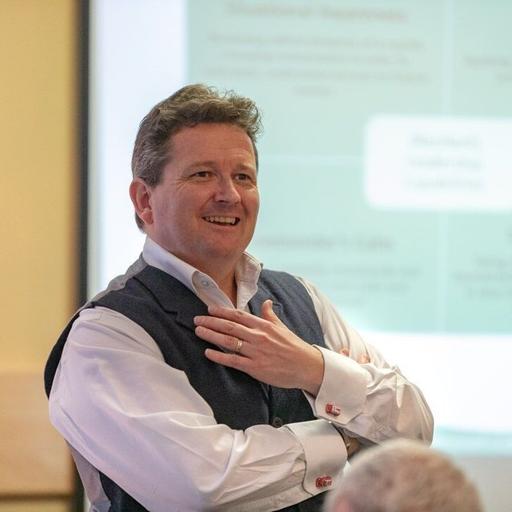
The Resilience Coach | Resilient Leadership Expert
100,000+ People positively affected6,000+ Executive coaching hours£12M+ ROI delivered by RWE npower leadership programme20+ years Learning, leadership and organisational development
Russell Harvey is The Resilience Coach - a resilient leadership expert, executive coach, facilitator and keynote speaker who helps leaders and organisations perform at their best when the world refuses to stand still.
With more than 20 years in Learning, Leadership and Organisational Development, 6,000+ hours of executive coaching and over 70 published podcast appearances, Russell is an experienced and engaging voice on resilience, leadership and navigating persistent change. He has worked with leaders across organisations including Novartis, the NHS, AB World Foods, Kerry Group and The Co-operative Group.
Russell’s work goes beyond helping people simply cope with pressure. He believes true resilience isn’t about “bouncing back”, being tougher or pretending everything is fine - it’s about springing forward with learning and becoming better equipped to lead because of the challenges you’ve faced.
His approach connects the human side of leadership directly to what matters to organisations: engaged people, stronger cultures, better decisions and improved performance. His work has delivered measurable results, including a leadership programme that returned £12 million to the business and a Resilient Leader Programme that achieved more than 1,100% ROI.
In August 2025, Russell achieved his long-held purpose of positively affecting 100,000 people.
More from Russell Harvey
All episodes → Living the Dream with CurveballSpringing Forward: Russell Harvey's Insights on Building Resilience and Embracing ChangeNov 2026Play episode →
 Transformation Station Leadership PodcastTSLP Season 5 Ep. 26- Thriving Is A VerbNov 2026Play episode →
 An Evolving Man PodcastReal Resilience: Why Pushing Through Isn’t Enough | Russell Harvey | AEM #172Oct 2026Play episode →
 Leadership From The Heart | Transformational Leadership InsightsResilience Without the Rebound | Leadership Mindset ShiftAug 2026Play episode →
 Burnout Proof Leadership: Identify Shift and Leadership Skills for Midlife Women EntrepreneursEssential Leadership Skills You Must Have If You Want to Build Resilience & Avoid Burnout When Your Business Gets Hard - with Russell HarveyJul 2026Play episode →
 Your Career JourneyHow to Build Resilience at Work: Leadership, Change & Thriving in Uncertain TimesJul 2026Play episode →
 The ThriveWell Journey | Entrepreneurship, Leadership & Life After DisruptionHow to Build Real Resilience Under Pressure | Russell HarveyJul 2026Play episode →
 Future Fit LeadershipThe 2030 Leader: Why Resilience is Your Most Vital Skill with Russell HarveyJun 2026Play episode →
 Different thinking for Different Time - Mindset Change and Thought LeadershipDifferent Thinking for Different Times - 7 Keys to Building Resilience with Russell Harvey How to Nurture a Resilient Mindset in Business and LifeMay 2026Play episode →