Leadership · Storytelling
The leadership story you already have is worth telling
Graham Brown explains why a leader does not need a dramatic biography to tell a useful story. One honest departure can show an audience what matters.
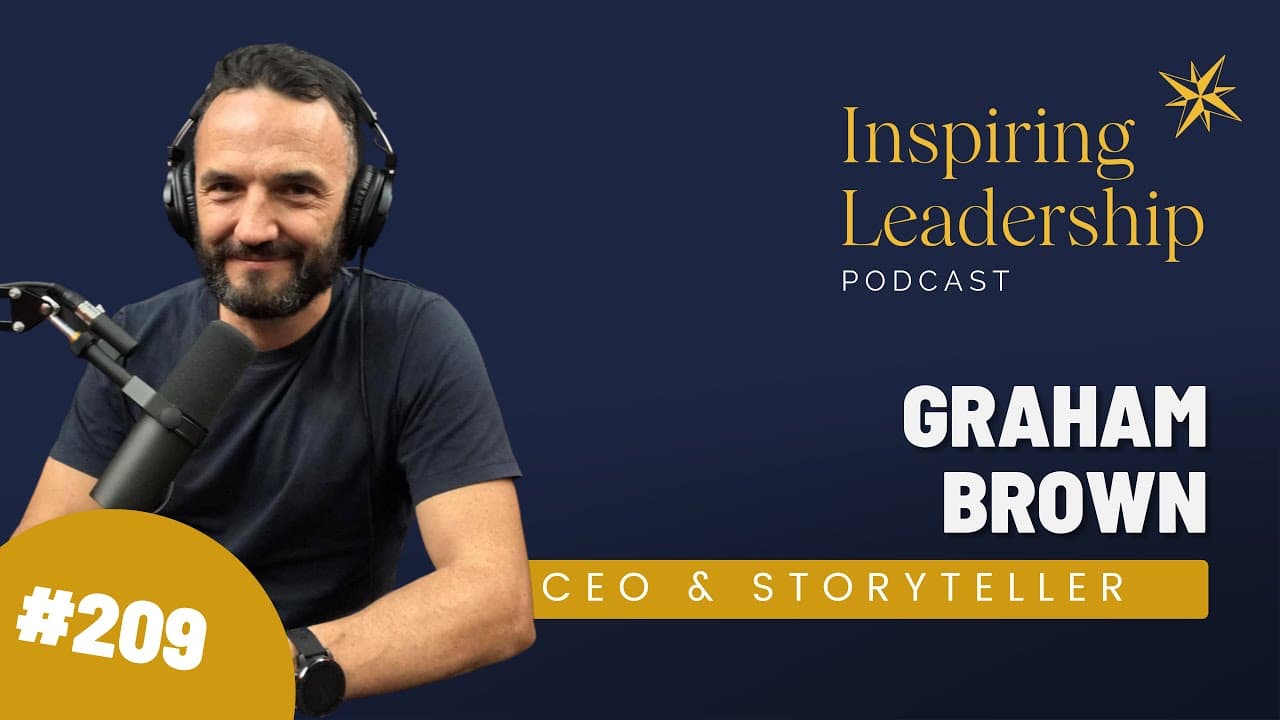
Inspiring Leadership interview
Video from Inspiring Leadership with Jonathan Bowman-Perks.
Guests on Air checked quotes against the official caption transcript and recording, then added editorial synthesis and supporting research.
How can a leader find a story worth telling?
A leader can start with one departure scene: the moment they left a familiar job, place, identity or way of working for an uncertain next step. Graham Brown recommends describing the choice, risk and consequence honestly, then connecting that scene to the question the audience is carrying instead of reciting a polished biography.
Many leaders think their story is too ordinary for an audience. They have not built a famous company, written a bestseller or won a public prize. In an Inspiring Leadership interview, Graham Brown argues that this is the wrong test. A useful story begins with one moment when somebody left what was familiar and chose an uncertain next step.
Brown calls it the departure scene. It is the point in a film or book where the character crosses a threshold and enters the unknown. In real life, that threshold may be leaving a bank, moving country, selling a business or starting work that friends thought was risky. The details are personal, but the choice gives another person something they can recognise.
The lesson is practical. Leaders do not need to recite their biography or polish themselves into a hero. They need to find the scene that explains what they care about, what they left behind and where they are trying to go. That gives a conversation a human starting point.
Key takeaways
- Find one departure scene instead of trying to tell your whole life story.
- Use the concrete choice, risk and consequence to make a leadership message easier to remember.
- Treat storytelling as a skill that improves through practice and listening.
- Keep the audience in view. A personal story works when it helps somebody else understand their own choice.
1. Find the moment that changed the direction
A departure scene has a before and an after. Before it, somebody has a job, a routine, a place or an identity that feels settled. After it, they have accepted a question they cannot answer yet. Brown says that this small structure can make a story easier to tell because it gives the listener a clear map. They understand the comfort that existed, the risk of leaving it and the possibility ahead.
Brown uses his own experience without turning it into a formula. After selling a telecommunications research business, he and his family asked what would happen if they did not start another business straight away. They sold possessions, packed three suitcases and spent years living in different places. The important point is not that everybody should copy the decision. It is that the decision revealed what he valued and gave him material for a story.
A leader can look for a less dramatic version of the same pattern. Perhaps they moved from technical work into a customer role. Perhaps they left a reliable employer to join a smaller company. Perhaps they decided a team needed a different way of working. The departure becomes useful when it names the real tension, rather than rewriting the past as a smooth route to success.
2. Make the story serve the listener
The point of a leadership story is not self-display. It is connection. Brown says people follow people rather than brands, especially when a leader has to speak in a setting where a slide deck cannot do all the work. A short personal scene can show why a message matters, but the leader still needs to connect it to the problem facing the people in front of them.
That is where the listener enters the story. Brown asks people to imagine the person looking out of a bank window and wondering whether they could make a different choice. The speaker does not need to tell them what to do. The story gives them a picture of someone who crossed a threshold and survived the uncertainty. It may help them name their own next question.

The 95% figure is a useful warning for organisations that treat thought leadership as a product announcement. Most prospective clients are not ready to buy at a given moment. A message that only asks for a purchase has little to offer them. A useful story can earn attention earlier by helping someone think about a problem differently, without pretending that one conversation settles it.
3. Practice until the story becomes useful
Brown rejects the idea that storytelling belongs to naturally confident people. He treats it as a craft. A leader can try a story in a meeting, notice where the audience leans in or loses the thread, and make the next attempt clearer. Practice does not mean memorising a speech until it sounds automatic. It means learning how to be present enough to respond to another person.
Leaders can keep notes on phrases and questions that opened real conversations with their audience.
Failure belongs in the practice too. Brown compares the work to a comedian testing material and noticing what lands. A story may feel flat because it begins too far from the moment of change, or because it leaves the listener unsure why it matters. Treat that response as information. Cut the extra history, bring the departure forward and give the audience a clearer place in the scene.
Brown's book Brand Love: How to Build a Brand Worth Talking About is relevant because it asks why people choose to repeat a brand story. Leaders face a similar test. The story has to give people something worth carrying into another conversation. It cannot be manufactured by a slogan or a perfect profile photograph.
Brown's final instruction is plain: "Start where you left off." Find the moment of departure, describe it honestly and connect it to the question the audience is carrying. That is enough to begin. The rest of the story can grow through the conversations that follow.