Entrepreneurship
Early retirement starts with redefining what retirement means
Graham Brown argues that retirement should mean freedom from the need to work, built on passive income that covers living costs, rather than a fixed age chosen by someone else.
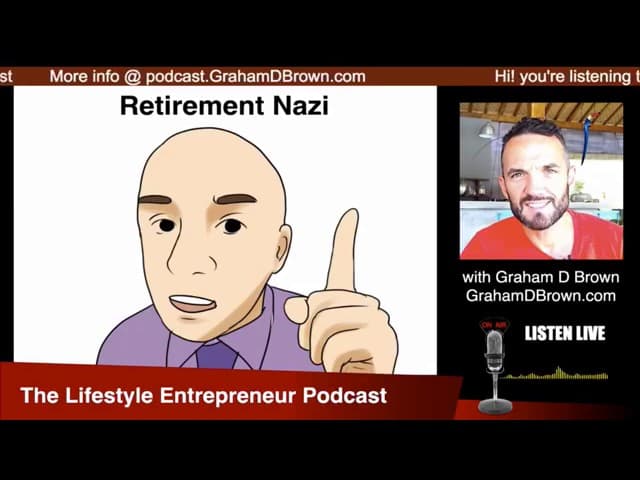
LEP8 | How To Retire Early | Lifestyle Entrepreneur Podcast
Video from Graham David Brown.
Generated from the canonical interview transcript and validated against source data by Guests on Air.
How can entrepreneurs retire early on their own terms?
Graham Brown says early retirement starts with redefining the word itself. Instead of the point where work stops completely, retirement becomes the point where a person no longer needs to work. That happens when passive income covers every living expense, which leaves a free choice to travel, rest or keep working on projects worth enjoying.
Most people picture retirement as a finish line set by someone else. You work for 40 years, stop at 65, and then enjoy whatever time is left. In an episode of the Lifestyle Entrepreneur Podcast recorded in Japan, Graham Brown challenges that picture and asks why anyone should accept it without question.
Brown trained and qualified as a financial adviser in London before leaving that career behind to travel and build businesses. That background shapes the argument. The financial industry, in Brown's account, earns commission on products and has little reason to help clients become independent of it early.
The episode makes a simple case. Retirement is a word, and whoever controls the word controls the goal. Brown sets out why the traditional definition no longer holds, what the numbers say about waiting until 65, and how passive income turns retirement into a choice rather than a date.
Key takeaways
- Retirement can mean the point where you no longer need to work, not the point where work has to stop.
- Rising retirement ages move the finish line for people who planned their whole careers around 65.
- A bigger salary rarely brings early retirement, because spending tends to rise along with income.
- Financial freedom arrives when passive income is greater than the monthly cost of living.
1. Why the definition of retirement matters
Brown says the strongest pushback on early retirement often comes from people whose own careers are built around the traditional model. Tell them you have retired and they reach for the dictionary, where retirement is the point a person stops employment completely. Brown does not dispute the dictionary. The issue is that accepting it means accepting someone else's goal.
Language, in Brown's view, is one of the quieter tools that shapes behaviour. If a society agrees that the goal of life is to work until a fixed age and then stop, it can steer expectations across an entire career. Entrepreneurs who want a different outcome have to own the words that describe their goals, not only the goals themselves.
So Brown offers a new definition. Retirement is not where work ends but where the need to work ends. Many retired entrepreneurs keep working because they enjoy creating things, and nothing in this definition stops them. On this view, retirement is freedom from having to earn, which leaves room for work that still matters.
2. The numbers behind waiting until 65
Brown points to news from Japan, where doctors proposed raising the retirement age to 75. The proposal was framed as a way to keep older people motivated. Brown compares it to a runner who can see the finish line of a marathon and is told another 10 kilometres have been added to the race.
The deeper reason, Brown explains, is cost. Many people believe their contributions build a personal pension pot. In practice, what workers pay today funds the people retiring today. With fewer young workers and longer lives in many developed economies, that formula no longer adds up, so raising the age becomes the easiest fix for governments.
Brown also cites an insurance risk calculator built on actuarial data. For a 45 year old male nonsmoker, it shows roughly a 25 percent chance of death, disability or critical illness before 65. Add a partner and the figure rises to roughly 50 percent. Waiting decades for a shared retirement becomes, in Brown's words, a flip of a coin.
3. Passive income as the real retirement plan
A higher salary does not solve the problem. Brown describes how income tends to rise through the 30s, 40s and 50s, while lifestyle costs such as housing, cars and family rise alongside it. From years of advising clients, Brown saw that most people were not better off as they earned more, unless they were financially educated.
The alternative is passive income, money that arrives without trading hours for it. When passive income is greater than expenses such as rent, food, travel and insurance, Brown calls that financial freedom. It is not the same as being rich. A yacht or a helicopter sits on top of that base and still has to be earned.
Financial education, Brown stresses, is different from academic education. The episode recommends five books, including Rich Dad Poor Dad, The 4-Hour Workweek and The $100 Startup, as a starting point. The lesson Brown draws is that businesses alone do not make people wealthy, assets do, and building them early is what turns retirement into a choice.