
Dr. Srini Pillay
Harvard-Trained Psychiatrist, Author, Brain Researcher & Co-Founder of Reulay Digital Therapeutics.
Sample Podcast Questions for Dr. Srini Pillay
- 1
You trained in some of the most rigorous medical environments in the world — when did you first start questioning the idea that illness has a single, simple cause?
- 2
A lot of longevity advice focuses on eliminating stress. What shifted for you in understanding that certain kinds of stress might actually make us stronger?
- 3
Can you walk me through a moment with a patient that forced you to rethink the relationship between belief and biology?
- 4
When you look at how we talk about cholesterol, alcohol, or supplements in the media, where do you think nuance gets lost — and what are the consequences of that?
- 5
You’ve spent years studying anxiety and the brain’s threat circuits. What happens inside someone when fear narrows their attention, especially in times of collective uncertainty?
- 6
Many people feel lost right now — in their careers, with AI, with how fast everything is changing. What have you noticed about what helps someone move from huddling in fear to actually reinventing themselves?
- 7
There’s research showing that expectation alone can measurably change brain receptor activity. How should that change the way we think about treatment, healing, or even performance?
- 8
You’ve written about the power of unfocused time — doodling, daydreaming, wandering attention. When did you realize that this “unproductive” state might be biologically protective?
- 9
In corporate environments, people love clear frameworks and step-by-step plans. What do you think gets missed when we try to turn human growth into a neat formula?
- 10
If someone in their 50s or 60s is facing retirement, health shifts, or identity changes, what would you want them to understand about attention, purpose, and the possibility of reinvention at that stage of life?
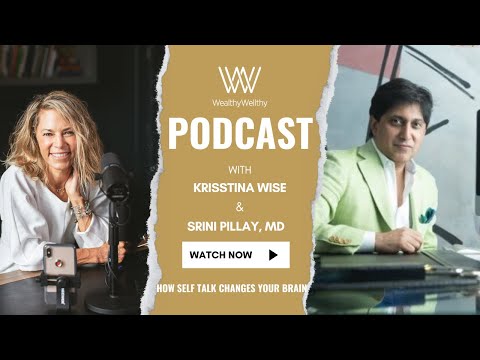
Latest episodes

Key topics
If you are not lost right now you might not be paying attention
In a world reshaped by AI, economic instability, and institutional distrust, feeling unmoored may be the most psychologically sane response available. The danger isn’t feeling lost - it’s letting fear narrow your attention until you start huddling instead of reinventing. Srini breaks down how threat circuits shrink possibility and how defining your “ideal self” can widen it again. This conversation turns existential confusion into a navigational tool.
The obsession with eliminating stress is quietly making people weaker
We’ve been sold the fantasy of a stress-free life, but biology doesn’t reward fragility. Small, contained stressors can strengthen systems, that’s hormesis, while chronic overload erodes them. The real question isn’t “How do I avoid stress?” but “Where is my threshold, and how do I train it?” This conversation reframes resilience as dosage management, not positive thinking.
The overlooked modulator of treatment outcomes
We measure milligrams, biomarkers, and mechanisms with precision, yet often treat expectation as background noise rather than a variable. In certain cases, like cough treatments without active suppressants, belief can account for a substantial portion of improvement and corresponds with measurable changes in brain receptor activity. Srini doesn’t argue for replacing medicine with optimism; he questions why we rigorously subtract placebo in trials but rarely ask how expectation interacts with treatment in real life. This conversation examines whether belief functions as a neuromodulatory factor shaping outcomes - and what responsible integration would look like inside modern care.
View all topics →
Latest episodes
Key topics
If you are not lost right now you might not be paying attention
In a world reshaped by AI, economic instability, and institutional distrust, feeling unmoored may be the most psychologically sane response available. The danger isn’t feeling lost - it’s letting fear narrow your attention until you start huddling instead of reinventing. Srini breaks down how threat circuits shrink possibility and how defining your “ideal self” can widen it again. This conversation turns existential confusion into a navigational tool.
The obsession with eliminating stress is quietly making people weaker
We’ve been sold the fantasy of a stress-free life, but biology doesn’t reward fragility. Small, contained stressors can strengthen systems, that’s hormesis, while chronic overload erodes them. The real question isn’t “How do I avoid stress?” but “Where is my threshold, and how do I train it?” This conversation reframes resilience as dosage management, not positive thinking.
The overlooked modulator of treatment outcomes
We measure milligrams, biomarkers, and mechanisms with precision, yet often treat expectation as background noise rather than a variable. In certain cases, like cough treatments without active suppressants, belief can account for a substantial portion of improvement and corresponds with measurable changes in brain receptor activity. Srini doesn’t argue for replacing medicine with optimism; he questions why we rigorously subtract placebo in trials but rarely ask how expectation interacts with treatment in real life. This conversation examines whether belief functions as a neuromodulatory factor shaping outcomes - and what responsible integration would look like inside modern care.
View all topics →