Mergers and Acquisitions
What Buyers Really Check Before They Pay for Your Business
Chartered accountant Saul Cohen explains why trust in the accounts, a clear pipeline and a leadership team that works without the owner shape the price of a small business.
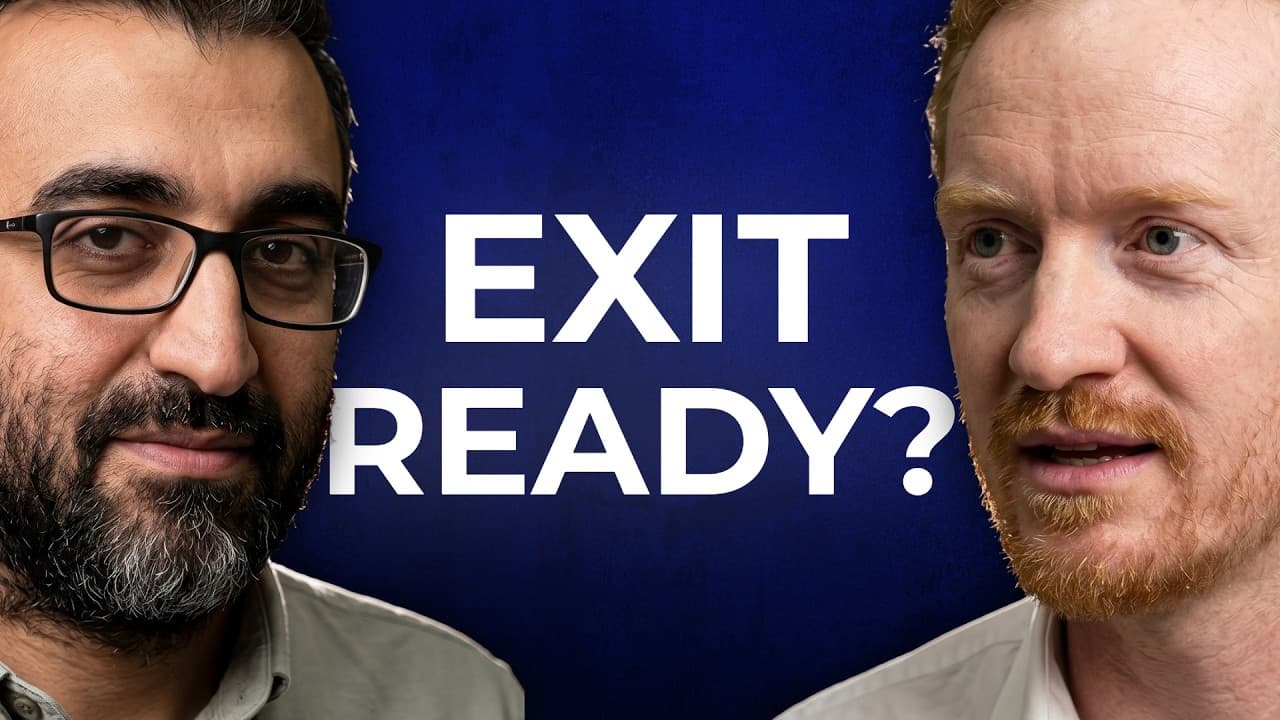
Buying A Business: What Every Seller Gets Wrong | Saul Cohen
Video from James Lamb.
Generated from the canonical interview transcript and validated against source data by Guests on Air.
What do buyers check in due diligence before buying a small business?
Buyers mainly want to know whether the cash a business generates today will still be there in the year after they buy it. Saul Cohen says they test that through the accounts, which show whether the owner's word can be trusted, and then through the pipeline and the leadership that will remain once the founder leaves.
Saul Cohen trained as a chartered accountant at PwC, where he worked in risk assurance before starting his own firm and moving fully into mergers and acquisitions. He says he lost count of the deals he has worked on after around 150, many of them for businesses with less than a million in EBITDA.
In a conversation with James Lamb, Cohen explained that the corporate diligence playbook he learned did not fit smaller companies. An initial request list of 150 line items was too much for a business with a part-time bookkeeper, so he rebuilt his approach from first principles around one question: what is the buyer actually buying, and what is the risk to it?
His answer shapes how he thinks about valuations, deal terms and exit planning. For owners who hope to sell one day, it is also a practical checklist. Buyers read the accounts, the pipeline and the leadership team as evidence of risk, and every piece of that evidence moves the multiple they are willing to pay.
Key takeaways
- Due diligence is mainly a test of trust: can the buyer rely on what the owner has told them?
- A lower profit figure usually leads to a renegotiation, while a breakdown in trust is what kills a deal.
- Buyers want to see how new customers arrive and whether the business keeps running when the founder steps away.
- Sellers who accept deferred payments or other flexible terms can often achieve a higher headline price for their business.
1. Why the accounts come first
Cohen says two fundamentals go hand in hand in any sale: the relationship between buyer and seller, and the accounts. He stresses that he is not favouring accounts because he is an accountant. The numbers matter because they show a buyer how far the seller's word can be trusted, and whether a claimed profit of two million is real.
In his view, due diligence is less about catching every error and more about confidence. His firm looks at last year's accounts, checks the history only for anomalies and asks whether the figures are reasonably accurate within a margin of error. Once that baseline is set, the work turns forward to the risk that cash generation will not continue.
The distinction matters when problems surface. If diligence shows a business earns 1.5 million rather than the two million claimed, Cohen treats that as a renegotiation of terms, not the end of the deal. What kills a sale is a loss of trust, such as slow replies to requests for accounts, which can make a private equity buyer walk away.

2. Pipeline and leadership come next
After the accounts, Cohen says pipeline and leadership are the next biggest factors. He does not expect six months of signed work, but he does expect an owner to explain the customer journey, the numbers at each stage of the funnel and what would happen if advertising spend went up. Consistency in that process lowers the buyer's risk.
His biggest concern when an owner leaves is that new client work dries up, or that the owner takes the clients or the way of working with them. Leadership is the other gap. Successful owners often believe the business runs without them, yet their know-how and presence hold the team together far more than they realise.
He recalls a business that looked excellent on paper until the buyer visited while the owner was away and saw the team at each other's throats all day. She decided not to buy. The more an owner can genuinely step back while the business keeps growing, Cohen says, the higher the valuation will be.
3. How size and deal terms shape the price
Cohen chose to specialise by company size rather than sector, because the buyers change at each step. Below a million in EBITDA he sees average multiples of three to four times profit. Around a million it moves to four to six, and near five million it sits between nine and twelve, because larger and more ambitious buyers become interested.
Within each band, the difference between four and six times is not a rounding error. Cohen links it to what sits inside the business: the culture, the people and the depth of management. Terms matter too. An owner who wants more than a buyer will pay can often close the gap by accepting seller financing or payments contingent on future results.
Most small deals he has seen involve some deferred consideration, with about half paid up front on average and much of that funded by debt. His advice to owners is to find advisors who transact every day, understand their ideal buyer and prepare the accounts early, so that trust is established before a buyer asks for proof.