Leadership
How founders make their companies sellable before buyers arrive
Practical steps for founders to remove dependency, build systems, and prepare for a private equity exit.
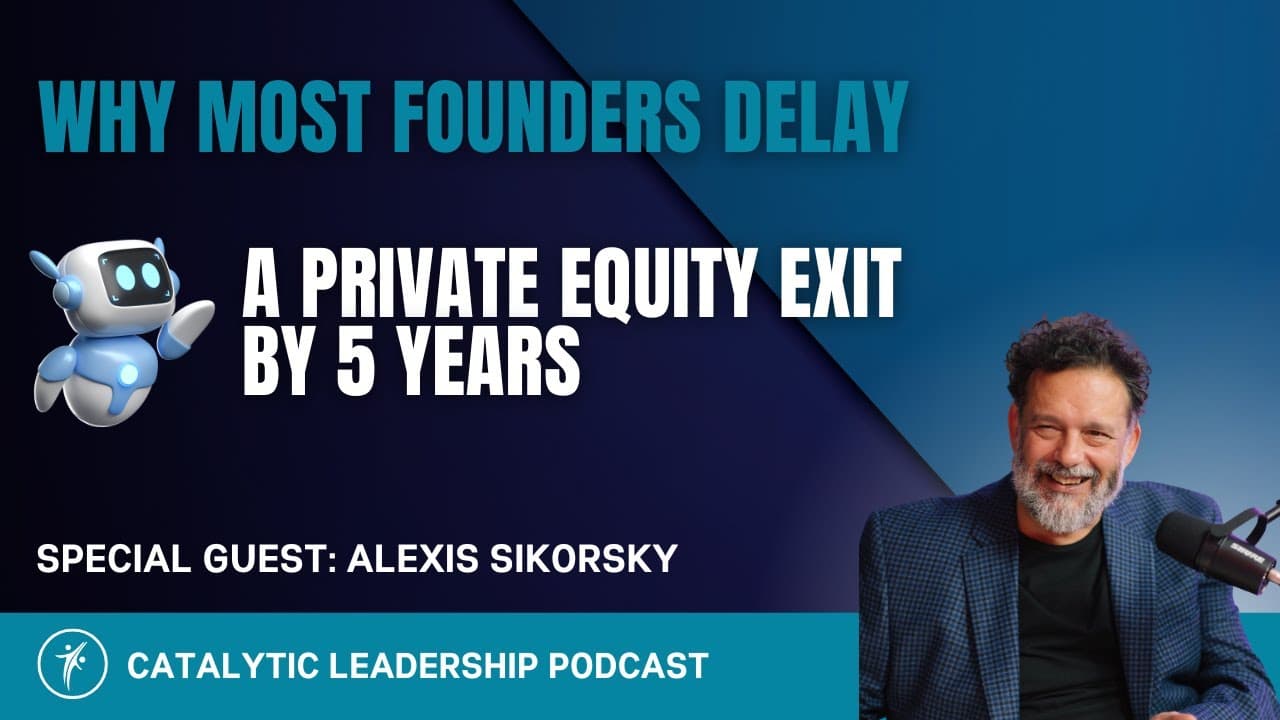
Why Most Founders Delay a Private Equity Exit by 5 Years
Video from Catalytic Leadership with Dr. William Attaway.
Generated from the canonical interview transcript and validated against source data by Guests on Air.
How can founders prepare their businesses for private equity exits before buyers appear?
Prepare early by removing founder dependency, documenting processes, and building repeatable metrics and cadence. Use the APeX steps—Assess, Plan, Execute, eXit—to prioritise operational fixes. Bring short-term senior operators to add C-suite thinking and prove improved KPIs so buyers see predictable growth and stronger negotiation leverage.
Many founders reach a point where day-to-day fire fighting keeps growth alive but prevents scale. Alexis Sikorsky calls this the Five Million Plateau and shows how founder dependency, informal processes, and missing metrics become the real constraints. In this interview, he outlines practical changes founders can make to test whether their company will survive if the founder steps away.
His experience includes a nine-figure private equity exit and a career built from mistakes, luck, and deliberate learning. Alexis argues exits are engineered long before a buyer appears by Assessing, Planning, Executing, and preparing for eXit, the APeX methodology. He cautions founders who wait for buyer interest because hidden weaknesses then determine valuations and negotiation leverage.
For founders doing five to twenty million in revenue, the key move is shifting from heroic leadership to repeatable systems and C-suite thinking before making expensive hires. Alexis describes interventions that bring senior operator expertise temporarily into founder-led businesses, fix reporting and accountability, and build the operational readiness that attracts better offers from private equity and speeds value creation.
Key takeaways
- Test whether the founder can disappear for ten days; absence reveals informal processes and decision gaps.
- Assess sellability long before a buyer arrives; plan operational fixes to strengthen valuation and negotiation leverage.
- Bring C-suite thinking early via short interventions to add capability without the full-time cost of senior hires.
- Track the right numbers frequently; founders must replace memory and instinct with reliable metrics and cadence.
1. Why founders stall at five million
Founders often reach a point where their personal energy runs the company and that single-person dependency prevents repeatable scale. Early advantages like rapid decision-making and personal relationships become liabilities when the business needs predictable processes, metrics and delegation. Alexis frames this as the Five Million Plateau because informal ways of working and insufficient reporting hide gaps until they cause growth to stall. That reality forces different leadership.
Start by testing whether the company can run without you for ten days. Alexis suggests this brutal thought experiment because absence exposes processes that depend on memory and loyalty rather than documented procedures. The test reveals where decision authority resides, which roles lack handovers, and which clients or contracts create concentration risk. Use the result to prioritise system fixes and role accountability. Addressing these items is far cheaper than recovering stalled growth later.
Practical fixes include documented decision trees, service level agreements, and a cadence of reporting that highlights leading indicators. Replace one-to-one tribal knowledge with simple dashboards and agreed escalation points for critical customer or vendor issues. When founders invest in these operational building blocks, the company becomes more attractive to buyers and much easier to scale without constant founder intervention. Those improvements also shorten due diligence and increase bargaining power. For a related perspective, read Turning Setbacks Into Exits: Alexis Sikorsky on planning a sellable business.
2. Engineering exits long before buyers appear
Alexis insists the best private equity exits are engineered as an ongoing operating discipline, not a last-minute scramble. The APeX framework—Assess, Plan, Execute and eXit—turns exit preparedness into a sequence of value-improvement steps that a founder can prioritise over multiple quarters. That means mapping EBITDA drivers, tightening margins, and building the narrative and proofs that a buyer will use to value the business. Buyers pay for predictable growth and visible leverage rather than heroic leadership.
A core insight from Alexis's story is how private equity contributes operational capability and network value that founders often undervalue. He recounts selling a majority stake and then working with a PE team that doubled revenue through CFO guidance, strategic acquisitions, and integration work. Founders should recognise that the buyer’s playbook often unlocks multiple revenue and margin levers faster than solo execution. Learning how to partner with those capabilities is critical to pre-exit planning.

For many founders the choice is whether to try to replicate buyer capabilities internally or to make the business attractive enough that a buyer brings them. Alexis recommends focused execution on the highest impact areas identified in the Plan phase and using short-term senior operator engagements to bridge capability gaps. This approach reduces risk while preserving founder control until exit timing feels right. That preserves negotiation strength and clarifies fixes that drive valuation. For a related perspective, read Cashing Out: Exit planning and scale lessons from Alexis Sikorsky.
3. Bringing C-suite thinking without full-time hires
Many founders doing five to twenty million in revenue cannot yet afford full-time C-suite hires but need C-suite thinking. Short senior engagements give targeted leadership, data discipline, and change programs that scale. Related reading: book called Cashing Out: The business owner’s guide to selling to private equity. Use these interventions to fix reporting, modelling and hiring decisions so the company gains the clarity buyers pay for.
Alexis explains that temporary senior operators, brought in for three-to-six-month interventions, can build the governance and forecasting cadence founders lack for the next growth step. These people set KPIs, test pricing and margin assumptions, and implement simple dashboards so leadership sees leading indicators. The goal is to buy time: raise capability, prove improved metrics, and then make permanent hires only when justified by clearer performance.
This approach mirrors Alexis's own path: he combined learning from mistakes with operational partnerships that multiplied results. Founders who accept short-term external leadership often avoid rebuilding later and increase exit optionality. Making those choices requires honest assessment, prioritisation of high-impact fixes, and the humility to trade perfect control for faster, measurable improvement that private equity and strategic buyers can value. Start with the highest returning interventions and document the gains to show prospective buyers progress. For a related perspective, read Preparing Your Company for a Private Equity Exit.
