Leadership
Georgina Woodley on Why Joy Belongs at the Boardroom Table
The insight strategist explains how stress on both sides of a customer interaction distorts experience scores, and why she built the Joyometer to measure joy instead.
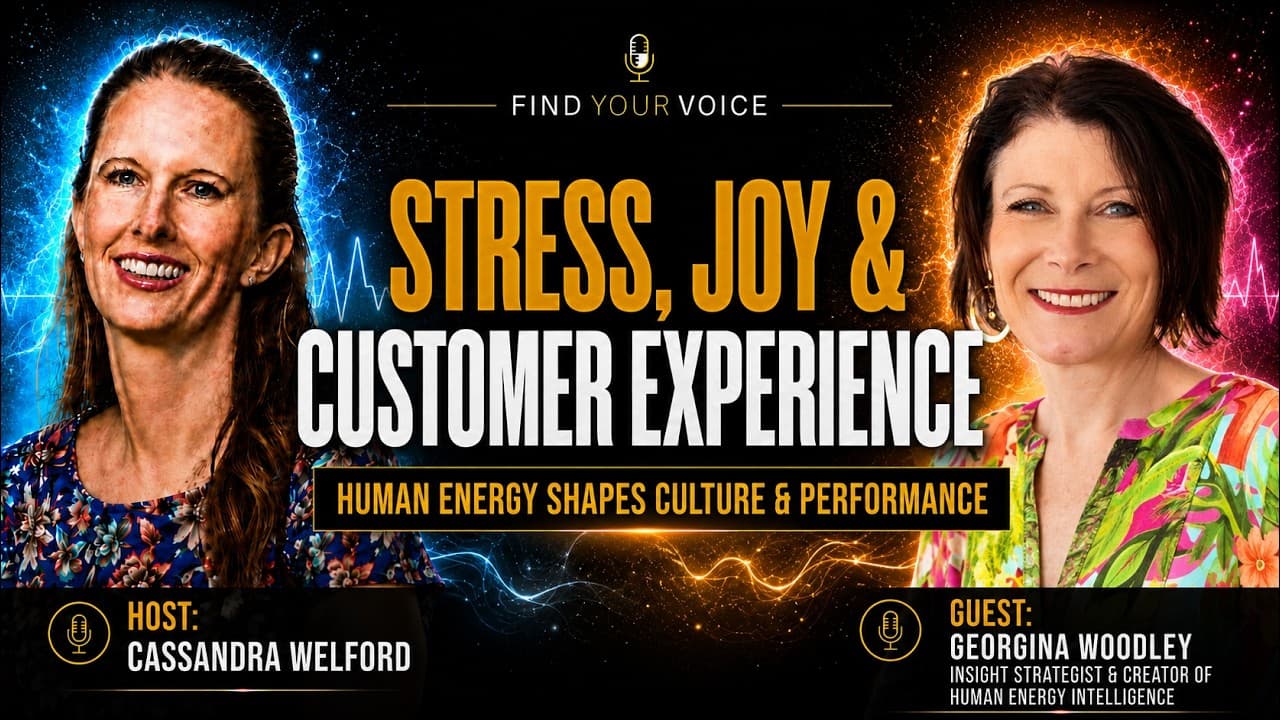
How Stress and Joy Shape Customer Experience | Georgina Woodley
Video from Podcast Guesting Pro.
Generated from the canonical interview transcript and validated against source data by Guests on Air.
How do stress and joy shape customer experience?
Stress narrows what people can give, and joy widens it. Georgina Woodley argues that staff and customers both carry their own state into every interaction, so stress spreads in both directions and lingers in experience scores for years. Her answer is to measure joy on both sides, including each person's internal state, so leaders can see where capacity is being drained.
Georgina Woodley is an insight strategist and the creator of human energy intelligence, with more than 20 years in market research and customer psychology. On Find Your Voice, the Podcast Guesting Pro interview series, she explained why she no longer treats customer experience and employee experience as separate problems, and why stress is the thread that joins them.
Her case begins with what she saw in the research itself. One client had grown so used to a customer score of four out of 10 that nobody thought about the people behind it. When she played recorded customer interviews to staff in an auditorium, the room went silent, and the numbers suddenly had voices.
From there, Woodley built the Joyometer, a measure that asks how joyful an experience was rather than whether people were satisfied or would recommend a brand. It covers staff and customers together, and it also measures each person's internal state of joy, because what people bring into the room shapes how they rate what happens there.
Key takeaways
- Every customer interaction runs two ways, and staff and customers each bring their own stress into it before a word is spoken.
- Strong experiences, good or bad, can stay in a person's brand scores for 10 years, distorting the signal leaders act on.
- The Joyometer measures joy with the brand and each person's internal state across 10 key areas, for staff and customers alike.
- Woodley treats joy as the opposite of stress and a signal of capacity, which turns a soft-sounding idea into a business case.
1. Stress travels in both directions
Woodley's view formed over several moments rather than one. Sitting in on a contact centre's calls, she watched a staff member take an angry customer, transfer the call to a colleague, and then spend five minutes chatting about the weekend while the customer waited on the line. It happened in front of an observer, which told her how routine it had become.
For her, that call showed a two-way street. The staff member and the customer both arrive with their own pressures, and then something happens between them. Customers go home and tell their families how badly they were treated, and staff who absorb angry calls all day go home and do the same, so the stress keeps spreading.
She argues that human capacity is heavily shaped by the level of stress a person carries. When something knocks people off guard, they spend time ruminating and carrying on about it, which quietly drains their energy. She also points to the strong links between stress and illness, which she believes most organisations are still not actively considering.
2. Why old experiences distort today's scores
In her research data, Woodley sees strong experiences carried forward for years. A particularly positive or negative moment can still be reflected in someone's scores for a brand two, five or even 10 years later. She sees it clearly on the customer side and expects the same pattern among staff, even though she does not yet have direct measures there.
That creates a problem for decision makers. Brands invest in fixing a mobile app, a branch or a call centre on the assumption that feedback reflects current issues, when part of it is emotional baggage from long ago. She calls this distortion in the signal, and it can still stop people taking up new products or push them to leave.
Internal state adds a second distortion. Two people can walk into the same place and come away with very different experiences and memories of it. A grumpy customer will rate a brand lower than a naturally joyful one, and a grudge purchaser of insurance tends to rate every insurer poorly, so an insurer can end up investing against feedback that was always going to be low.
3. Making the business case for joy
Woodley says joy is often rejected as a bit fluffy, so she frames it through the body. Under stress, the brain shuts down creativity and innovation and moves into survival mode. Joy is the opposite, bringing creativity and flow with it. That makes joy, in her words, a signal of capacity, and something leaders can measure rather than a slogan.
The costs of ignoring it are already on the books, even if businesses treat them as normal. She lists turnover, presenteeism, where people turn up but are not really there, and at the extreme end sick days and mental health days. Sustained stress floods the body with cortisol, and she says shaving even a little off that load helps performance and people alike.
Part of the gap is measurement. Net promoter and engagement scores are common, but few have global benchmarks, so she set up the Joyometer as a uniform set of questions that can be measured worldwide. An ex-colleague once told her there was no place for joy at the boardroom table, and she has made the opposite her mission.