Technology
Agent Memory Is More Than RAG
How enterprises should build memory, retrieval, and governance for production agents.
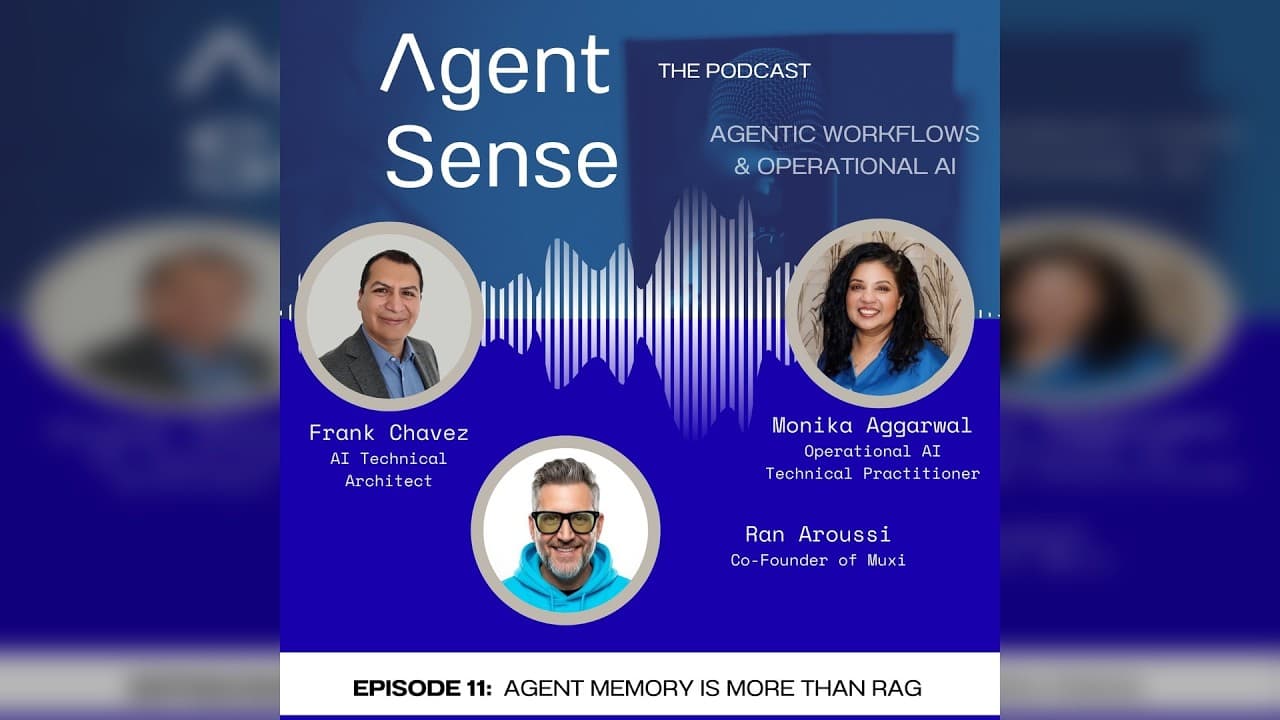
Video from Agent Sense.
Generated from the canonical interview transcript and validated against source data by Guests on Air.
How should enterprises design agent memory beyond RAG?
Enterprises should treat memory as layered knowledge: ingest raw signals, continuously distill into a captain's log, map relationships with a graph, enforce software gatekeepers for access, and optionally fine-tune an internal model so agents can reason over organizational context rather than relying on RAG alone.
Ran Aroussi, a systems builder of thirty years, joined Agent Sense to explain why agent memory requires more than simple RAG. He argues organizations must treat memory as knowledge, not as a dump of documents. This discussion outlines a multi-layered approach that includes ingestion, distillation, graphs, and access controls to make agents reliable at scale.
He names practical building blocks: an ingestion API that captures raw signals, a continuous distillation service, relationship graphs linking people and decisions, and hard software gates for privacy and roles. Ran emphasizes the captain’s log idea, a compact, traceable daily distillation that sits between raw files and the agent’s working memory so retrieval is precise and explainable.
From his thirty-year practice building unseen infrastructure, Ran warns pilots stall when teams assume a model solves memory. He recommends enterprises own retrieval, provenance, and governance, and to consider fine-tuning company-specific models for reasoning. When memory is modeled as layered knowledge with traceable links, agents stop asking repetitive questions and start offering trustworthy, auditable answers across teams.
Key takeaways
- Treat memory as knowledge, not a document dump; distill context into a compact, retrievable captain’s log.
- Build ingestion, distillation, and graph layers; retrieval over distilled summaries improves precision and reduces hallucination.
- Enforce hard software gates for role-based access and provenance; prompting alone cannot secure sensitive data.
- Consider company-tuned LLMs for internal reasoning; organizational models can embed context that retrieval alone misses.
1. Why RAG Alone Fails
RAG relies on chunked documents and semantic similarity, which often returns contextually similar but disconnected snippets. Ran explains that similarity search finds related words, not relationships or decision histories, so agents frequently hallucinate, repeat questions, or answer I don't know. For enterprise tasks that require personalization and decision traceability, RAG must sit behind a structured memory system built to distill, relate, and point back to sources.
The missing piece is distillation: condensing raw signals from email, Slack, calls, and files into a working summary the agent can reason over. Ran calls this the captain's log, a user-level daily distillation that records what happened and links to original items. By scanning smaller, distilled data the agent reduces noise, focuses on relevant decisions, and produces consistent responses tied to verifiable evidence. This creates an auditable trail for later review.
Distillation alone still needs relationship structure. Ran emphasizes a graph or tree connecting people, roles, decisions, and related documents so agents can trace context across time. Without that graph, retrieval returns similar passages but cannot answer who decided what or why. For critical enterprise uses, the memory must include provenance pointers that let humans verify how an agent reached an answer before action is taken. For a related perspective, read Multi‑Monitoring Agents: The New Dev Skill.
2. Designing a Working Memory System
A practical architecture starts with ingestion: a dump that collects raw data from every source without transformation, from emails to call transcripts. Ran describes an ingestion API feeding a raw, append-only store so nothing is lost. On top sits a distillation engine that continuously summarizes and labels new material while building the relationship graph. This layered pipeline separates collection from reasoning and enables scalable updates.
Access control and governance are not optional decorative layers; they must be enforced in software. Ran warns that prompts cannot be relied on to withhold sensitive figures because an agent might be tricked. Instead, hard gatekeepers sit between data and any agent or human requester and enforce role-based access, ensuring that salespeople see trends but not raw financials. This model prevents accidental leakage and preserves auditability.
Operationally, tracking provenance matters for compliance and debugging. Every distilled entry should link back to its source chat, file, or record, and the system must record who approved any edits. Ran's acropolis metaphor distinguishes the parthenon that holds raw data from the agents that act on distilled knowledge. With recorded provenance, teams can audit decisions and untangle failures quickly. This reduces mean-time-to-resolution and builds trust across departments.
3. Operational Patterns and Related Reading
As related reading, consider the book called Company-Scale Agentic Al: The operator's guide to a company that runs on intelligence for operators planning a company-wide approach. The book presents an operator's playbook for visibility, judgment placement, and building a company that learns. While the interview does not reference the book, its themes align: treat memory as an asset, engineer retrieval, and prove impact before scaling across the organization.
Practically, teams should instrument their agent layer with observability, test suites, and declarative configs so behavior is inspectable. Ran's earlier work on production-grade layers shows why ownership of pipes matters: without clear ownership, memory and orchestration fragment. Invest in a single source of truth for memory and a team that maintains distillation rules, provenance links, and the access policies tied to corporate roles and monitors usage metrics continuously.
Finally, consider owning a tuned internal LLM for reasoning and to reduce repeated retrieval load. Ran suggests large organizations can justify the cost of a fine-tuned model to embed company knowledge. Combined with distilled captain's logs and graph relations, a company-tuned LLM supports agents that reason over organizational context and helps shift pilots into durable, audited production of real business value. That combination also reduces repetitive questions and improves trust.