Leadership
Why Transformations Fail When Organisations Lose Control
Scott Ayscough argues that most large technology programmes stall because the environment around capable people breaks down, not because the technology or the team is wrong.
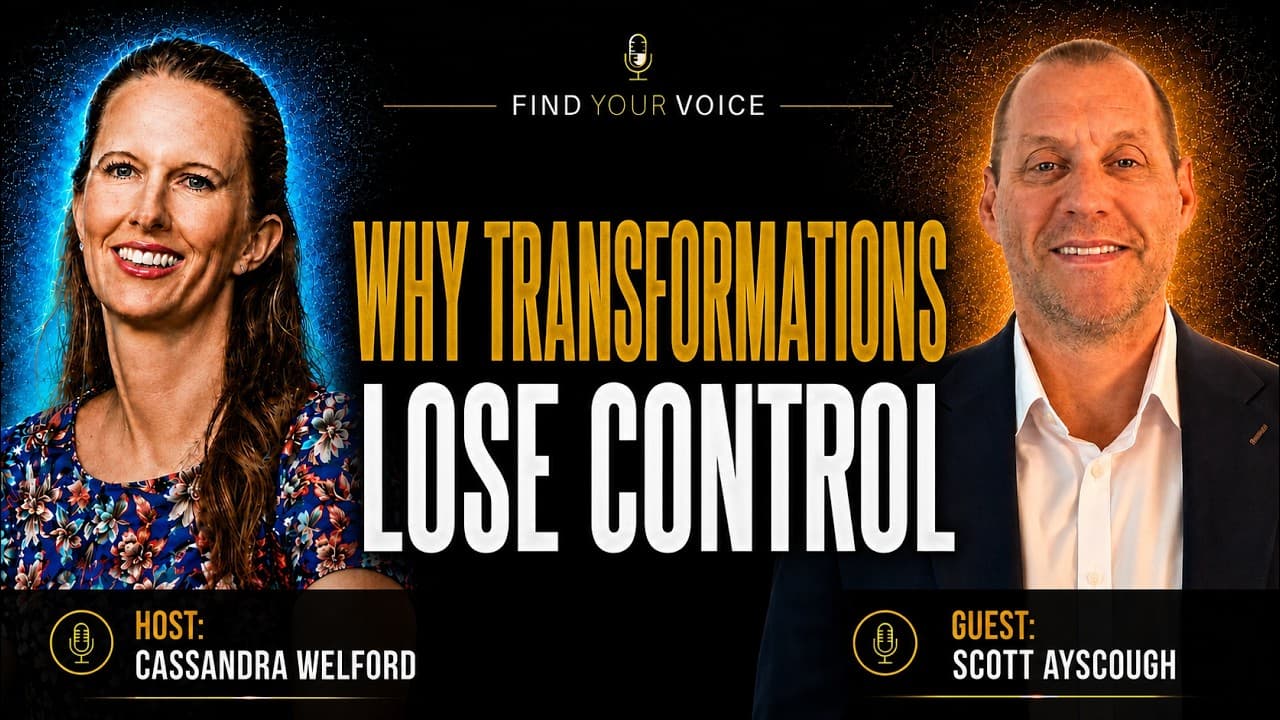
Why Technology Transformations Lose Control | Scott Ayscough
Video from Podcast Guesting Pro.
Generated from the canonical interview transcript and validated against source data by Guests on Air.
Why do technology transformations fail when the people and technology are capable?
They fail because the organisation loses control of the environment around the work. Governance becomes unclear, accountability fragments, stakeholders drift out of alignment and decisions stall. Scott Ayscough found that when those conditions were restored, the same people using the same technology often started delivering very different results, without replacing either of them.
When a major technology programme starts to slip, the usual response is to question the platform, the supplier or the team. Scott Ayscough, founder and managing director of the UK consultancy Valuecom, has spent more than two decades recovering programmes like these, and he says the first diagnosis is usually wrong.
In his experience of recovery work, he rarely changed the technology and rarely changed the people. The technology was often capable of delivering the outcomes, and the people were usually hard working and knowledgeable. What he changed was the environment they were operating in, because that was where control had been lost.
His view was shaped early. Four years in the Royal Signals at NATO headquarters in Germany taught him that live operations depend on clear process, strong governance and a shared sense of purpose. Those same conditions, he argues, decide whether an enterprise transformation succeeds or quietly drifts. In this interview he explains how that belief grew, and what leaders can do about it.
Key takeaways
- Most transformations do not fail because of technology; they fail because the organisation loses control.
- Delivery problems are often symptoms, while the root cause sits in governance, accountability and alignment.
- Capable people struggle in badly designed environments, so fix the conditions before replacing leaders.
- Start any recovery with political alignment and anchor the programme vision to the company strategy.
1. Control, not technology, is the real failure point
Scott describes a pattern he saw repeatedly in struggling programmes. Governance was unclear, accountability was fragmented, stakeholders were not aligned, and decisions were made too slowly or not at all. None of those problems sat in the code or the infrastructure, yet together they could stop a well funded programme from delivering anything useful.
Over time he noticed that delivery problems were being treated as the cause when they were really symptoms. Teams chased missed milestones and failed releases while the root cause sat elsewhere. That is why he says most transformations do not fail because of technology. They fail because organisations lose control of the environment the work depends on.
The encouraging part is what happens once control returns. When governance, accountability, visibility and alignment were restored, the same people with the same technology often began delivering very different results. For leaders facing a failing programme, that suggests looking at the system around the work before paying for a new platform or a new team. A new supplier inherits the same broken environment.
2. Why good people struggle in badly designed systems
Most people Scott meets in transformation programmes are experienced professionals who understand their specialist area and want the programme to succeed. The problem is rarely capability. It is uncertainty. When people lack a clear vision, cannot tell who owns decisions, or face shifting priorities and inconsistent governance, their performance deteriorates. That is a design problem rather than a people problem.

He contrasts high performing teams with struggling ones. Strong teams understand the mission, their own role and how decisions are made, and they trust the governance around them because it gives certainty under pressure. In struggling teams, people spend more time working out what is happening than moving the work forward.
His military service showed him that people from all walks of life can perform exceptionally well when given clear structure, accountability, training and purpose. The same principle applies in business. Good systems create clarity, clarity creates confidence, and confidence enables performance. Before replacing leaders, he suggests asking whether the right conditions exist.
3. The PET framework and where recovery begins
Scott built the PET Transformation Framework from patterns he saw across many recoveries, regardless of sector, technology or supplier. Successful transformations consistently showed four traits: strong political alignment with key stakeholders, clear governance and authority, effective commercial structures for suppliers, and robust architecture, where designs were known in advance and held to. Each domain is about the environment, not the tools.
He also wrote Politically Exposed Technology: How CIOs Restore Control Under Executive Scrutiny, which he describes as a personal effort to understand why he could recover programmes that large consultancies had struggled with. Large programmes can involve dozens of senior stakeholders, a big delivery team, other consultancies and many suppliers, which makes keeping everyone aligned very complicated. The book brings those threads together around the four domains.
For leaders running a transformation today, his first step is political alignment. Understand the stakeholders, what the business is trying to achieve and what outcomes and benefits the programme should deliver. Then anchor that vision to company strategy, so when tough questions arrive and senior people must make costly decisions, the programme has a clear reason to exist.