Retirement
Retire to Something: Why Purpose Matters as Much as Money
Chris Maduri says a sound retirement plan covers the money, the marriage, care and health, and gives you a reason to get out of bed.
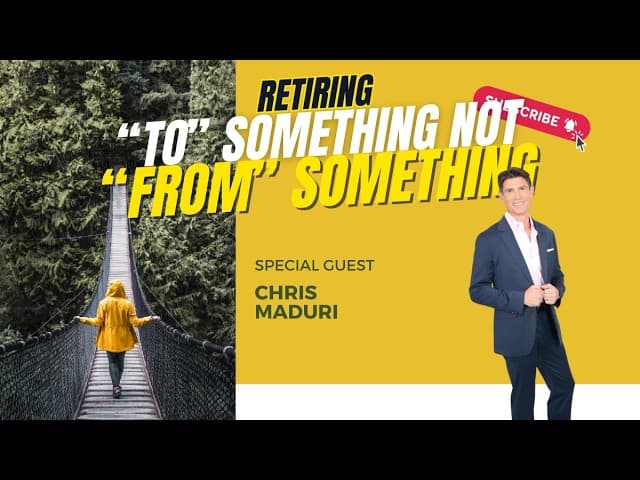
Retiring TO Something and not FROM something
Video from DebiRoncaOfficial.
Generated from the canonical interview transcript and validated against source data by Guests on Air.
How do you plan a retirement that has purpose as well as money?
Plan the way down as carefully as the climb. Protect income in the five years either side of retirement, then decide what you are retiring to: people, service and some daily structure. Couples should talk openly about time, money and care before work ends, and a healthy lifestyle protects both wellbeing and savings.
Most people spend decades preparing to reach retirement and very little time preparing to live in it. Chris Maduri, who has spent nearly two decades in retirement and investment planning, told the Transition Bridge podcast that people need to retire to something, not just from something.
His argument starts with money but does not end there. Work gives people an identity, a structure and a sense that they matter. When it stops and nothing replaces it, he says, people can struggle psychologically and emotionally, much as parents do when their children leave home.
The conversation covered what couples face when they suddenly share every hour, why long-term care is the biggest unknown in most plans, and why health is a financial asset as much as a personal one. The common thread is simple: plan for the life you want, not only for the income.
Key takeaways
- Plan the descent as carefully as the climb, because every risk changes once you start spending your savings.
- Decide what you are retiring to, and test volunteering or mentoring before your last day at work.
- Couples should agree how they will spend their time and money in the five years before retirement.
- Long-term care and personal health are the two issues most likely to change a retirement plan.
1. Plan the descent, not only the summit
Chris Maduri compares retirement to climbing a mountain. People prepare hard for the ascent and picture themselves on the summit, but few plan the way down, and he points out that more climbers die on the descent than on the way up. Retirement works the same way: once savings are being spent rather than built, every risk changes.
The timing of a market fall matters more than most people expect. He says a significant correction in the first five years of retirement can raise the chance of running out of money by up to 40 percent, because assets sold while prices are down cannot grow back. His own parents retired in 2008, and he counts them fortunate to have had a pension.
That is why he focuses on what he calls the retirement red zone, the five years before retirement and the first five years after it. The aim is to know exactly where income will come from and to protect it from market swings, so essential spending runs on autopilot while other assets have time to recover.
2. Retire to something, not from something
For Maduri, a good outcome is not just having enough money to last. It is enjoying the years that money pays for. Careers give people much of their identity and a feeling that they matter, and when that disappears without a replacement, the result can look a lot like empty nest syndrome, where people suddenly feel they are no longer needed.

He does not hand clients a list of hobbies. Instead he asks what lights them up, and he suggests taking a pause, finding some stillness and asking how you would spend your time if you had all of it. He also encourages people to try things before they retire, such as volunteering for a day or mentoring someone, and to change course freely if it does not fit.
Some structure matters too. Without a reason to get up, people who are older or unwell can slide into isolation and even mild depression, with days that all look the same. Social isolation is one of the risks he watches most closely, and he notes that men are often less practised at building community once colleagues are gone.
3. Talk as a couple about time, care and health
Retirement removes the buffer that work gave a marriage. Some couples have always done everything together, while others built separate identities. Either way, he says, partners need outlets and goals of their own, or daily life can quickly feel like Groundhog Day. He recommends open conversations in the five years before retirement, so one partner's dream of travel does not collide with the other's wish to stay home.
Care is the hardest question. If one spouse becomes the other's caregiver, resentment can build, especially when money is tight. A protracted long-term care event can cost around $200,000 a year depending on where people live, and he says the earlier families look at options such as hybrid long-term care policies, ideally in their 50s or early 60s, the more leverage they get.
Health ties it all together. Maduri describes health as wealth in both senses: it shapes how you feel each day, and it protects savings from being spent on repairing years of stress. As a father who had his last child at almost 40, he wants to stay well so his children are not caring for him while raising young families of their own.