Business exits
Mark Mills on Finding the Buyer Who Pays for Fit, Not the Multiple
The business sale advisor explains why strategic buyers pay premiums, where founders can find them, and why the pitch should sell the market rather than the product.
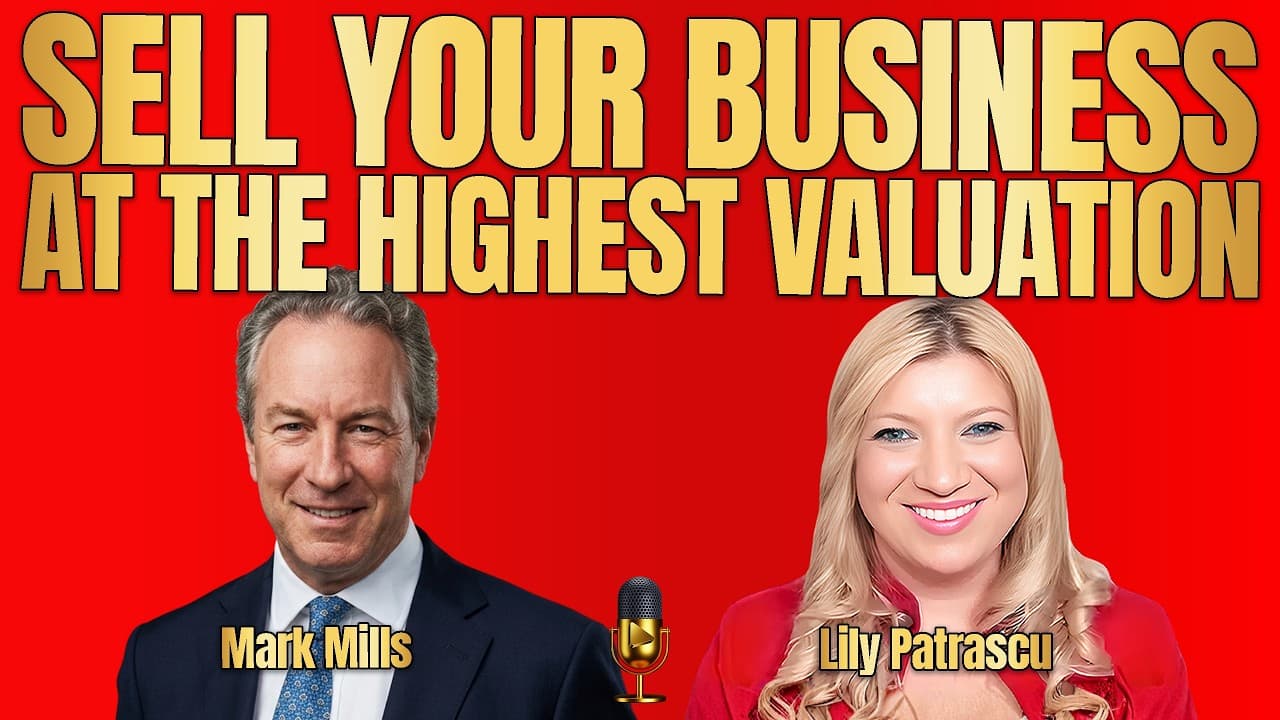
Sell Your Business At The Highest Valuation - Mark Mills and Lily Patrascu
Video from Lily.Global.
Generated from the canonical interview transcript and validated against source data by Guests on Air.
How can founders find a strategic buyer who will pay more than the usual multiple?
Mark Mills says founders get the highest price by selling to a strategic buyer in an aligned market rather than to a competitor, supplier or customer. That buyer cares more about fit and cross-selling than the multiple. Founders can find such buyers in listed companies' strategy documents and through private equity houses, then win them with a pitch about customers and market size.
Mark Mills has built and sold five businesses, most notably Cardpoint, the cash machine company he exited at a £175 million valuation. He now works as a business sale advisor to UK founders. Talking with Lily Patrascu, he argued that the highest price rarely comes from the obvious buyer, and that most owners look for buyers in the wrong places.
His starting point is the multiple. A business making £3 million a year might expect around eight times profit, roughly £24 million, give or take. Mills treats that figure as a floor. A strategically positioned business that is growing fast and owns its place in its market can command a much higher multiple, because the buyer is paying for what the business unlocks.
The rest of his advice follows from that idea. Choose the right kind of buyer, become the kind of company that buyers compete for, then tell the story in a way that makes a room full of acquirers want the deal. None of it is complicated, he says, but each step takes work that most owners never get round to doing.
Key takeaways
- Sell to a strategic buyer in an aligned market rather than to a competitor, supplier or customer of the business.
- A buyer who would spend more competing for your customers than buying you will pay a strategic price.
- Consistent, profitable customer acquisition turns a business into a sales machine, and sales machines attract competing buyers.
- Listed companies' strategy documents and private equity portfolios show founders which buyers already want a business like theirs.
1. Why the strategic buyer pays more
Mills does not like selling to competitors, suppliers or customers. In his experience they make the seller reveal too much, and they never pay the price. A strategic buyer with an aligned interest behaves differently. The financials still matter to that buyer, but the deciding questions are whether the business fits and whether the buyer can cross-sell between its existing operation and the new one.

He gave an example from a sale a few years ago. The buyer already owned businesses in the north and in the south of the country, and the company Mills was selling operated right in the middle. It had been valued at £3 million and later at £2.5 million. Mills worked out what it would cost the buyer to set up a rival operation and win those customers itself.
That figure was £10 million, so he went to the buyer with a £10 million price tag, and the buyer paid just over £10 million. In return it gained full national coverage, best practice and a customer base to cross-sell into. Strategic positioning coupled with fast growth, Mills says, is what big buyers look for, and they pay healthy premiums to get it.
2. Becoming a business that buyers compete for
Asked how a business becomes irresistible to buyers, Mills gave one answer: be a sales machine. Buyers gather around a team that brings in new business profitably, in the right model, month in and month out. Big companies rarely have that mentality. They grow incrementally because they are low risk, which he compares to turning an ocean liner, while a smaller firm can be the speedboat.
When a buyer can see that engine working, the price becomes academic. Mills described the buyer's reasoning: a business making £3 million now may be making six or nine within two years, so paying 15 times today still looks clever later. He says he has read buyers' own statements, years after a deal, celebrating the price they paid once the business had tripled in size.
Simplicity adds to the premium. Spare buildings, spare vehicles and side ventures put buyers off, because nobody wants a clean-up operation after the deal. The same goes for unsigned agreements, stale pricing, undocumented premises and open disputes. Mills advises owners to run the business as if someone will one day examine it closely, because a tidy business gives the buyer certainty and the seller a higher price.
3. Finding buyers and pitching the business
His main research tool is the public markets. Companies listed in London or on the NASDAQ publish annual reports and strategy documents, and many state openly what kind of business they plan to buy, in which countries and at what size. Mills looks beyond direct competitors to companies that supply or serve the same industry, because those documents hand founders a ready list of likely buyers.
Private equity is the second source. Once a house has backed a management team, it likes to make follow-on investments, because that is easier than starting a new deal from scratch. Mills goes round the private equity houses himself, and he suggests founders use the British Venture Capital Association listings to find investors by sector and start those conversations well before they plan to sell.
The last step is the presentation. Mills says most pitches open with the team, the financials and the market, and buyers switch off within 30 or 40 seconds. He builds the story around what the product does for customers, why they keep buying and how much of the market is still to win. Done well, every buyer leaves the room wanting the business, and the talk moves from price to who gets it.