Investing
Follow the Evidence, Not a Prophet: Theodore Hicks on Faith and Investing
A financial planner shaped by two market crashes explains how his Christian faith taught him to test every investing rule, and why protecting wealth must come before chasing growth.
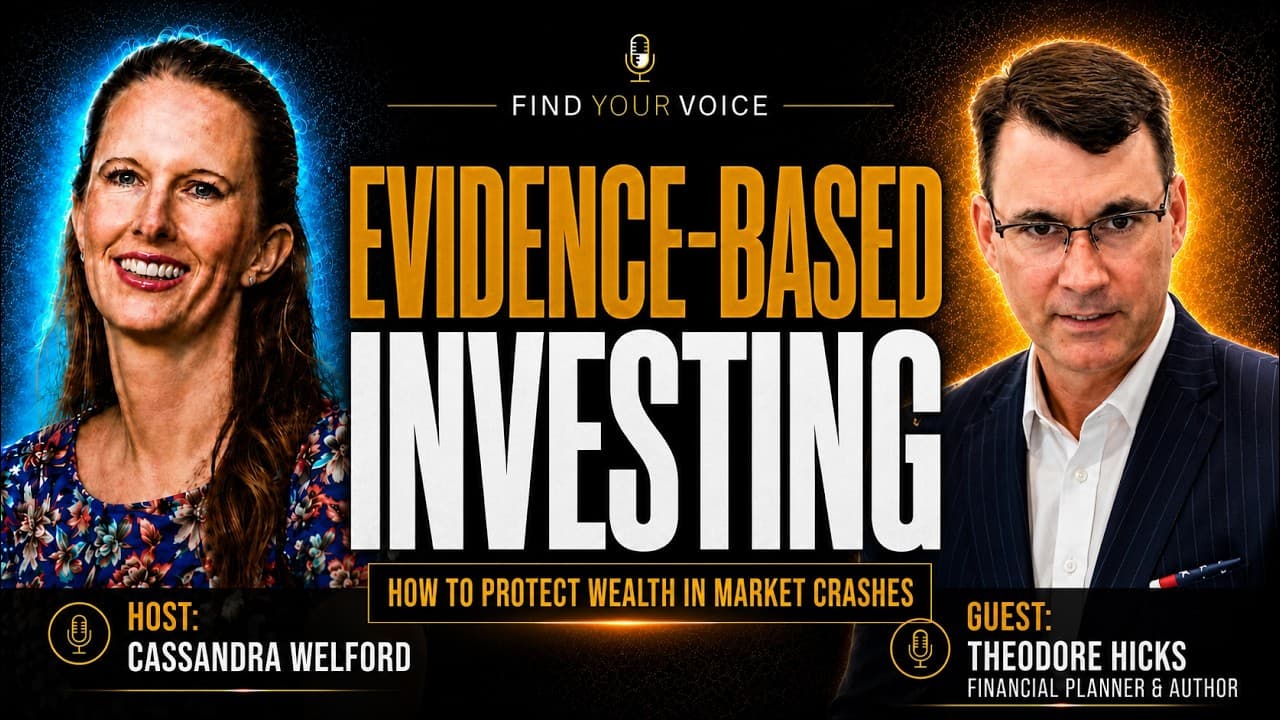
Evidence-Based Investing: How to Protect Your Wealth During Market Crashes | Theodore Hicks
Video from Podcast Guesting Pro.
Generated from the canonical interview transcript and validated against source data by Guests on Air.
Why should investors question conventional financial wisdom?
Theodore Hicks argues that conventional rules, such as trusting diversification to soften every crisis, failed when markets fell together in 2008 and again in 2022. Investors should test advice against the evidence instead of accepting it from experts, put guardrails around the wealth they have already built, and only then pursue growth, because nobody knows when the next crisis will come.
Theodore Hicks joined the financial planning industry straight out of college in February 1999, about 13 months before the dot-com crash ended the great bull run of the 1990s. Colleagues at the large planning firm he had joined told him it was a once-in-a-career crisis, and that it was good to get it over with early. A few years later the global financial crisis arrived with the same reassurance.
Speaking with Cassie Welford on Find Your Voice, the Podcast Guesting Pro interview show, Hicks traced how those two crashes changed the way he thinks about risk. Diversification, the principle he had been taught would soften the damage in a crisis, failed when nearly every asset fell at once. The experience pushed him to question the conventional wisdom preached by Wall Street and academia.
That questioning has a deeper root. Hicks is a Christian, and his faith gives him a habit of testing what he is told against the evidence before accepting it. The result is an approach to wealth he sums up as guardrails first and growth second, and a short, approachable book written to give ordinary investors permission to ask harder questions of their advisers.
Key takeaways
- Diversification can fail in a severe bear market, because correlations rise and nearly every asset falls together.
- Testing advice against the evidence, rather than deferring to experts, is a habit Hicks draws from his Christian faith.
- Protecting accumulated wealth comes first and growth second, especially for savers in their fifties and sixties.
- Students and young professionals should keep learning and questioning long after they leave college or university.
1. Two crashes that rewrote the rulebook
When Hicks started out, he took the reassurance at face value. He was young enough to believe that a once-in-a-career crisis at the very start of a career was a stroke of luck, so he carried on. The practice recovered and grew again, and he bought his wife a new minivan and a bigger house for a growing family. Then the global financial crisis hit, bringing the same promise that it would not happen again.
The deeper lesson was about diversification. Modern portfolio theory teaches investors to combine assets with low correlation, so that one holds up when another falls. Hicks explains correlation with his suit: the jacket and trousers match perfectly, while polka-dot trousers and a striped jacket do not. In theory the mismatched portfolio protects you. In the global financial crisis, nearly everything went down together, and that protection never arrived.
As the industry saying goes, the only thing that goes up in a bear market is correlation. Hicks saw the pattern again in 2022, when stocks and bonds fell at the same time. Those episodes convinced him that a plan built only for normal markets can fail exactly when it matters most, and that the textbook answer deserved to be tested rather than simply repeated to clients.
2. Faith that tests what it is taught
Hicks connects his habit of questioning directly to his faith. One of his favourite Bible verses is Acts 17:11, which describes the believers in Berea as more noble than the Thessalonians because they searched the scriptures daily to check whether what Paul taught was true. For Hicks, the lesson is that questioning a teacher is not disrespect. It is a noble habit that a good student, and a good citizen, should keep.
He worries that too many people graduate from college or university and then stop learning. A wise person, in his view, keeps asking whether what they have been taught actually makes sense. The message reaches students as well: a professor in Ohio uses his book in university classrooms, and Hicks wants young professionals to look harder at how they manage other people's wealth.
Hicks applies the same standard to his own writing. In Evidence-Based Investing: To Invest Well Over a Long-Term, Sometimes You Have to First Survive the Short-Term, he tells readers not to take his words as gospel truth and to test them instead. Asked for the most important lesson from challenging accepted thinking, Hicks pointed to being true to himself and following his conscience, describing it as how God wired him to question authority.
3. Guardrails before growth
Most people in the industry tell clients to buy, hold and ride out volatility. Hicks accepts that this works in theory, but nobody knows when the next crisis will come or how long it will last. History offers long stretches when markets went sideways or fell, and he points to heavy national debt as a risk that could bite at some unknown point, so investors sometimes have to survive the short term first.
His answer is a simple phrase: guardrails and growth, in that order. Most of the clients who come to Hicks are in their fifties or sixties, with savings that have to last the rest of their lives. He wants to put a guardrail around the wealth they have already built before chasing returns. Sometimes that means giving up the highest possible rate of return, a trade he is comfortable making for his clients.
The same thinking shapes how he raises his children. His son, a soccer goalkeeper now on his fourth or fifth coach, will hear advice that contradicts earlier coaches, including advice from his own father. Hicks hopes he learns when not to listen. In investing, Hicks says the principle is identical: listen carefully to the experts, but follow the evidence, not a prophet.