Investing
Drive to the Conditions: Theodore Hicks on Protecting a Nest Egg in Retirement
Wealth manager Theodore Hicks argues that retirees do not need a new appetite for risk, they need a process that changes how much risk they carry as markets change.
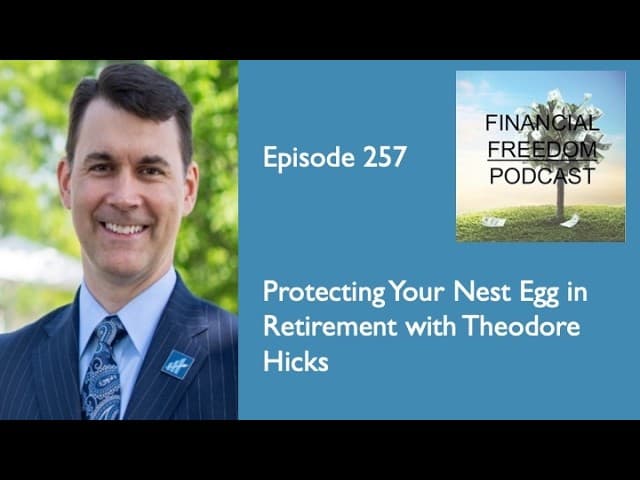
Episode 257: Protecting Your Nest Egg in Retirement with Theodore Hicks
Video from Richardson Law Offices.
Generated from the canonical interview transcript and validated against source data by Guests on Air.
How should retirees protect their nest egg when markets turn?
Retirees should stop treating buy and hold as set and forget. Theodore Hicks says the market does not care when someone retires, so a portfolio needs a defensive process: hold growth assets while the trend is up, step back to cash when it turns, and stop assuming bonds or broad diversification are automatically safe.
Most savers hear the same advice for decades: stay the course, ride out the dips and trust the long term. That advice gets harder to live with once the paychecks stop and the portfolio has to pay the bills. A bad market in the first years of retirement can do damage there is no longer time to wait out.
Theodore Hicks, founder and chief investment officer of Hicks & Associates Wealth Management, has spent almost 30 years helping clients answer that question. He started his career in 1999, just in time for the dot-com crash and then the 2008 financial crisis, and those two bear markets shaped how he manages money for people at or near retirement.
In a conversation on the Richardson Law Offices podcast, Hicks explained why he thinks a retiree's risk tolerance is the wrong thing to focus on, why bonds are not automatically safe any more, and how a defensive, rules-based process can let people retire on schedule and stay calm when the market turns against them.
Key takeaways
- The market does not care when you retire, so a retirement portfolio needs a defensive plan as well as a cash reserve.
- Hicks says risk tolerance rarely changes in retirement; what should change is how much risk you carry in current conditions.
- Bonds are not automatically safe. In a rising rate environment their prices fall, and 2022 saw stocks and bonds drop together.
- Buy and hold works best with a twist: stay invested while the trend is up and be willing to step aside when it turns.
1. Change the exposure, not the appetite
The usual line is that people should take less risk as they age. Hicks disagrees with the framing. He argues that a retiree's tolerance for risk does not necessarily change at all. What may need to change is their exposure to risk, and that depends on what the market is doing at the time rather than on a birthday or a retirement date.

He explains it with his own cars. He used to drive a BMW 550 and would take a long, banked entrance ramp near his home at speed, but only in the right conditions. He would never take the same curve that way in his Dodge Ram, in the rain or with a headlight out. Most drivers, he says, already adjust to the conditions without thinking about it.
His question is why investors do not do the same with their portfolios. Retirement might even be a good time to press the accelerator, he says, as long as conditions allow it. The problem is that most retail money management has no process for measuring the prevailing risk, so it cannot tell when to push and when to ease off the throttle.
2. Why bonds and diversification are not automatic safety
Many retirees assume bonds are the safe part of their portfolio. Hicks uses the image of a teeter totter, a graphic he includes in his book, to show why that can fail. Bond prices sit on one end and interest rates on the other. When rates go up, bond prices go down, and he believes the long era of falling rates since the 1980s is over.
Most people now near retirement built their wealth during that bull market for bonds, so they expect bonds to behave the way they always have. Hicks points to 2022, when most of the stock market fell and the bond market fell too. Investors who thought owning both made them safe found out otherwise, and in a bear market, he says, correlations tend to go to one.
He also warns that a well known company and a good investment are not the same thing. He noted that utilities, a sector usually seen as safe, were negative for the year alongside bonds when he posted about it. His wider point, and the reason he wrote his book, is that investors should learn enough to question the labels rather than simply trust them.
3. A defensive process for the years after the paycheck
Hicks describes his firm's answer as being diversified by strategy rather than only by asset. Most clients have exposure to four equity strategies, because he does not believe any single strategy works all the time. Two are rules-based quant models that buy when set conditions are true and sit in cash when they are not. The others follow trends, aiming to cut losses short and let profits run.
Taxes are part of the plan too, though he does not like letting the tax tail wag the investment dog. For large positions with big gains, he prefers trimming on the way up, so a client is not forced to sell everything and pay a large tax bill in the middle of a crisis. Every choice, he says, is about how much pain you accept and when you accept it.
His closing advice is the lesson his late father gave him: never stop learning. Hicks wants retirees to read enough to ask their advisers good questions, and he cites Acts 17:11, about the Bereans checking what they were taught, as the principle. Listen to your planner, your attorney and the news, he says, but question them too, before a crisis forces the issue.