Rebuilding After Abuse
Anne Paphitis on Choosing Joy While Rebuilding After Coercive Control
Life coach Anne Paphitis explains how a mental container, small daily rituals and a return to creative classes kept joy alive during a narcissistic marriage and its long fallout.
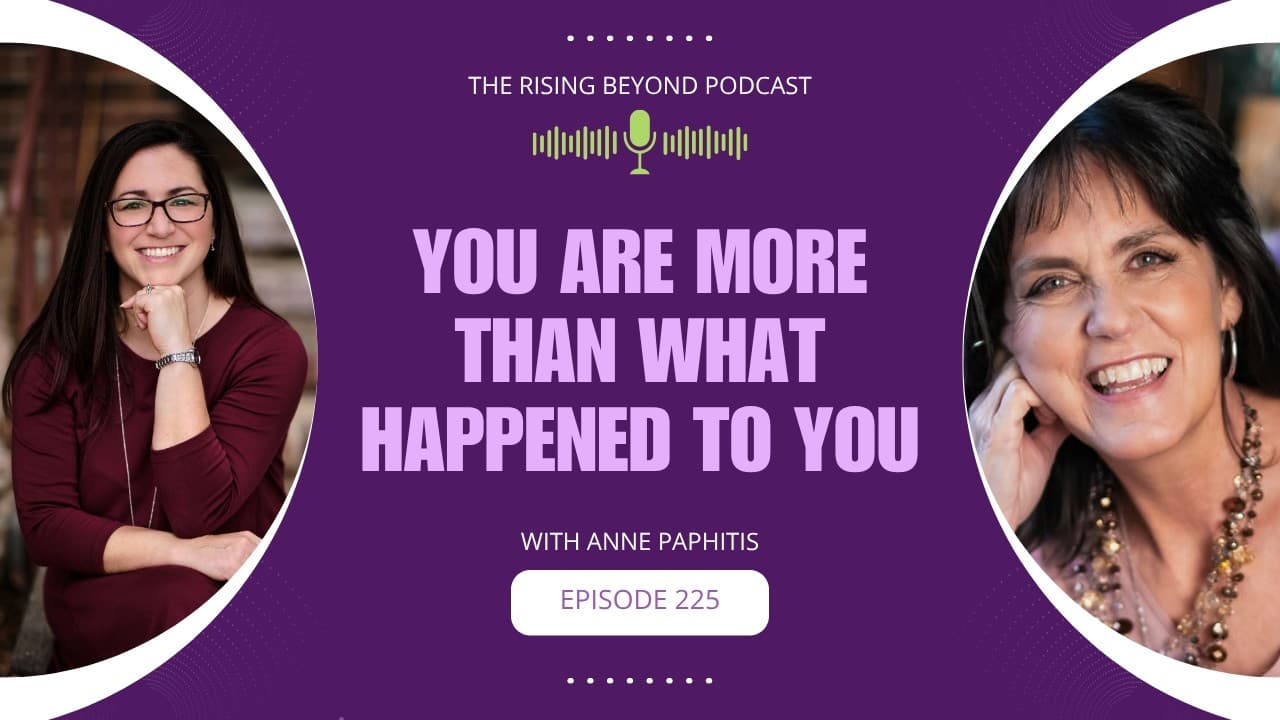
You Are More Than What Happened to You
Video from Rising Beyond Power and Control.
Generated from the canonical interview transcript and validated against source data by Guests on Air.
How can you find joy while still dealing with coercive control?
Anne Paphitis says joy can be chosen even while abuse or its fallout continues. She set hard moments aside in a mental cupboard, gave full attention to good moments, turned her grandmother's glass and her best china into daily rituals, and went back to art and drama. Those choices rebuilt her piece by piece.
Anne Paphitis spent many years in a toxic, narcissistic marriage before she left and rebuilt her life, first in South Africa and now in Cork, Ireland. On The Rising Beyond Podcast she talked about something many survivors are told is impossible: finding real moments of joy while the abuse, or its fallout after separation, is still going on.
Her answer is not that the pain goes away. She describes a set of deliberate choices that kept most of her life full of colour while one part stayed hollow. Friends later asked how she came through looking unscathed, and those questions made her realise that what felt normal to her was a method other people could use too.
Today she works as a life coach, not a therapist, and she leans heavily on creativity as a tool for rebuilding. This article sets out the approach she shared: a mental container for what cannot be fixed yet, small rituals that raise the value of good moments, and a patient return to the activities she loves for their own sake.
Key takeaways
- Joy can be chosen on purpose, even while coercive control or abuse after separation is still going on.
- Setting unresolved problems aside for a while lets good moments become building blocks for recovery.
- Small rituals, like drinking from an inherited glass or using the best china, raise the value of ordinary days.
- Creative classes are worth trying for their own sake, and one bad group says nothing about your worth.
1. Put the hard things in a cupboard for a while
Anne Paphitis is careful to say this is not avoidance. She calls it compartmentalising: a firm decision that the situation will not define every part of her life. On holiday with her children, whether on a beautiful beach or at Disney World, there were still outbursts, but she refused to let them ruin the parts of the trip that were good.
She describes putting the problem away in a cupboard, shutting the door and turning her attention to whatever was good in that moment. The same rule held after she left, when the attacks grew worse and more constant. A film with a friend, a coffee, or a literature workshop with her students became protected time that the conflict was not allowed to enter.
The host, a therapist, linked this to the container exercise used in trauma work, where clients imagine a safe box, often a treasure chest, to hold what they cannot deal with yet. Anne agreed, adding that nothing was being solved in those hours. They were still the blocks from which she rebuilt herself while other parts of her life were being broken down.
2. Make ordinary moments feel special
The second part of her method is ritual. When she met a friend for coffee, she wore something lovely and put on pretty earrings so that the value of the meeting outweighed everything else happening in her life. When friends came round for tea, out came the special china and the beautiful teacups, along with scones she had baked herself.
She admits it can sound silly when said out loud, but the rituals turned simple visits into valuable memories. The acts themselves, such as baking or pouring tea from a teapot, pulled her attention away from the things that were designed to break her. Ritual became a quiet way of taking up space in her own life again, one small habit at a time.
When she left a big house and a lavish lifestyle, she took only sentimental things, many inherited from her grandmother, and made a daily practice of using them. She still drinks water every day from one of her granny's glasses, which once sat in a display cabinet. She compares it to building a fairy tale cottage, safely away from the ogre outside.
3. Go back to the things you love, without needing to be good
Coercive control isolates people, the host noted, and that slowly strips away identity, because the only person left reflecting back who you are is the abuser. Anne answered by leaning back into what had fallen away: art classes, drama with students, studying and other interests she had never had time for. Her aim was to explore who she is beyond the label of victim.
She stresses that you do not have to be good at any of it. Later in life, after a divorce or once the children are growing up, you can take up painting simply because you enjoy it, not to sell work through an expensive gallery. For the two hours you spend painting, the weight of what you are going through is set aside.

She also warns against giving up too early. A yoga class or an evening art group may not fit, and survivors often assume the problem is them, because they were told so for years. Her advice is to treat it like trying on clothes in a changing room: try several places, keep what fits, and slowly learn to trust your own judgment again.