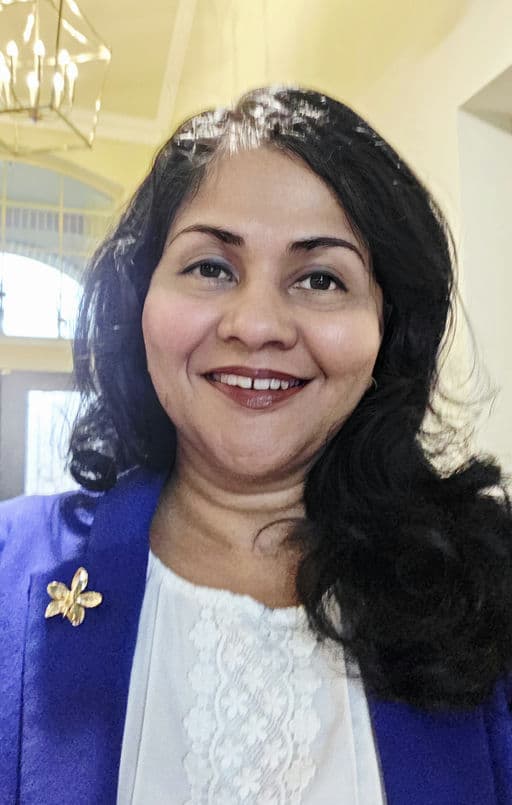
Venilla Rajaguru
Founder and CEO of The Peacebright Institute, Author & Scholar with an International Law Background
About Venilla Rajaguru
For Venilla, peacebuilding or peacemaking, isn’t a slogan or a post-conflict project. Peacebuilding is a civic practice for public good. Societal peace is an effective structural lens on human security and national security; and a strategy to prevent crises before they become the headline. From her base in Houston, she founded The Peacebright Institute, a nonprofit dedicated to advancing dialogue through research, conferences, community engagement, and training in nonviolent dispute resolution. The Peacebright mission is to build systemic peace, by bringing together diverse institutions and communities of peace practitioners, including scholars, community leaders, legal and public safety professionals to address the many challenges of public safety and security.
Venilla’s professional path moves easily between practice and scholarship. After studying English Literature at Oxford as a Rhodes Scholar (1992–94), she spent nearly two decades in corporate and nonprofit environments in international development, leading communications and community outreach work in settings shaped by change, crisis, and public accountability. She later returned to graduate study, earning a Master’s in International Development at Cornell (2013) with a focus on international law, international security, and science and technology policy. Her research continued through doctoral study in Science & Technology Studies at York University, where she taught undergraduate courses including Environmental History, Natural Resource Management, and Science & Technology in Global Development (2015–2017), and her interests expanded into outer space governance through a postgraduate certification in Strategic Space Law at McGill University (2019). In 2021, she founded KeyVisory Consulting, shaped by her analytical method PACE (Principles & Accountability Criteria of the Enterprise), to help organizations navigate stakeholder tensions with clarity and accountability.
Alongside her peacebuilding work, Venilla writes and speaks as both a poet and a scholar. Her poetry fuels her literary talks on craft and meaning, while her legal and policy interests—ranging from the Law of the Sea to space governance and Indo-Pacific dynamics—keep her focused on how rules, power, and security shape everyday life.
As a podcast guest, Venilla connects personal experience, community realities, and global policy into grounded conversations about what peace can be; what version of peace can include and exclude communities, even while it’s being implemented; and the multiple ways of how peace can be built for common and collective security.
Key topics
Peacebuilding is education plus practice, not a slogan plus hope
Most peace talk stays inspirational because people don’t know what peace looks like as a repeatable method. The misconception is that peace is an abstract value rather than a set of skills: negotiation, mediation, dispute resolution, and credible dialogue. Peacebright treats peace as something you build “brick by brick,” with training and certification in nonviolent dispute resolution and community programming designed to strengthen social cohesion. That makes peace measurable-not perfect, but operational.
Trade conflict quietly erodes peace long before it makes headlines
Economic tension gets treated like spreadsheet drama-tariffs, ports, supply chains-until it turns into social instability and political radicalization. The misconception is that peace and security live “above” markets, when markets are often where pressure becomes resentment. Venilla frames “socio-economic peace” as a real peace domain: rules of trade, regulatory trust, trafficking incentives, and the legitimacy of cross-border cooperation. It’s a conversation built for business, policy, and national security audiences who want fewer shocks and more stability.
Why “peace” debates go nowhere until you ask whose peace we mean
People argue about peace like it’s a universal good with a universal definition, and then act surprised when communities feel erased by the solution. The default assumption is that “peace” means quiet-no protests, no friction, no disruption. In real life, peace can be enforced in ways that deepen injustice, or pursued in ways that ignore who gets protected and who gets policed. Venilla can unpack how inclusion, human rights, and legitimacy determine whether “peace” is stability-or simply a pause before the next rupture.
View all topics →
Key topics
Peacebuilding is education plus practice, not a slogan plus hope
Most peace talk stays inspirational because people don’t know what peace looks like as a repeatable method. The misconception is that peace is an abstract value rather than a set of skills: negotiation, mediation, dispute resolution, and credible dialogue. Peacebright treats peace as something you build “brick by brick,” with training and certification in nonviolent dispute resolution and community programming designed to strengthen social cohesion. That makes peace measurable-not perfect, but operational.
Trade conflict quietly erodes peace long before it makes headlines
Economic tension gets treated like spreadsheet drama-tariffs, ports, supply chains-until it turns into social instability and political radicalization. The misconception is that peace and security live “above” markets, when markets are often where pressure becomes resentment. Venilla frames “socio-economic peace” as a real peace domain: rules of trade, regulatory trust, trafficking incentives, and the legitimacy of cross-border cooperation. It’s a conversation built for business, policy, and national security audiences who want fewer shocks and more stability.
Why “peace” debates go nowhere until you ask whose peace we mean
People argue about peace like it’s a universal good with a universal definition, and then act surprised when communities feel erased by the solution. The default assumption is that “peace” means quiet-no protests, no friction, no disruption. In real life, peace can be enforced in ways that deepen injustice, or pursued in ways that ignore who gets protected and who gets policed. Venilla can unpack how inclusion, human rights, and legitimacy determine whether “peace” is stability-or simply a pause before the next rupture.
View all topics →