Harsh Parenting Results and Alternatives
Bryan Saint-Louis · March 27, 2024
Interview with Bryan Saint-Louis
Podcast: The Fatherhood Challenge Podcast & Radio Program
March 27, 2024 · 30 min
Were you raised with harsh parenting techniques? Do you still rely on the same harsh parenting style you were raised with when parenting your own kids but find you’re not connecting with your kids or getting the results you want? If you’re ready to try something different, my…
Listen
About Bryan Saint-Louis
Empowering Youth, Parents and Teachers Through Radical Empathy
10+ Years Educational leadership across North America300+ Student leaders addressed at one summit3 Continents Speaking across North America, Europe & AsiaJuvenile detention Career experience
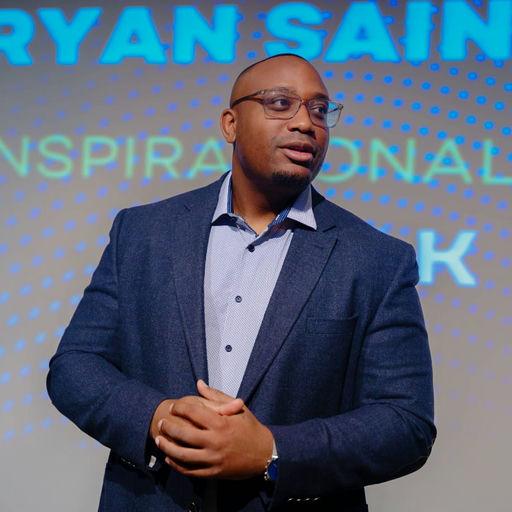
Bryan Saint-Louis is a catalyst for change in the lives of young people, educators, and parents alike. With a mission rooted in radical empathy, Bryan seeks to bridge the gap between misunderstanding and perspective, fostering a deeper understanding of compassion and care in today's youth.
As a seasoned educator, Bryan understands the pivotal role adults play in shaping the lives of young individuals. He speaks at conferences, engages with parents, and collaborates with teachers, advocating for a holistic approach to education that extends beyond academic success. Bryan's message resonates with educators, urging them to cultivate environments of empathy within schools, where trust and belief in students form the foundation for positive change.
Bryan's journey to becoming a youth advocate is marked by personal transformation and a deep sense of purpose. From his own experience in school as an average student to his pivotal career working in juvenile detention facilities, Bryan witnessed firsthand the transformative power of mentorship. Motivated by the belief that every young person deserves a positive role model, he embarked on a mission to uplift and empower.
In a world that often feels divided, Bryan Saint-Louis stands as a beacon of hope, championing the power of radical empathy to transform lives and communities.
About this episode
Were you raised with harsh parenting techniques? Do you still rely on the same harsh parenting style you were raised with when parenting your own kids but find you’re not connecting with your kids or getting the results you want? If you’re ready to try something different, my guest will share some tips you can begin using right away.
Bryan Saint-Louisis a Youth Inspirational Specialist and Speaker with over a decade of experience in driving positive outcomes in education and parenting. And now I’ve brought his expertise to help you dads listening now.
You can connect wit Bryan Saint-Louis or learn more about what he's doing by visiting https://www.bslspeaks.com/
Facebook: https://www.facebook.com/bslspeaks
YouTube: https://www.youtube.com/@bslspeaks
Email: info@bslspeaks.com
Special thanks to Zencastr for sponsoring The Fatherhood Challenge. Use my special link https://zen.ai/CWHIjopqUnnp9xKhbWqscGp-61ATMClwZ1R8J5rm824WHQIJesasjKDm-vGxYtYJ to save 30% off your first month of any Zencastr paid plan.
Transcription - Harsh Parenting Results and Alternatives
---
Were you raised with harsh parenting techniques?
Do you still rely on the same harsh parenting style
you were raised with when parenting your own kids?
But find that you're not connecting with your kids
or getting the results you want
if you're ready to try something different.
My guest will share some tips.
You can begin using right away in just a moment,
so don't go anywhere.
- Welcome to the Fatherhood Challenge,
a movement to awaken and inspire fathers everywhere
to take great pride in their role.
And a challenge society to understand
how important fathers are to the stability
and culture of their family's environment.
Now here's your host, Jonathan Guerrero.
- Greetings everyone, thank you so much for joining me.
My guest is Brian St. Louis,
a youth inspirational specialist and speaker
with over a decade of experience
in driving positive outcomes in education and parenting.
And now I brought of his expertise on the program
to help dads listening now.
Brian, thank you so much for being on the Fatherhood Challenge.
- Jonathan, thank you so much for having me.
I really appreciate it.
And it says an honor.
Thank you so much.
- Brian, what is your favorite dad joke?
- Man.
So I heard this one and I actually like this one a lot.
So someone comes to the dad and says,
"Hey, dad, Sunday was a sad day."
And then he says, "But yesterday was a sadder day."
(laughing)
Okay, all right, good.
We got it.
(laughing)
All right, I love it, we got it left, man.
That's all I need.
(laughing)
It got me.
- All right, but I hope the listener
has got a little left out of that one too, but.
(laughing)
As well.
- I'm sure they did.
That was awesome.
- Oh man.
- Well, Brian, let's start with your story.
How did you get involved with working with youth
and helping parents connect with their kids?
- I was 20 years old.
I used to work in a, as a,
not speaker necessarily at that time, right?
But 20, I was working as a, as a Bible teacher.
And I remembered I was embossed at the time
and there was a group of kids.
I wanna say about 70 kids and it was three of us.
And we were supposed to be basically helping them out
for, for the whole month that this series was happening.
And we were supposed to be teaching in the Bible.
Ultimately, the two other guys kind of stepped off
and found myself being the one having to take care
of a room of 70 kids between the ages of 13, 12, 13 to 17.
- Oh wow.
- Yeah.
And of course, I had some people who would come in
and help out and such, but for the most part,
the brunt of that focus was on me.
But man, when I tell you, I was,
I was so impressed with these kids being able to,
ask answers or certain questions that I had.
But then I also realized that I was very keen on connecting
very well with this age group because, you know,
I wasn't so old, you know, I'm only 20,
even though they said I was old, but I was only 20 at the time
and so I wasn't so far away from being a teenager
and I remembered what it felt like to be a teen,
trying to understand certain concepts
and also feeling like a lot of what was being taught
had no relativity to me.
And so I was very specific and intentional on the questions
that I was asking these kids ended up being such a powerful
time that brought me and led me to continue to do work
with youth when I was 21.
I started working at a youth juvenile detention facility,
just seeing the power of how radical empathy
was able to make me help build stronger relationships
with these youth but also impacting their lives
when they get out of that juvenile detention facility.
Being in that space at such a young age
helped me to see how powerful youth really are
and understanding how much they need strong supports
in their lives because a lot of them,
sometimes we see kids who are acting crazy,
we see kids who, you know, speak out of their disrespectful
and such and I always ask myself the question,
who taught them?
What was it that happened in their background
or their life that got them to the place that they were?
That they were and ultimately I'm not responsible
for who they are before they meet me
but because of the connection that I am right now with them,
now I'm responsible of modeling the proper behavior
that they can now choose to use in their future.
And so this is something that I started
when it was about 2021 and just seeing the power of how youth
are need that strong mentor and youth need that one caring adult
has pushed me to want to continue in the work with youth as well
but then as you said, right, as I got older, became a dad
I'm realizing how powerful it is for these children
to have strong figures in the home.
And so now as I'm also working with youth,
my main focus as well is also uplifting
and supporting the adults in the lives of youth
so that they can also know how to properly connect
with those teens and the children in their lives as well.
- The next question could be a tough one,
but definitely an important one.
Harsh Parenting has been a reality for many generations
and is argued to be effective.
This includes everything from yelling to even corporal punishment.
In fact, some say that we have crime rates
because parents are often too soft on their kids.
I'll give you one example I saw.
There was a post by a very popular pop star bragging
about the fact that she actually uses corporal punishment
on her kids and I believe she's a,
either a Gen Xer or a millennium.
And I looked in the comments and the comments were flooded
with mostly baby boomers who were jumping in there
and congratulating her.
So I'm curious, you know, if this is,
if this rule, this idea that harsh parenting is effective
and we don't have enough of it
and that's why kids are going wrong these days,
is this true or is this a lie?
- I don't think that's true.
We have seen high rates of criminality throughout the years
since the 80s, since the 90s.
And corporal punishment was absolutely a major use
in parenting at that time.
So it's not as though because of corporal punishment,
it made for better conditions.
A lot of youth were treated that way, right?
They had corporal punishment used
and yet crime rates have not necessarily lowered
or were lower back then than they are today.
I think there's a lot of more different factors
that deal with why youth are still necessarily
being connected or getting involved with criminality,
especially with the rise of social media,
they're being influenced in a major way,
which I think can also contribute to what they want
to do or how they're connected to other people around them,
but it's not necessarily for corporal punishment.
And in fact, I mean, when you look at the question, right,
for the fact that people argue as effectiveness
and I know a lot of people wanna say
mental health has also risen in these years,
but in the 80s, 90s, early 2000s,
how many people were actually going to counseling
due to their mental health?
We weren't necessarily seeing a lot of individuals
who were connecting to psychologists, the therapists,
because it was such a taboo concern.
And individuals were not necessarily trying to see
what was going on introspectively in their minds.
And so many of them, the statistics show
that mental health is on the rise right now,
but if we were actually doing the right work
to better ourselves, to connect ourselves
with mental health professionals,
when we were dealing with traumatic events,
we would have seen the same level of mental health
back then as well.
And I know people, for instance, Jonathan,
I know people love to say, well, it worked for me
and look how I turned out.
But I always ask the question,
if you go back to that child that you were,
don't think about the child, the adult that you are today.
I'm not talking about the adult that you are today.
I'm talking about that inner child that you were.
What was it that you're inner child needed?
Not that you're an adult and you can see things
in a better perspective.
What was it that you're inner child needed?
Did they need all of that punishment?
Did they need all of that yelling?
Even if it happened once or twice,
did they need it happening 10 times a week
or 10 times a day?
Right?
A lot of times we sometimes look at the perspective
of who we are today, but we don't look back
at who that inner child was
and what they probably needed better
in order for them to live a better life,
not just focusing on the impact that it has on our today,
but realizing that child probably needed
a little bit more love.
And if we looked at it that way,
maybe we would have a different perspective as well.
I can weigh on those two a little bit
from a slightly different perspective.
A lot of these arguments tend to reside in,
especially in conservative religious organizations
and denominations.
This is where we really tend to see that argument stick.
And I can tell you from my observation
that a lot of those same adults that are arguing
that have
Guest: Bryan Saint-Louis

Book Bryan Saint-Louis for your show
2+ podcast & stage appearances. Remote or in studio, broadcast-grade audio.