
September 22, 2026
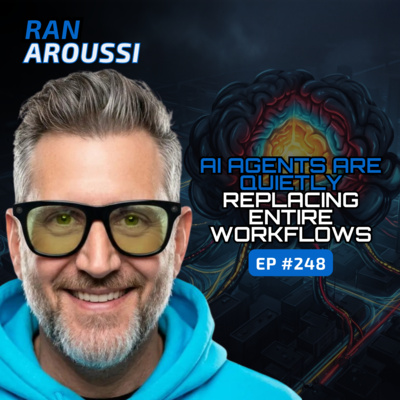
How Invisible AI Agents Are Taking Over the Enterprise (With Ran Aroussi of VarOps) - Ep #248
Listen
Show notes
Marc and Ran Aroussi explore how invisible AI infrastructure is transforming the enterprise, breaking down how autonomous agent teams can execute complex tasks without forcing employees to adopt new software.
About the Episode
The race to integrate artificial intelligence into established enterprises is running straight into a major bottleneck: nobody wants to learn another complicated software platform. Instead of forcing teams to adopt disruptive new dashboards, the real breakthrough is making agentic infrastructure completely invisible by embedding intelligence directly into existing communication channels. Proactive agents are already stepping in to monitor conversations, dynamically build standard operating procedures, and handle complex administrative tasks across accounting, legal, and IT departments. This frictionless transition enables businesses to automate repetitive busywork without derailing daily operations or confusing their workforce.
As autonomous systems become more deeply embedded in enterprise architectures, traditional security and governance strategies must drastically evolve. Giving agents unmonitored access creates severe vulnerabilities, making strict permissions, read-only guardrails, and human-in-the-loop validation mandatory for preventing costly hallucinations and data leaks. When structured with proper hierarchical oversight, agentic workforces are already starting to outperform human teams in critical areas like engineering, testing, and system diagnostics. The organizations that master this balance between automated execution and disciplined governance today will define the next standard of corporate productivity.
About the Guest
Ran Aroussi brings over 30 years of engineering experience to his work transforming complex systems across AdTech, finance, and artificial intelligence. A self-taught technologist, he previously built ad-serving engines delivering three billion daily ads, created the massively adopted yfinance library, and founded Tradologics. Today, as the Founder of MUXI and Automaze, he focuses on delivering production-grade infrastructure that empowers autonomous AI agents to think, remember, and collaborate safely.
Drawing from decades of navigating high-stakes tech shifts, Ran recognizes that the AI industry is finally entering its demanding enterprise era. He actively champions transparent design discipline, arguing that auditable reasoning and strict permissions are the only ways to build resilient systems leaders can actually trust. Through his ongoing open-source work, Ran continues to provide the foundational architecture businesses need to transition from fragile AI experiments to scalable, agentic workforces.
Timestamps:
00:01:21 - Episode Commences 00:03:35 - Enterprise AI Implementation Challenges 00:07:40 - AI Implementation Strategy Discussion 00:15:03 - Business Automation Implementation Discussion 00:21:47 - Cybersecurity for AI Agents Implementation 00:29:52 - AI Server Security Incident Review 00:35:19 - Agentic Workforce Performance Evolution 00:39:45 - AI Costs and Implementation Strategies 00:51:19 - Episode Concludes
About Ran Aroussi

Founder of VarOps • Building software and Resident AI into companies that can't afford to guess.
35+ years Production coding experience30M+ Open-source downloads per month50K+ GitHub stars3B+ Ads delivered daily by systems he built
Ran Aroussi has spent 35 years building software infrastructure. Now he thinks we’re building AI for businesses backwards.
Most companies are adding copilots, chatbots, and agents, then asking employees to learn how to use them. Ran’s argument is almost the opposite: people shouldn’t have to adapt to AI. AI should adapt to the company.
He’s the founder of VarOps, where he’s building what he calls "Resident AI": AI that lives inside an organization, learns how it actually operates, and works through the tools and workflows people already use. No new destination. No constant prompting. Ideally, employees barely notice it’s there.
The idea grew out of a problem Ran believes the AI industry has underestimated: AI doesn’t understand organizations.
A chatbot might have access to every document, meeting, and message in a company and still not understand why a decision was made, which unwritten rule matters, who actually knows how something works, or that the official process hasn’t been followed in three years.
Retrieval gives AI information. It doesn’t necessarily give it understanding.
Ran’s work focuses on building that missing layer: a living model of the organization itself – its knowledge, decisions, relationships, processes, and unwritten operating context. He describes it as an "Organizational Language Model" (OLM) rather than another LLM with access to company data.
More from Ran Aroussi
All episodes → The Future Of The FutureRan Aroussi. Simplicity Is The Key For AI Adoption.Sep 2026Play episode →
 AI: Trust but VerifyVibe Coding, Real Consequences: The Rise of the AI Architect, with Ran AroussiSep 2026Play episode →
 The AI Native Dev - from Copilot today to AI Native Software Development tomorrowYou Don't Need Juniors to Code. Hire Them Anyway.Sep 2026Play episode →
 Agent Sense | Agentic Workflows & Operational AIAgent Memory is More than RAGAug 2026Play episode →
 School for Startups RadioJuly 16, 2026 - AI Systems Open Source Platform Ran Aroussi and Six Leadership Actions Susan MacKenty Brady - School for Startups RadioJul 2026Play episode →
 Gaining the Technology Leadership EdgeThe Real Reason Your Engineering Team Is Always DelayedMay 2026Play episode →
 Invest in YouHow Coding Systems Drive Better TradesMar 2026Play episode →
 XTraw AI: Machine Learning and AI ApplicationsEngineering Trust in the Age of Agentic AIMar 2026Play episode →
 Scrum Master Toolbox Podcast: Agile storytelling from the trenchesWhen AI Decisions Go Wrong at Scale—And How to Prevent It With Ran AroussiFeb 2026Play episode →