
December 31, 2025
Reality check every founder needs in 2026
Listen
Show notes
It’s late December energy. The year’s basically over. The cookies are gone, the group chats are quiet, and this is the one moment where you’re allowed to stop shipping long enough to look back.
Because 2025 was insane for AI. Every week felt like a new launch, a new model, a new panic, a new promise that this one would change everything. Faster code. Cheaper labor. Smarter agents. Louder fear. And somewhere in the middle of all that noise, a lot of founders quietly fell behind without realizing it.
That’s why this moment matters. Not to chase headlines, but to understand what actually shifted.
Ran Aroussi has been building software for 30 years, and what he’s seeing isn’t hype. It’s pressure. In 2025, delivery timelines got cut in half. Clients didn’t ask for less. They asked for more, faster. AI didn’t end projects early. It turned the same teams into factories. MVPs shipped sooner, and instead of stopping, they kept going. More features. Better architecture. Automated workflows. Less “we’ll clean this up later.”
Here’s the part founders miss. The advantage isn’t the model. It’s the system around it. If your onboarding breaks at scale, if your backend can’t handle growth, if your workflows still assume humans for everything repetitive, AI just exposes the weakness faster. That’s where teams like Automaze step in, acting like a technical co-founder, rebuilding foundations while AI quietly takes over the expensive, soul-crushing work you assumed required more headcount.
And looking ahead to 2026, the big question isn’t capability. It’s trust. Agents can already do more than we’re comfortable admitting. The real winners will be the founders who learn how to delegate to AI without surrendering judgment. Copilots turn into coworkers. Systems get quieter. Interfaces disappear. Output goes up. And the margin between leaders and laggards gets brutal.
So here’s the question worth sitting with. If your company doubled its output overnight, would it give you freedom, or would it just raise expectations and tighten the leash?
__
__
About Ran Aroussi

Founder of VarOps • Building software and Resident AI into companies that can't afford to guess.
35+ years Production coding experience30M+ Open-source downloads per month50K+ GitHub stars3B+ Ads delivered daily by systems he built
Ran Aroussi has spent 35 years building software infrastructure. Now he thinks we’re building AI for businesses backwards.
Most companies are adding copilots, chatbots, and agents, then asking employees to learn how to use them. Ran’s argument is almost the opposite: people shouldn’t have to adapt to AI. AI should adapt to the company.
He’s the founder of VarOps, where he’s building what he calls "Resident AI": AI that lives inside an organization, learns how it actually operates, and works through the tools and workflows people already use. No new destination. No constant prompting. Ideally, employees barely notice it’s there.
The idea grew out of a problem Ran believes the AI industry has underestimated: AI doesn’t understand organizations.
A chatbot might have access to every document, meeting, and message in a company and still not understand why a decision was made, which unwritten rule matters, who actually knows how something works, or that the official process hasn’t been followed in three years.
Retrieval gives AI information. It doesn’t necessarily give it understanding.
Ran’s work focuses on building that missing layer: a living model of the organization itself – its knowledge, decisions, relationships, processes, and unwritten operating context. He describes it as an "Organizational Language Model" (OLM) rather than another LLM with access to company data.
More from Ran Aroussi
All episodes → The Future Of The FutureRan Aroussi. Simplicity Is The Key For AI Adoption.Sep 2026Play episode →
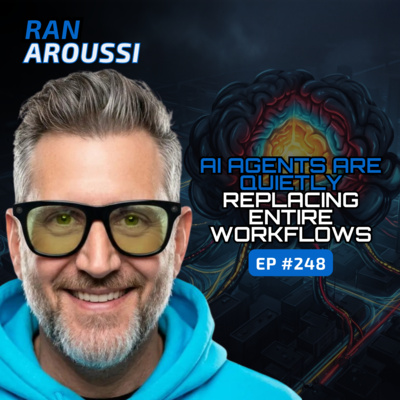 Future Tech And ForesightHow Invisible AI Agents Are Taking Over the Enterprise (With Ran Aroussi of VarOps) - Ep #248Sep 2026Play episode →
 AI: Trust but VerifyVibe Coding, Real Consequences: The Rise of the AI Architect, with Ran AroussiSep 2026Play episode →
 The AI Native Dev - from Copilot today to AI Native Software Development tomorrowYou Don't Need Juniors to Code. Hire Them Anyway.Sep 2026Play episode →
 Agent Sense | Agentic Workflows & Operational AIAgent Memory is More than RAGAug 2026Play episode →
 School for Startups RadioJuly 16, 2026 - AI Systems Open Source Platform Ran Aroussi and Six Leadership Actions Susan MacKenty Brady - School for Startups RadioJul 2026Play episode →
 Gaining the Technology Leadership EdgeThe Real Reason Your Engineering Team Is Always DelayedMay 2026Play episode →
 Invest in YouHow Coding Systems Drive Better TradesMar 2026Play episode →
 XTraw AI: Machine Learning and AI ApplicationsEngineering Trust in the Age of Agentic AIMar 2026Play episode →