Leadership
Why the Real Cultural Divides in Your Team Are Not About Nationality
The Global DISC founder explains why culture is less about country and more about how we think, and what leaders should look at instead.
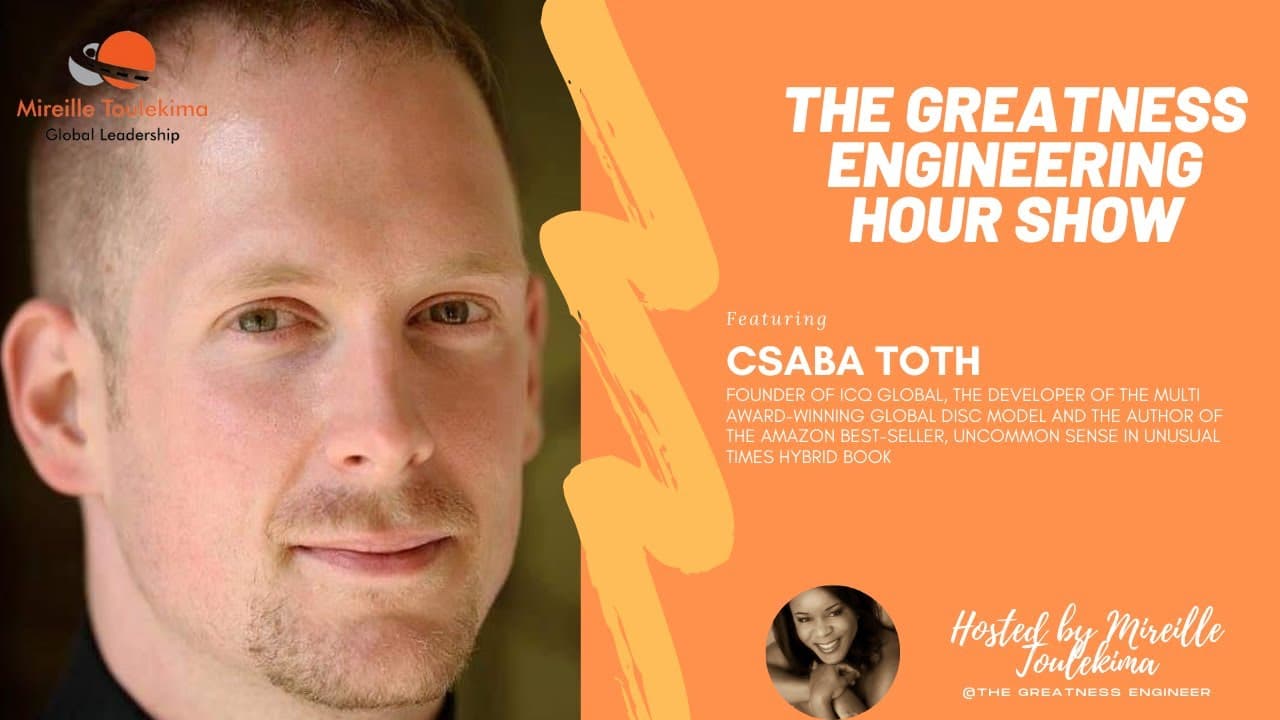
The Greatness Engineering Hour Show with Csaba Toth, founder of ICQ Global, developer of Global DISC
Video from Uncommon Sense.
Generated from the canonical interview transcript and validated against source data by Guests on Air.
Why do diverse teams struggle when leaders focus on nationality?
Csaba Toth says diverse teams struggle when leaders manage by nationality, gender or generation, because most cultural differences sit within countries rather than between them. He recommends building inclusion and psychological safety first, paying attention to cognitive diversity, and treating disagreements as clashes of common sense by asking what the other person can see that you cannot.
Csaba Toth, founder of ICQ Global and developer of the Global DISC model, argues that most leaders are measuring the wrong kind of difference. Speaking on The Greatness Engineering Hour, he explained why nationality, gender and generation tell us far less about how people think than we assume, and why that blind spot quietly drains performance from diverse teams.
His interest began with a failure. After a master's degree in international management, he built a restaurant booking site that grew within a year from 35 restaurants in Brighton to venues all over the UK. On paper the joint venture made sense, yet he could not work with the French chief executive, and he eventually had to leave the business.
That clash sent him back to the research. He trained in many personality and intercultural models, looking for the overlap between them, and the result was Global DISC, now an ICF accredited framework with licensed partners in 31 countries. He calls the approach the science of uncommon sense, and it starts by questioning what we treat as obvious.
Key takeaways
- More cultural difference sits inside a country than between countries, so nationality is a weak guide to how people think.
- Aim for inclusion and psychological safety first, because diversity added without that understanding tends to backfire.
- Cognitive diversity is the layer with proven benefit, yet hiring people who think like us quietly removes it.
- Treat a disagreement as a clash of common senses and ask what the other person can see that you cannot.
1. Country is what we are used to, not who we are
Toth pushes back on the idea that culture is a fixed national trait. Most intercultural training, he said, focuses on only one of the fifteen or twenty culture groups each person belongs to, the country of origin. Yet the research he cites shows that most cultural differences sit within countries rather than between them, which makes national averages a poor tool for managing real people.
He points to studies comparing seventeen kinds of culture group on how practical they are and how wide their differences run. Country of origin, gender and generation came bottom of that list. We do not choose those groups, so we learn to conform to their norms even when they feel unnatural, which hides how different people really are underneath.
The groups we do choose, such as our profession or our hobbies, often reveal more. Engineers in different countries may share more values and beliefs than random people from the same nation. So rather than widening the gap with statistical stereotypes, Toth suggests that leaders find the common ground first and then learn to make the most of the differences.
2. Why diversity without inclusion backfires
Many organisations, in his view, focus on the visible layer of diversity, often as a public relations move. When clients tell him they want to increase diversity, he surprises them by saying please don't. His advice is to aim for inclusion first, with psychological safety in place, because diversity is simply the existence of differences and can cause real trouble without that foundation.
The layer of diversity with proven benefit, he says, is cognitive diversity. He compares ignoring it to buying a laptop for the internet without knowing that wireless connections exist. The machine is not broken, yet its owner might conclude that it does not work. Teams that overlook cognitive diversity can reach the same wrong conclusion about diversity itself.
He also warns about homophily, our habit of liking and trusting people who are like us. A colourful international team can be more alike on the inside than a random local one, because managers rarely hire people who disagree with them. A meeting feels energised when everyone agrees, but that feeling does not make the decision right.
3. Turning clashes of common sense into better decisions
Toth describes cultural differences as clashes of common senses. When two people disagree and each feels certain, the default is to spend energy proving the other person wrong. With trust and an uncommon mindset, the question changes to what the other person can see that you cannot, and that shift is where diversity starts to produce innovation instead of friction.
He is blunt about why change stalls. Like homeowners who grow used to a smell in their own house, teams accept high staff turnover as normal and blame individuals. He argues that people often need to see the cost in numbers before they act, because most lost time and energy at work comes from friction with others and from self sabotage.
For readers who want to go further, his book is built as a hybrid book linked to an interactive coaching platform, and its full title is Uncommon Sense in Unusual Times: How to stay relevant in the 21st century by understanding ourselves and others better than social media algorithms and people trained in taking advantage of us. His closing question for listeners was simple: do you want to be right, or find an even better solution?