Leadership
Why Emotional Intelligence Is a Leader's Edge as AI Takes Over Tasks
The leadership coach and author explains why caring, candour and cultural awareness matter more, not less, as automation spreads through the workplace.
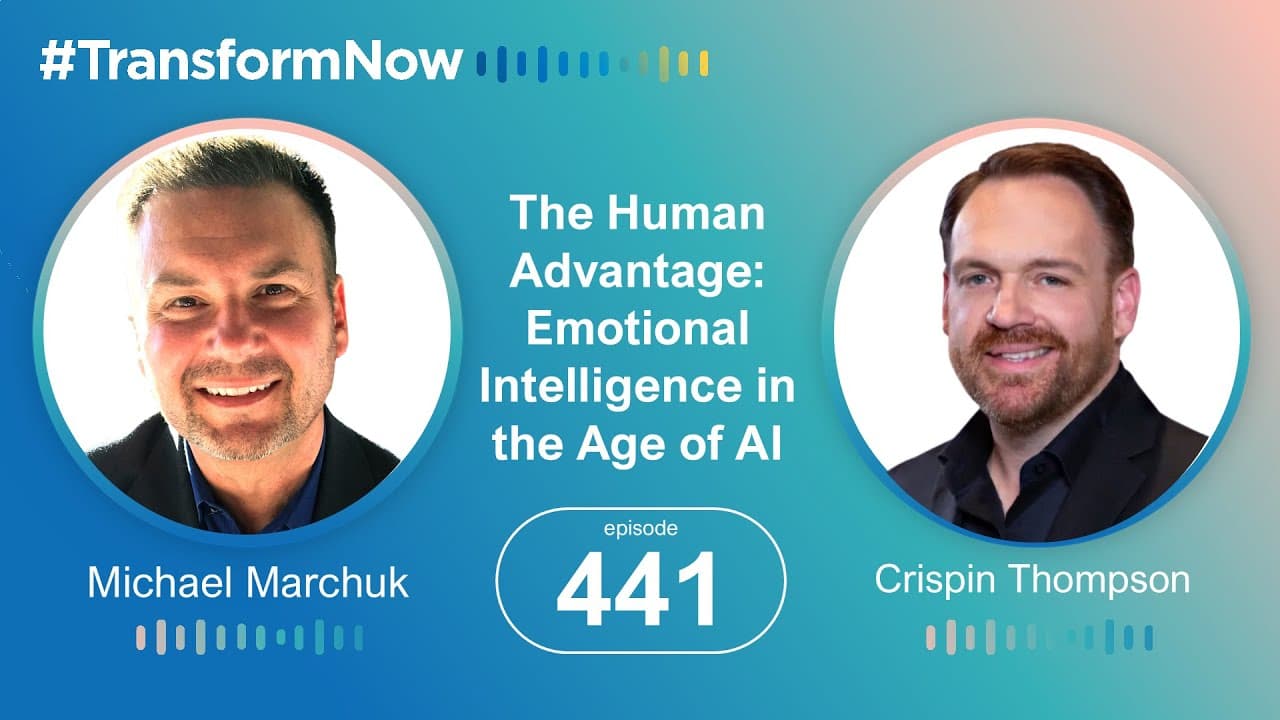
The Human Advantage: Emotional Intelligence in the Age of AI
Video from SS&C Blue Prism.
Generated from the canonical interview transcript and validated against source data by Guests on Air.
How can leaders use emotional intelligence as AI takes over routine work?
Use AI for repetitive, transactional work and put leadership time into the human parts of the job: checking whether outputs are relevant, slowing down when speed risks burnout, delivering hard news with empathy, being open about coming change, and adapting how you communicate to each team and culture you lead.
Crispin Thompson spent about 25 years inside Hewlett Packard and the companies that became part of it, then ran large operations and sales teams before founding The Leadership Studio. On the Transform Now podcast with host Michael Marchuk, he argued that the rush toward automation makes a leader's emotional intelligence more valuable, not less.
Thompson is no sceptic about the tools. He says he cannot go a day without AI and cannot run his company without it. His worry is that people and companies lean on it so hard that they forget what it still cannot do, such as connect with a team, notice when something is wrong, or judge whether an output is even relevant.
This article draws out the practical side of that argument. It covers why slowing down can be a leadership skill, how to handle conversations about jobs changing, why remote culture fails faster than office culture, and how Thompson adjusted his own style when he led teams in Eastern Europe, India, China and Mexico.
Key takeaways
- Check every AI output for accuracy and relevance; the tool can make a call, but a leader decides whether it matters.
- Be willing to slow a project down, and defend that choice, when speed would push a team toward burnout.
- Deliver hard news about roles as if you were the one receiving it, and line up new options before it lands.
- Adapt your style to each culture you lead, and raise the hard question nobody in the room wants to ask.
1. Why emotional intelligence matters more as AI speeds up
Thompson had raised emotional intelligence with large audiences for about ten years, first as a reminder that people should stay human while companies leaned into automation. When he began offering coaching and certification in it through his company, he felt his material was not yet fully built. Writing The Human Advantage: Emotional Intelligence in the Age of AI started as a way to collect those thoughts and do the research.
The book opens with a question the host put back to him: what happens when machines learn faster than we do, and does it matter? Thompson's answer was that it matters if you let it. AI can make a decision, but people still decide whether that decision is relevant, important and useful right now. He pointed to a newspaper article that ended with a chatbot offering to make the copy punchier, printed because no one had checked it.
His view on what to hand over is blunt. If he were building a large operations team today, there are tasks he would never give a person, such as repetitive analytics and number crunching. The most undervalued human trait, he said, is the willingness to slow down and ask why a team is moving so fast. Speed and burnout go hand in hand, and a leader sometimes has to trade a little speed today for a better result tomorrow.
2. What caring looks like when jobs change
Much of Thompson's corporate career sat in strategy and planning, including workforce strategy in the early 2010s, when technology firms moved work from high-cost to low-cost locations. Whatever label was used, it meant people's jobs. Someone once gave him advice about delivering layoff news that he never forgot: don't ever get good at this. He turned that line into a rule for himself and for the managers who worked for him.
The rule is to deliver that conversation as if you were the person receiving it. He contrasted it with a well-known case in which an entire workforce was let go by voicemail, and asked listeners to imagine the same thing done today by email or text. A machine might conclude that bare facts are the efficient way to break the news, but none of the people hearing it are robots, and they remember how they were treated.
The same thinking applies to AI. When leaders know a redesign is coming, Thompson's advice is to be as transparent as the situation allows, encourage people to learn the skills the new work will need, and line up other roles before the news lands. He also urges leaders to spend time with the group most afraid of the change, because unnecessary fear and negativity can bring an organization down faster than almost anything else.
3. Building trust across distance and cultures
Thompson has led teams that were almost entirely remote since around 2016, and he says distance forces a leader to work differently. A company needs a defined culture and then has to live it. If leaders promise an open door and never show it, that culture fails in any office, yet a remote or hybrid team feels the gap at once, because nobody can see the disappointed look on a colleague's face.

Voice still carries signals. Even on a call with no camera, he says, you will hear tension or hesitancy, and a leader can talk people through it. The hallmarks he looks for in emotionally intelligent leaders are being authentic and genuine, a willingness to take questions they cannot predict, and the nerve to raise the concern people discuss at the water cooler but never voice in the meeting.
Culture also changes how a message lands. Thompson studied history at school, and that background proved useful once he led teams around the world. In Bucharest, Romania, he found a strong team that could be tough and challenging, shaped in part by decades of distrust in leaders, so he broke messages into small, clear pieces with little grey area. He made similar adjustments in Poland, India, China and Mexico, and he still starts by asking who the audience is.