AI adoption
Why AI adoption in dental practices is a change management job
Trehan Stenton argues that practices get more from AI when they plan the people side first, start small and set clear guardrails.
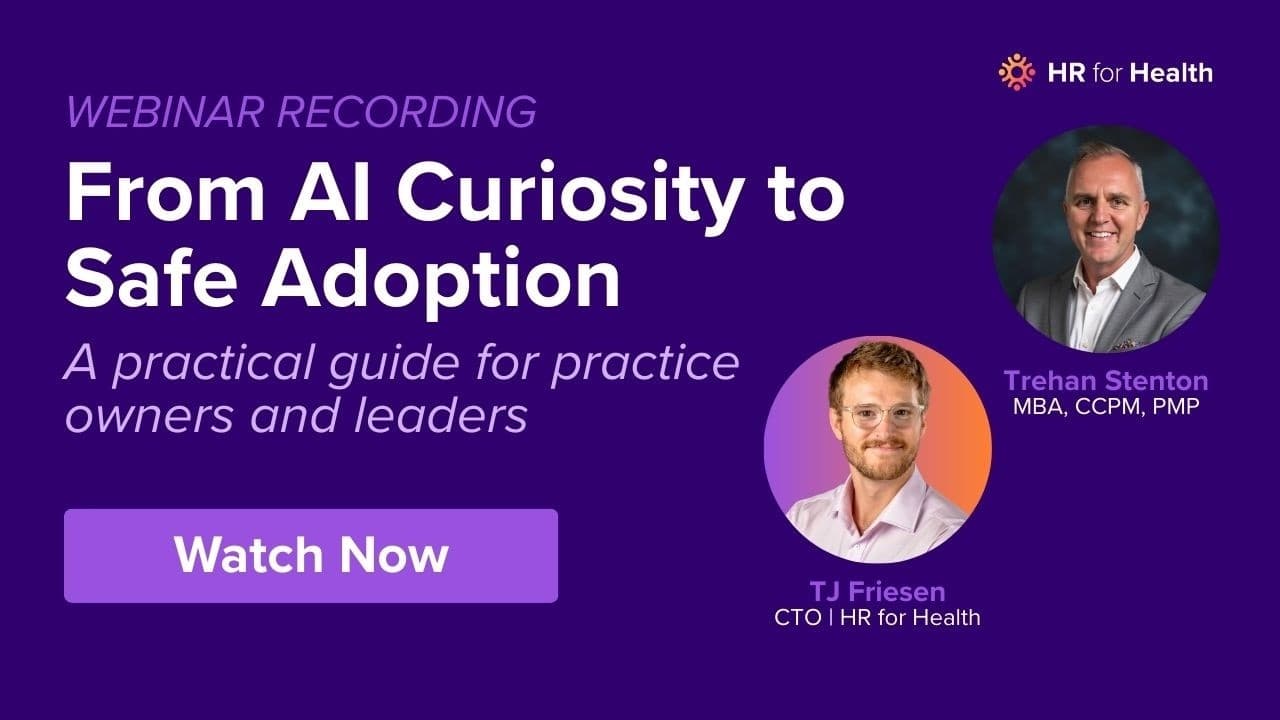
From AI Curiosity to Safe Adoption with Trehan Stenton
Video from HR for Health.
Generated from the canonical interview transcript and validated against source data by Guests on Air.
How should a dental practice introduce AI to its team?
Treat AI as a change management process, not a technology purchase. Explain why the practice is using it, set a clear data boundary, choose approved tools and run a small pilot with modest, measurable goals. Review results with the team each month, then expand what works. Banning AI only drives staff to use it out of sight.
Most dental and allied health practices already have AI in the building, whether or not the owner has approved it. Team members use it on work computers and personal phones to rewrite emails, summarise meetings and look things up. For Trehan Stenton, who has spent more than 15 years in dentistry and allied health and has owned a practice, the real question is how to manage it well.
In a webinar hosted by HR for Health, Stenton set out a practical path for owners and office managers. His central point is that AI adoption fails less often because of the tool and more often because the people using it were never brought along. A tool can work exactly as designed and still land badly in a practice that skipped the groundwork.
He frames the work through an ADOPT model: align on why, diagnose current work, weigh the options, plan the rollout and transform how the team works so the change sticks. Alongside it sit guardrails for patient privacy, a lightweight governance routine and a 60-day starter plan that keeps early goals small enough to hit.
Key takeaways
- Treat AI adoption as a change management process, because staff worry first about what it means for their own jobs.
- Do not ban AI in the practice, because a ban pushes staff toward hidden shadow AI use that nobody can guide.
- Keep patient health information and sensitive employee data out of public AI tools, and use approved tools only.
- Start with small, low risk pilots and modest targets, then refine and expand what the team proves works.
1. Why AI is a people problem before a technology problem
Stenton describes generative AI as a piece of code that predicts the next most probable step. That makes it useful, but it also means its output needs checking. He calls this discernment: the owner of the decision stays responsible for it, and so does every team member who uses an AI result in their work.
The bigger risk, in his view, is how people react. If a first attempt produces wrong numbers, staff may decide the tool is useless, when the cause might be the wrong tool or poor input data. Others will quietly wonder whether AI will question their judgment or take their job. Those fears are reasonable and deserve a direct answer.
That is why he treats adoption as change management rather than a technology rollout. Leaders should explain the why, spell out the benefits for each role and bring staff in early, so they become part of the solution instead of resisting it. A first pilot that fails for lack of planning leaves problems that are hard to undo later.
2. Guardrails that protect patients and trust
Healthcare teams carry a higher duty of care for data, and Stenton's first guardrail is a clear data boundary. No protected health information and no sensitive employee records go into public AI tools, whether at work, on a phone or at home. When analysis needs real records, staff should strip out names, dates of birth and other identifying details first.
His second guardrail is an approved tool list. Options such as Copilot, or enterprise versions of the major assistants, keep data inside the practice's own environment and let owners set filters. For anything inside the HIPAA boundary, practices should look for vendors that sign a business associate agreement, and speak with existing customers before committing.
The third is a clear escalation path. When an answer looks odd, staff need to know who to ask. Stenton recalls a report that showed every employee working four hours of overtime a day, which turned out to be a time zone error in the data rather than a fault in the tool. Good questions usually find the real cause.
3. Start small and measure what changes
Stenton compares AI to the printing press: revolutionary in effect, but evolutionary in how a practice should adopt it. He does not expect it to change a practice overnight. He suggests starting with low risk, bite-sized uses such as rewriting notes, drafting training guides from equipment manuals, preparing the daily huddle list or summarising team meetings.

The mistake he sees most often is expectations set too high. Owners assume a pilot will remove several roles or save hours each day, then judge it a failure when it does not. Setting modest goals up front, such as hours saved on a regular report, gives the team a result it can reach and a reason to keep going.
He measures success through time saved on administration, more consistent HR documents, faster hiring and onboarding, lower data risk and team confidence. A short monthly review of quick wins, lessons and problems keeps governance light. His advice to practices is to aim for progress rather than perfection, learn from each pilot and expand from there.