Birth education
Why a doula built her own birth education program and had it tested
Nadine Richardson turned years at the birth coalface into She Births, then invited university researchers to put the program through a randomised trial.
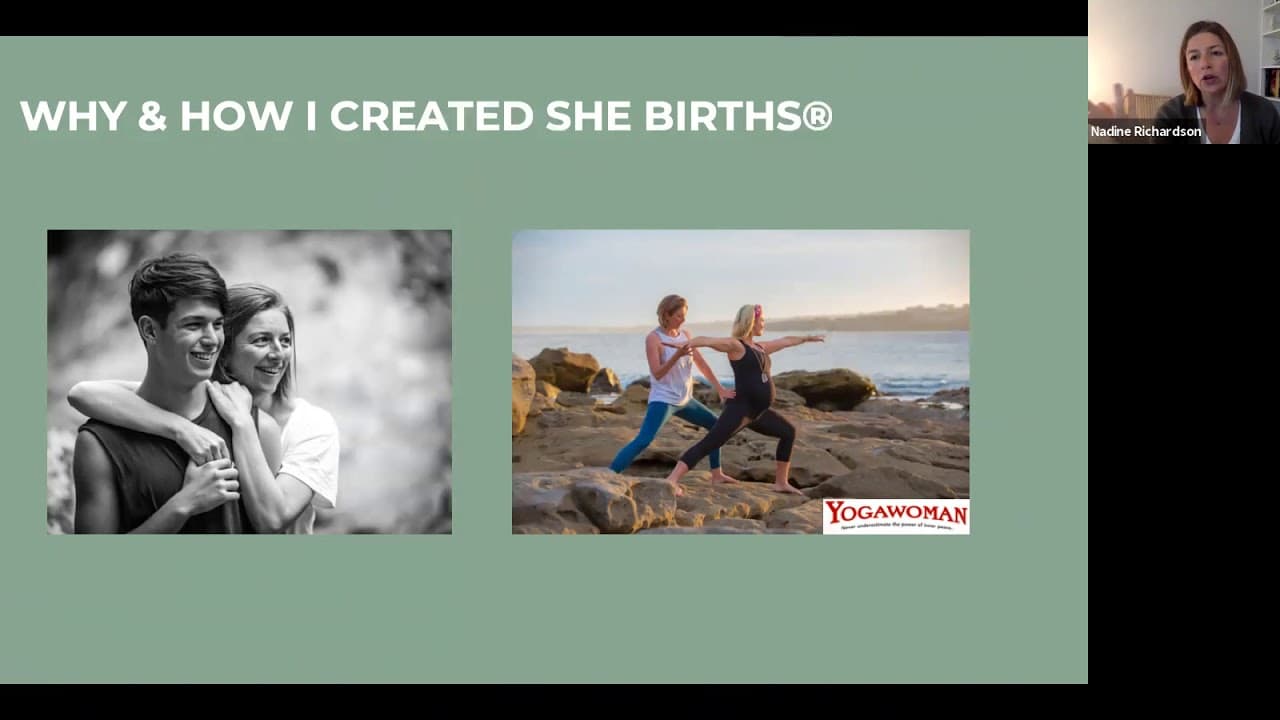
Webinar - Discover how She Births® can support your birth and work
Video from She Births® Education | Nadine Richardson.
Generated from the canonical interview transcript and validated against source data by Guests on Air.
Why should a childbirth education program be tested like a health intervention?
Because preparation changes outcomes, families deserve to know which classes actually work. Nadine Richardson says many standard hospital courses build fear without giving practical tools. Her She Births program was studied in a randomised controlled trial of 176 couples in Sydney, which reported fewer epidurals, caesareans and uses of synthetic oxytocin than standard hospital education.
Nadine Richardson did not set out to start a business. She was a yoga teacher who had left a documentary film career at 21, and then the birth of her son left her with questions that even birth experts could not answer. In a founder webinar, she explains how those questions became She Births, a program more than 5,000 families have now taken.
The story matters for anyone building a business around a calling. Richardson trained as a doula, worked long hours at births and taught hundreds of women in pregnancy and postnatal yoga classes. What she saw there convinced her that birth education was hit and miss, and that too many women were leaving birth feeling they had failed.
Her answer was not just a new course. It was a course she was willing to have tested. About five years in, a lecturer from Western Sydney University asked to study the program, and the results were published in BMJ Open. That decision to invite scrutiny runs through her account of building She Births from Bondi Beach.
Key takeaways
- Nadine Richardson built She Births after her own first birth raised questions that the experts around her could not explain.
- Years as a doula and yoga teacher gave her the steady feedback she used to shape and refine the program.
- A randomised trial of 176 Sydney couples compared She Births with the standard education offered in hospitals.
- Richardson argues that satisfaction after birth depends on how involved a woman is in decisions about her care.
1. From a hard first birth to a new program
Richardson describes her first birth as a shock. After 12 weeks of birth education, days of pre labour and two days of established labour, she was only two centimetres dilated and needed an epidural. She was not traumatised and had excellent care from an independent midwife, but no one she spoke to afterwards could explain why the birth had unfolded that way.
Soon after, a close friend had a calm water birth in a birth centre, with a similar pelvis and a similar sized baby. Richardson began reading everything she could find and saw big gaps in what she had been taught. She trained as a doula, then as a birth educator in two other programs, and kept finding gaps in those as well.
The turning point was personal rather than commercial. She kept meeting women who came out of birth feeling they had failed, and she says that broke her heart. It pushed her to spend thousands of hours building a program that would help women feel proud of what they had done, whatever their birth looked like.
2. Building a program from feedback at the coalface
Richardson calls the first five years of She Births a period of biofeedback. She was teaching large numbers of pregnant and new mothers, attending births and hearing their stories, and she paid close attention to which breathing, positioning and support tools were really working. Those observations, rather than a business plan, shaped what the program taught.
Her background explains the shape of it. Yoga helped her through severe anxiety when she was young, and she brings that body and mind focus into the course alongside anatomy, hormones, the stages of labour and practical tools partners can use, such as massage and acupressure. Partners are a deliberate part of the design, not an afterthought.
The business grew from a single day of tea, lunch and conversation into weekend courses, an online program and an app. The community began in Bondi Beach, families have travelled from across Australia to attend courses in Sydney, and she has launched in Byron Bay. She also describes a one for one sponsorship that funds text message birth support for families in developing countries.
3. Why she let researchers test it
Richardson believes many standard hospital classes are ineffective, and that some even build fear without giving people practical ways to manage labour. That is why she welcomed a randomised controlled trial. In it, 176 couples were split between standard hospital education at two major Sydney hospitals and the two day She Births program.
She reports that the She Births group had a 65 percent reduction in epidurals, fewer caesarean sections, half the use of synthetic oxytocin and fewer babies needing resuscitation. The study found that no single technique made the difference. It was the combination of active and relaxation tools, practised together, that mattered.
For Richardson, the deeper measure is how women feel afterwards. She points to research showing that satisfaction after birth depends on involvement in decision making, not on whether a woman had an epidural. Testing the program, and teaching families to ask their caregivers about benefits, risks and alternatives, both serve that same goal.