Wellness
Why a changed belief can change how a life challenge feels
PSYCH-K instructor Rosemarie Pletzer explains why the same hard situation can feel different once the belief underneath it changes.
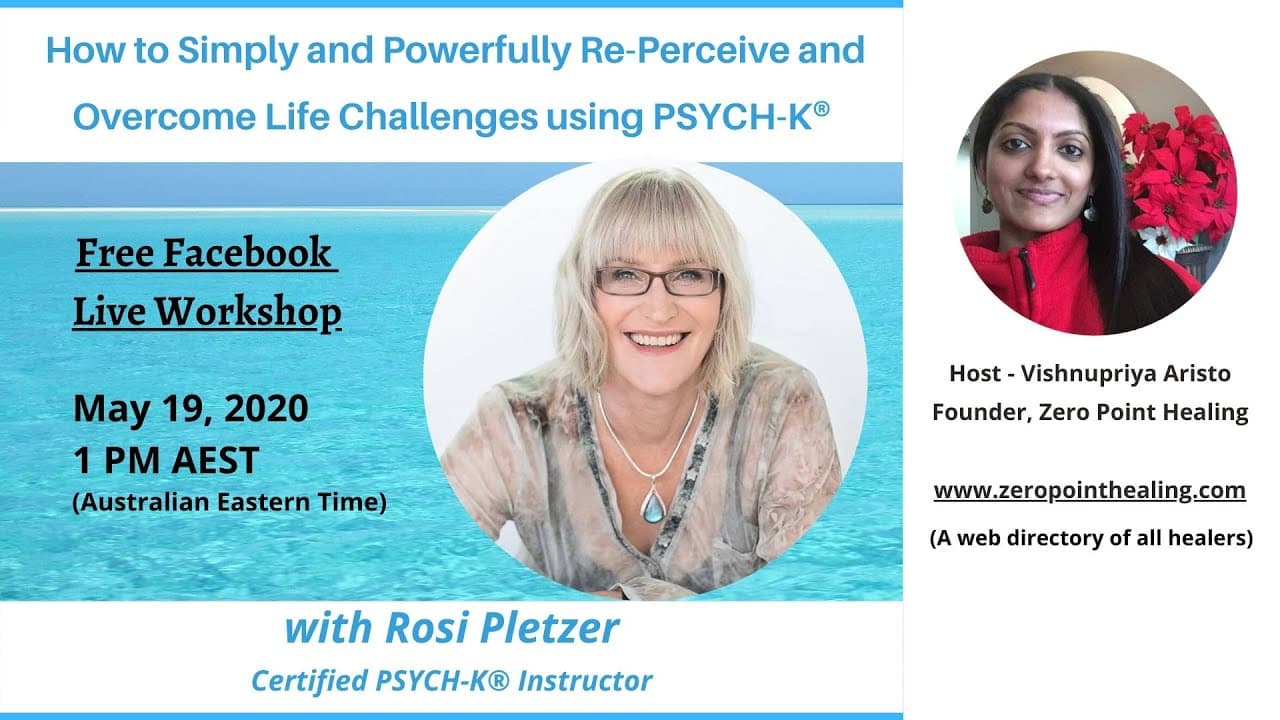
How to Simply and Powerfully Re-Perceive and Overcome Life Challenges with Rosi, PSYCH-K® Instructor
Video from ZeroPointHealing Shows.
Generated from the canonical interview transcript and validated against source data by Guests on Air.
How can changing a subconscious belief help someone overcome a life challenge?
Rosemarie Pletzer says challenges are experienced through subconscious beliefs, which act as filters for most of daily life. When those beliefs contradict a conscious goal, effort stalls. In a PSYCH-K session she helps a person identify the limiting belief, restate the goal in language the subconscious accepts and close with a small action, so the same situation can be met in a new way.
Most people meet a hard season of life by pushing harder or waiting for it to pass. Rosemarie Pletzer, a PSYCH-K instructor based in Canberra, Australia, takes a different view. On the Zero Point Healing Show she explained that how a challenge feels depends on the beliefs it is seen through, and that those beliefs can be changed.
Pletzer came to the work through a difficult time of her own. She had trained as a naturopath, studied nutrition and biochemistry, and run a multidisciplinary clinic. After a basic PSYCH-K workshop she applied the processes at home, noticed simple and natural change in her own life, and later certified as an instructor with the method's originator, Rob Williams.
In the interview she described what she means by re-perceiving, how a private session runs from goal to action step, and why the method treats the client as a partner rather than a patient. She also shared two client stories, one about grief and one about a frightening near drowning, that show what a changed belief can do.
Key takeaways
- Subconscious beliefs act as filters, so a conscious goal stalls when deeper beliefs say the opposite.
- Re-perceiving means editing a limiting belief into a supportive one, then letting it shape future situations.
- A PSYCH-K session moves quickly past the old story and spends its time defining what the person wants instead.
- Each session ends with a small conscious action that shows the analytical mind a change has happened.
1. Why the subconscious decides how a challenge feels
Pletzer starts with a gap many people recognise. Someone can consciously believe they deserve success in their career while a deeper belief insists they are not worthy, not strong enough or not good enough. In her account the subconscious version usually wins, because it is the one that keeps running while attention is elsewhere.
She noted that the conscious mind is often busy with what happened yesterday or what to cook for dinner, while the subconscious stays in the present moment. In her view, subconscious perceptions and beliefs become the filters for most of daily experience. That is why a goal can stall even when a person is putting in real effort.
Her answer is to communicate with the subconscious directly, find the limiting belief and rewrite it. She compares the process to opening a file, editing a line that says I am not worthy into I am worthy, and saving it back to the hard drive, so the next similar situation lines up with what the person actually wants.

2. What happens inside a PSYCH-K session
Pletzer describes PSYCH-K, originated by Rob Williams in 1988, as a set of processes for change rather than a healing modality. She does not heal or fix the person in front of her. She calls that person a partner, and the partner chooses the goals, while she facilitates a session that lines up the subconscious to support them.
A private session, online or in person, usually runs for up to an hour. She spends only a short time on the story, because the partner already knows it well. Most of the time goes into naming the preferred outcome, putting it into language the subconscious can understand, and a balancing process that uses muscle testing as a communication tool.
The session ends with an action step. Because the conscious mind is analytical and inclined to judge, Pletzer wants it satisfied that a change has occurred, so the partner takes a small and concrete action. Afterwards the partner lives from the new normal, notices what has shifted and comes back only if an area still needs work.
3. What changed beliefs look like in real lives
Pletzer says people arrive with every kind of challenge: strained relationships, habits such as smoking or drinking, money that never stretches far enough, repeating patterns, stress and low self-esteem. For her the starting point is not a condition but an experience, the moment someone decides they want something different and wants the subconscious on their side.
One client had lost her husband suddenly two years earlier and had not been able to move on. Once the stress around his death was brought to a state of peace, she set goals to live more joyfully and be more present with her children. Her action step was clearing his clothes from the wardrobe, and within weeks she was reconnecting with friends.
Another client had nearly drowned while swimming and was hiding from people because even talking about it caused stress. After her session she was surprised to find herself discussing the event calmly, as something that had happened and was over, and she could walk along the beach again. Pletzer sees the work heading beyond willpower and positive thinking toward self-realisation.