Entrepreneurship
Sahil Nijhawan on Vision, Persistence and Investors Who Act Like a Jetpack
The Nexus DMC chief explains why founders should pick investors who share their vision, break big goals into steps, and treat a hard reset as a chance to rebuild.
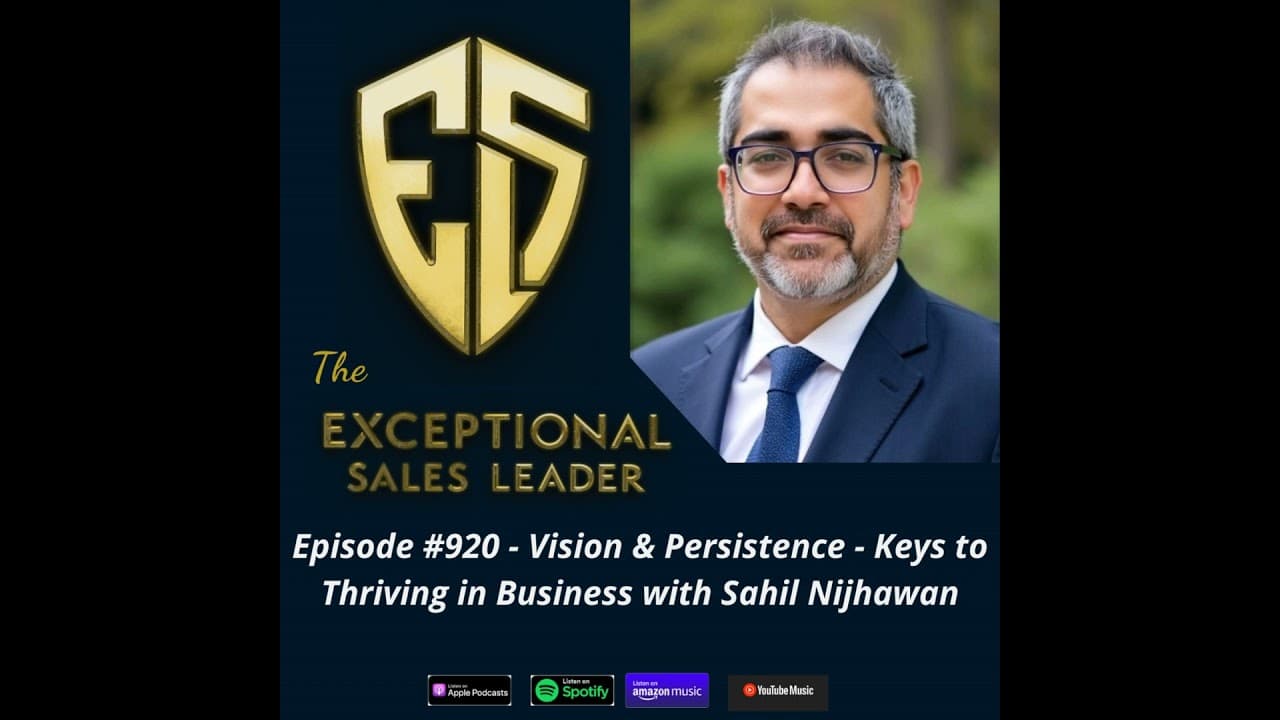
Vision & Persistence – Keys to Thriving in Business with Sahil Nijhawan
Video from Darren Mitchell.
Generated from the canonical interview transcript and validated against source data by Guests on Air.
How should founders balance vision, persistence and investor pressure?
Sahil Nijhawan says founders should write down a clear vision, take money only from investors who share it, and then persist through the setbacks. Big goals work best when they are broken into smaller goal posts, and a forced restart can build the fearlessness that later growth depends on.
Sahil Nijhawan has spent about 22 years in travel, from being one of the first five Expedia employees in Australia to running his own retail travel franchises and a destination management business. Today he leads the Oceania and US business of Nexus DMC, a global travel wholesaler that supports about 190,000 travel agents.
In a conversation with Darren Mitchell on the Exceptional Sales Leader podcast, Nijhawan returned again and again to one idea. Founders need a vision they write down and stay true to, and the persistence to keep going when the business is down and events move beyond their control.
He also spoke frankly about COVID, when his travel business of about 20 million dollars a year had to close after 18 months of lockdowns. The lessons he took from that period now shape how he thinks about investors, growth targets, risk, and the ego that holds many leaders back.
Key takeaways
- Take investment only from people whose vision lines up with yours, or the pressure will grow later.
- A good investor acts like a jetpack for the founder and lets them take their own shots.
- Break a large final target into smaller goal posts, then move each post once you reach it.
- A forced restart can remove fear, and fearlessness is often what lets a founder start achieving goals.
1. Choose investors who share the vision
Nijhawan's first rule on raising money is that the investor must be in line with the founder's vision. He warns against taking half a million or two million dollars simply because someone offers it. If the vision does not align, he says, the founder will feel that pressure in every decision that follows.
When the vision does align, the relationship changes. A good investor, in his view, lets the founder take the shots, because the founder knows the path to the goal. There is still a return to be earned, and he accepts that, but the investor's main job is to support the founder and back the risks the founder chooses to take.
He is equally clear about the bootstrapping route. Almost every growing business reaches a point where personal cash runs low, and raising money in Australia is not easy. His answer is persistence, and to keep talking about the business, because a person met a year earlier may come back, hear the vision again and want to be part of the journey.
2. Break big goals into smaller goal posts
Nijhawan encourages founders to hold a big final target, whether that is 100 million dollars or a billion. He also warns that a huge goal set too early can make founders delusional, so their ideas stay ideas and never get executed. The fix is to break the target into steps that can actually be reached.
He describes these steps as stairs to success. A first goal might be 5 million dollars, then 10, then 20, then 30. Once a goal post is reached, the founder moves it to the next level. Growth can sometimes accelerate between steps, but nobody gets to skip the hard yards at the bottom.
He is wary of social media stories about founders who built huge companies in a few years. Those cases happen, he says, but they are rare. Not everybody has the same start line, so he advises founders to leave that rat race, keep their feet on the ground and run their own journey. Success is not permanent either, he adds, which is another reason to stay humble.
3. What COVID taught him about timing and fear
When COVID closed Victoria, Nijhawan and his wife kept their team of about 20 staff, expecting a three month pause. They also refunded customers in full, while a larger rival kept a fee. Customers loved the decision, but the cash gap kept widening as three months became 18, and the business had to close.
His lesson is about timing. When the biggest player in the market follows a rule, he says, there is usually research behind it. To cover a gap of about half a million dollars he sold assets, went back to work at Coles, launched a small tea brand, and later spent two years selling house and land packages in real estate.
A buyer from those property sales became the investor who backed his return to travel. Nijhawan now calls the whole period a blessing because it made him persistent, pushed him to diversify and removed his fear of starting again. He adds that leaders must drop their ego, sit with staff and fix the system, not blame the person.