Leadership and Mental Health
Nick Jonsson on Why Executives Keep Their Struggles Hidden
In an EGN keynote, Nick Jonsson shared his own story and the survey numbers behind executive loneliness, and argued that change starts when leaders speak first.
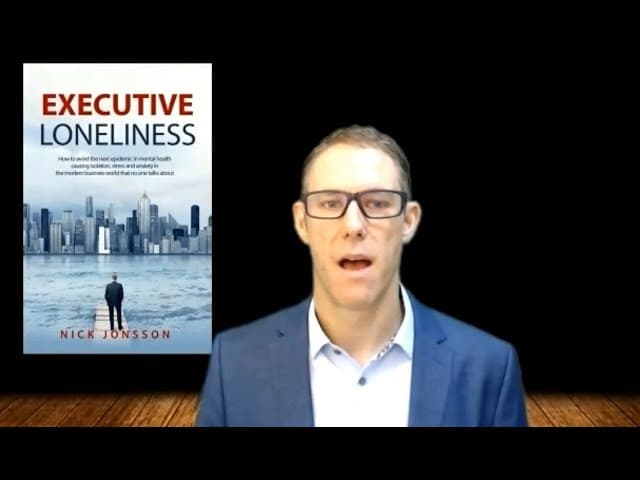
Nick Jonsson - Keynote: Executive Loneliness – The Workplace Isolation No One Talks About
Video from EGN - Executives' Global Network.
Generated from the canonical interview transcript and validated against source data by Guests on Air.
Why do senior executives hide depression and loneliness at work?
Senior executives often hide depression and loneliness because their role rewards looking strong. Conversations with their own bosses centre on targets and costs, not wellbeing, and stigma keeps most of them silent. Nick Jonsson's survey of senior executives in Singapore found that 82 percent would not raise depression or loneliness with their company at all.
Nick Jonsson opened his keynote with a question few companies ask out loud: who is looking after the executives? Leaders carry heavy responsibilities, he told the audience, yet at the end of the day they are human, and the higher they rise in an organization the fewer people they feel able to tell when something is wrong.
He spoke from experience. Over ten years in Vietnam and Indonesia he lost his job twice, once on the same day his wife told him she was pregnant, and each time he kept a poker face. By 2018, newly arrived in Singapore, anxiety, stress and heavy drinking had left him bedridden and convinced his life was over.
His recovery began when he started talking. That turn, and the death by suicide of a colleague who had seemed to have everything, led him to campaign for an end to executive loneliness. In this talk he set out what he had learned from his own story and from surveying senior executives for the book he was writing.
Key takeaways
- Executive loneliness grows with seniority, because the higher a leader climbs, the fewer honest conversations they have.
- Nick's survey of senior executives in Singapore found 30 percent were suffering from depression, six times the global rate.
- Stigma keeps leaders silent: 82 percent of executives surveyed said they would not raise depression or loneliness at work.
- Employees will only open up once their leaders go first, showing vulnerability and admitting they are human too.
1. Lonely at the top is more than a cliche
When a radio host asked Nick to define executive loneliness, he reached for an old phrase: it is lonely at the top. He admits it is a cliche, but says it remains the clearest way to explain what happens as people are promoted. Each step up the ladder removes a layer of peers who share the same pressures and can speak freely.

He gave the example of a general manager in the Philippines who reports to a regional director in Hong Kong or Singapore. Their weekly or monthly call covers targets, deliverables, sales and cost cutting. Very little time is left to ask how the general manager is actually doing, and even when someone does ask, an honest answer is unlikely.
Senior leaders feel they must appear strong, Nick explained, so they say everything is fine and move the talk back to the numbers. The gap between that public answer and what is happening inside is where loneliness takes hold, and if leaders never speak up about it, he warned, that silence can lead to depression.
2. What the numbers say about executives
Nick started with the global picture. World Health Organization figures put the number of people living with depression at around 300 million, or about 5 percent of the world's population. When he looked for equivalent research on senior executives he found nothing, so his team at EGN ran its own survey of senior executives in Singapore.
The results were stark. Thirty percent of the executives who responded said they were suffering from depression, a rate Nick describes as six times higher than the global average. The survey was completed before the COVID-19 pandemic, which he believed was adding to the strain as businesses shrank, jobs disappeared and leaders were cut off from colleagues and family.
Silence made the problem worse. Globally, 75 percent of people who need mental health support do not seek it because of stigma, and his Singapore survey found 82 percent of executives would not discuss depression or loneliness with their company. The research fed into his book, Executive Loneliness: The 5 Pathways to Overcoming Isolation, Stress, Anxiety & Depression in the Modern Business World.
3. Why leaders have to speak first
Nick's own turning point came from talking. He told his wife, his former wife and his parents what was happening, then saw doctors, two counsellors and a family counsellor. He dealt with an alcohol problem and stopped drinking, and just over a year after the lowest point he finished Ironman Sweden in 13 hours.
He also warned that the modern workplace can deepen isolation. Speaking at a digital transformation forum in Singapore, he argued that leaders who communicate mainly by email and messaging miss facial expressions and real connection. People once belonged to local clubs, teams and societies that built close friendships, and he believes much of that has now disappeared.
His central message for executives was simple. Talk to people about whatever you are feeling, and check in with your employees. They will not open up, he said, unless leaders do it first, by being vulnerable, showing that they care and admitting that executives are not perfect, make mistakes and can suffer like anyone else.