Leadership
Nick Jonsson on Ending the Stigma of Executive Loneliness
Two redundancies, a health crisis and the loss of a friend taught Nick Jonsson why senior leaders suffer alone, and why one honest conversation can start to change that.
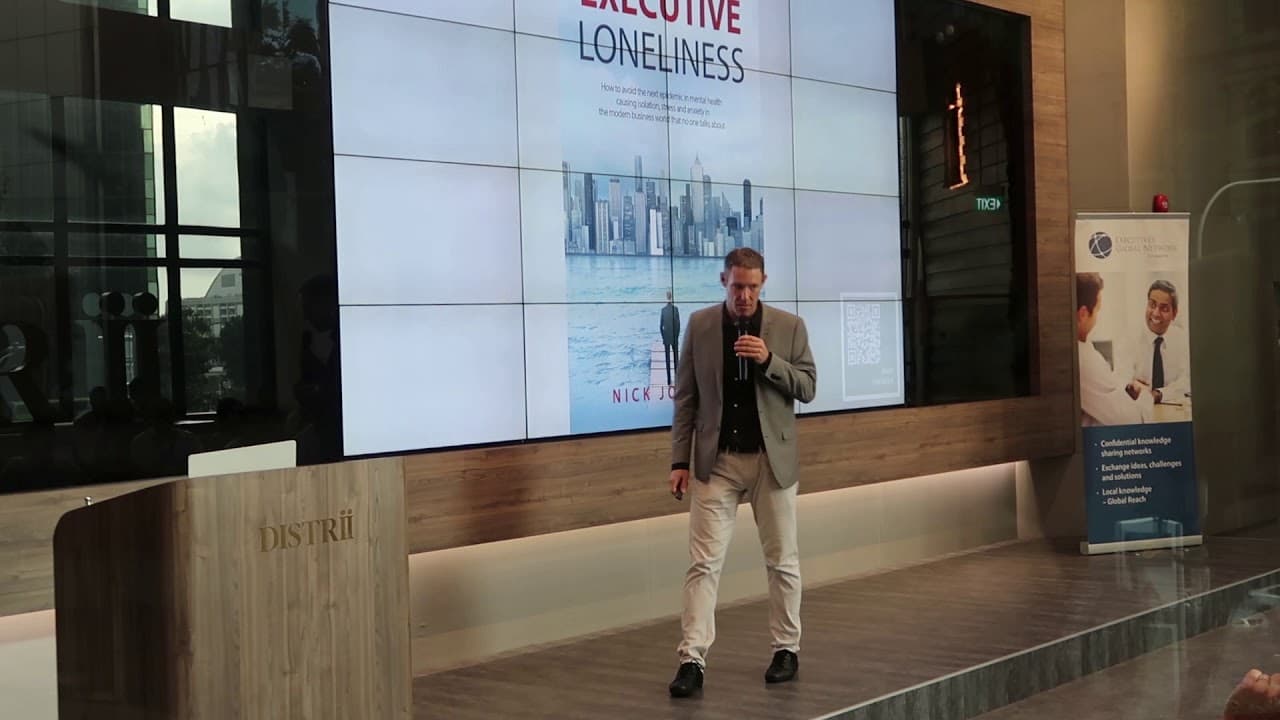
Celebrating the End of Executive Loneliness
Video from Nick Jonsson.
Generated from the canonical interview transcript and validated against source data by Guests on Air.
Why do senior executives hide loneliness and depression, and how can they start to recover?
Senior executives often hide loneliness and depression because stigma makes asking for help feel like a career risk, and because the people around them rarely ask how they really are. Nick Jonsson says recovery starts by telling the truth to one trusted person, then widening that circle to doctors, peers and people who have faced the same struggle.
Nick Jonsson opened his keynote on executive loneliness with a blunt line: he should be dead. By his own account, a string of career shocks across Vietnam, Indonesia and Singapore left him isolated, drinking to cope and physically breaking down. He came through it, but a friend in Singapore did not, and that loss turned a private story into a public campaign.
His argument is that loneliness at the top is not a lack of people. Regional leaders sit on weekly calls, visit their teams and host dinners, yet almost nobody asks how they are really doing, and they rarely volunteer the truth. That silence, reinforced by stigma, means many senior executives make the biggest decisions of their lives entirely on their own.
Speaking to an audience of executives in Singapore, Nick walked through what happened to him, what his own interviews with senior leaders suggest, and the practical steps that brought him back. The subject is serious, but the aim of the talk was hopeful: to celebrate the start of the end of executive loneliness by getting leaders to talk about it openly.
Key takeaways
- Executive loneliness means feeling disconnected while surrounded by people, because almost no one at work asks how you really are.
- Stigma keeps leaders silent; Nick cites global figures showing that 75% of people who need help do not seek it.
- His recovery began when he told the whole truth to one person, then to doctors and peers who had faced the same struggle.
- Honest conversations with trusted peers lead to better decisions than the ones leaders make alone under pressure.
1. How a career built abroad became a lonely one
Nick's first major blow came in 2008 in Ho Chi Minh City, where he was National Sales Manager for a Swedish cosmetics company. After clashing with a new managing director, he was let go. That same evening his then wife told him she was pregnant. As an expat, his home, medical insurance and work permit were all tied to the job, so everything went at once.
He rebuilt, landed a strong role and was later promoted to Indonesia by a French fashion company. Soon after the family settled in Jakarta, the company was sold and he was among 300 senior executives let go. Wanting to play the tough man, he asked his wife to take their son back to Sweden while he sorted things out on his own.
Even after landing a deputy general manager role, he lived with constant anxiety that he would be let go again. About a year and a half in, he resigned rather than wait for it to happen, and he told nobody the real reason. Looking back, he calls the decisions he made alone some of his worst, and says trusted people could have helped him.
2. What executive loneliness looks like from the inside
By early 2018 Nick had moved to Singapore to run the local business of a peer network for executives, hoping for a fresh start. Instead, the pressure of rebuilding it pushed his own health aside. He relaxed with drinks after work, slept badly and put on almost twenty kilos by March 2018, while keeping the struggle hidden from everyone around him.
Doctors told him his health was in a dangerous state. Frightened, he began preparing for his own death, writing a will and sending documents to his family. He even learned that the average age of men on his father's side was 44. The turning point came from the woman who would become his wife, the first person he told everything to.
Nick describes executive loneliness as feeling disconnected even when surrounded by people. A regional director may report to the US or Europe on weekly calls that ask whether the business is on track, but rarely ask how they are. Teams are visited once a month or once a quarter, and family is often left behind while the leader travels across Asia.

3. How leaders can start the way back
A year into his recovery, Nick's friend Simon died by suicide in Singapore. On the outside Simon looked happier than ever, which showed Nick that no one can see what is happening in someone else's head. With the support of Simon's brother, he launched a campaign on executive loneliness and raised money for Samaritans of Singapore, a suicide prevention agency.
His own recovery began by speaking to one person and telling the truth. He then gave doctors the full story, got the treatment he needed and, despite the stigma, walked into his first Alcoholics Anonymous meeting. There he met other senior executives who had spent years alone in hotel rooms, using drinks after team dinners as their only way to relax.
He also replaced drinking with healthier habits, working with a coach who tracked his walking, diet and sleep. Just over a year after struggling to put on a sock, he took on an Ironman in Sweden. Readers who want his fuller framework can turn to his book, Executive Loneliness: The 5 Pathways to Overcoming Isolation, Stress, Anxiety & Depression in the Modern Business World.