Leadership
Julian Reeve on Why High Achievers Burn Out and How Self-Awareness Helps
Burnout specialist Julian Reeve explains why driven, creative leaders resist looking at the habits that wear them down, and how self-awareness, authenticity and strategy change that pattern.
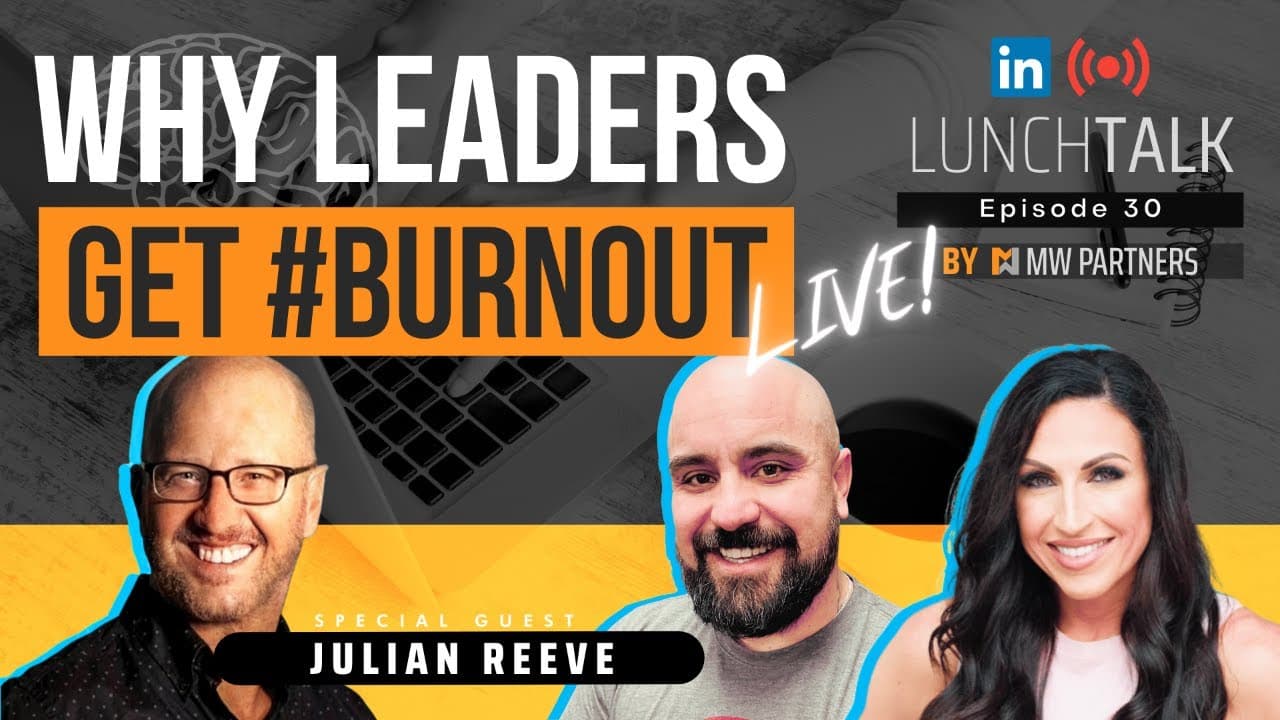
Why do LEADERS experience BURNOUT? 4 Steps to take CONTROL for HIGH ACHIEVERS
Video from MW Partners.
Generated from the canonical interview transcript and validated against source data by Guests on Air.
Why do high-achieving leaders burn out, and how can self-awareness help?
High achievers often burn out because they value the very traits that drain them, such as perfectionism and workaholism, so they avoid examining them. Julian Reeve recommends measuring those pressures first, then building daily self-awareness, noticing when behaviour is driven by ego rather than authenticity, and turning that knowledge into a deliberate personal strategy.
Leaders who run hard for years tend to treat exhaustion as the price of success. On a live leadership programme, keynote speaker and burnout specialist Julian Reeve argued that the price is optional, and that the warning signs usually arrive long before a breaking point forces anyone to change.
Julian Reeve spent more than two decades as a music director and founded several creative companies before turning to the study of burnout. That work led to a framework called Perfect Equilibrium, built around four steps: understanding creative interference, developing self-awareness, practising authenticity and building a personal strategy.
The conversation focused on a group Reeve calls creative high achievers: driven people who often succeed because of the habits that later wear them down. Reeve's central claim is simple. People who measure what drives them, and listen to what their bodies are already saying, can keep their ambitions without paying for them in burnout.
Key takeaways
- Reeve names six forms of creative interference: perfectionism, workaholism, anxiety, stress, loneliness and low self-esteem.
- High achievers often protect the traits that hurt them, so a measured baseline helps them take the problem seriously.
- Three morning questions build self-awareness: what am I thinking, what am I feeling and what am I sensing.
- Authenticity means knowing when the authentic, adaptive or performing self is in charge, and choosing that role on purpose.
1. Why high achievers resist looking at burnout
After a period of research into what had been driving the strain in Reeve's own career, Reeve concluded that creative high achievers are largely governed by six pressures. Reeve groups perfectionism, workaholism, anxiety, stress, loneliness and low self-esteem under one name, creative interference, and treats them as forces that quietly steer decisions.
The obstacle, in Reeve's experience, is that ambitious people rarely want to examine those forces. Because they have achieved a lot, they value what they have and fear that changing a habit will cost them their edge. Many would rather stay in stress and anxiety than question the drive that brought them success in the first place.

Reeve's answer is evidence. The Perfect Equilibrium approach draws on established psychometric tests, written and refined by psychologists, to give each person a baseline for all six areas. Reeve stresses that the scores are not a diagnosis, but they show how strongly each pressure is operating, which gives a sceptical high achiever a reason to act.
2. Three questions that build daily self-awareness
Self-awareness is the second step, and Reeve argues that most people overestimate how much of it they have. Citing organisational psychologist Tasha Eurich's research for the book Insight, Reeve noted that around 95 percent of people believe they are self-aware, while the real figure sits somewhere between 12 and 15 percent.
To close that gap, Reeve suggests a short routine before getting out of bed. The first question is what am I thinking, answered specifically rather than with a vague sense of being busy. The second is what am I feeling. The third is what am I sensing, done as a simple body scan from the top of the head downwards.
Reeve believes the third question matters most for burnout, because the body often signals trouble long before the mind accepts it. A tight shoulder or a persistent ache becomes useful information that can shape new habits. Reeve also recommends asking what rather than why, since what questions lead to direct answers and forward movement.
3. Authenticity, acceptance and a personal strategy
The third step begins with acceptance. Reeve says high achievers must admit that much of their drive may come from ego or low self-esteem rather than from what they truly want. Reeve described a concert promotion venture that lost a great deal of money largely because the motive behind it was not authentic, a lesson that only became clear in hindsight.
Reeve draws on the authenticity principle, which describes three selves people move between: the authentic self, the adaptive self that compromises for a smoother situation, and the performing self that conforms to what others expect. Playing all three is normal. The problem starts when the adaptive or performing self speaks far more often than the authentic one.
The final step, strategy, turns those insights into a plan: keep what works, drop what does not and track the results. Reeve also places weight on community, because creative high achievers often believe they face these pressures alone. The aim is not to abandon ambition but to pursue it with self-compassion, so that the goal stays in place while the cost comes down.