Leadership
Hugo Brooks on Separating Ambition From the Goals You Inherited
The ambition strategist argues that the drive to improve never fades with age, but the destinations we point it at need questioning far more often than most people allow.
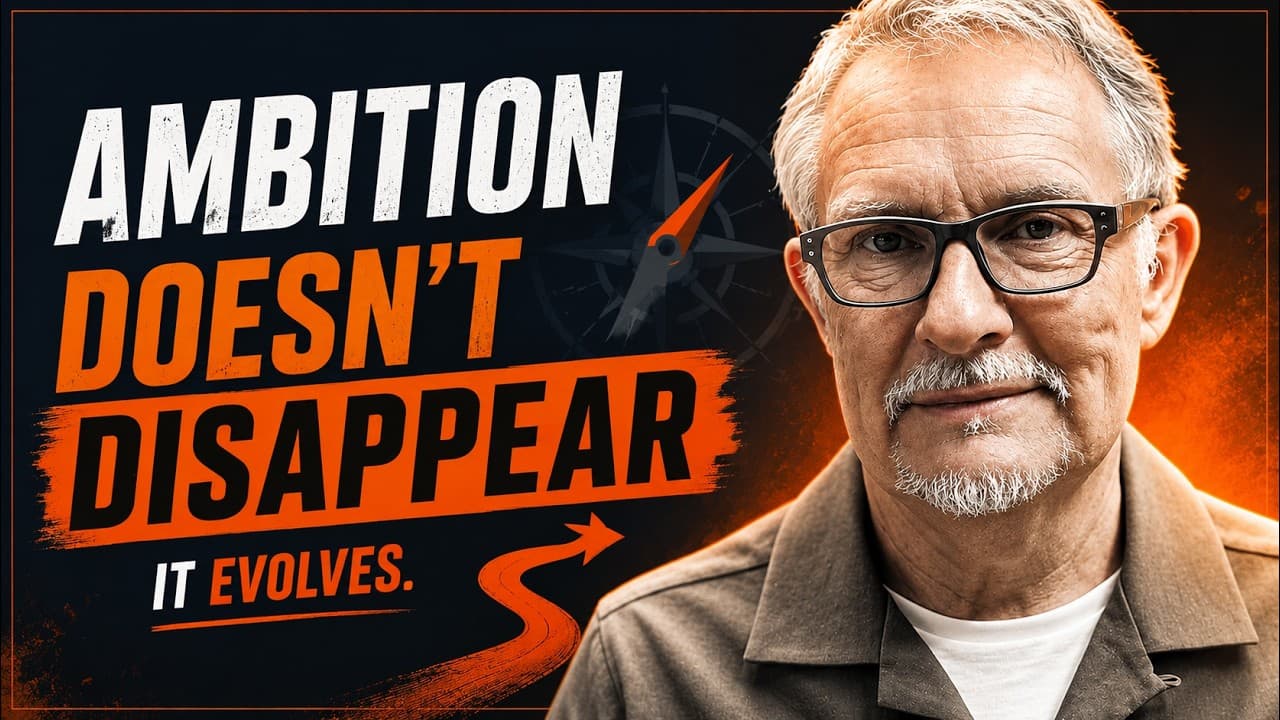
Does Ambition Fade After 50? Rethinking Success, Purpose and Goals
Video from What Happens Next.
Generated from the canonical interview transcript and validated against source data by Guests on Air.
How can you tell whether your goals are really your own?
Hugo Brooks says the first step is to see ambition as a separate force from the goals it chases. Once you do, you can put your goals on the table, ask where each one came from, and test it against your values and a fast-changing world. Many people find a clear mismatch, and that gap is where redesign begins.
Most people talk about ambition as if it were a destination: selling a company, reaching a senior title, owning the big house. Hugo Brooks, who spent more than 30 years running brand and innovation consultancies for global clients, says that framing hides a quiet problem. On What Happens Next, he explained why ambition is a force in its own right, and why the goals we attach to it deserve far more scrutiny.
His own turning point came when his wife asked whether he really wanted to rebuild his business through yet another downturn. He had never asked himself that question. When he did, the honest answer was no, so he let his management team take the company on and stepped away, left with a sudden vacuum and a question about what had been driving him all along.
That question led him to talk with between 30 and 40 very driven people, many of them business founders, and to write a book on the subject. What he found reframes ambition for anyone facing a transition, whether in their fifties, their sixties or their twenties, as work, technology and the familiar career ladders shift beneath them.
Key takeaways
- Ambition is the human drive to make tomorrow better than yesterday; goals are only where we choose to point it.
- Many goals are inherited from parents, peers and social pressure, so ask where each one came from before chasing it.
- Review your goals regularly, because they may need to change completely several times over a lifetime.
- Treat progress as experimentation: expect to fail, learn and try again rather than cling to one fixed strategy.
1. Ambition is the force, not the destination
Hugo draws a sharp line between ambition and the goals it serves. In his view, society defines ambition through specific destinations and material markers such as money, career ladders and company sale prices. Those, he says, are simply ways we use ambition. The force itself is the desire to make tomorrow better than yesterday, and unlike other species, humans have no natural stop button for it.
He illustrates the point with a lion that kills an antelope, eats it over several days and only then hunts again. People behave differently: as soon as one thing is achieved, they want the next. That restless energy can build extraordinary things and can also do great harm, which is why Hugo argues it has to be recognised as a power and used consciously rather than left on autopilot.
Seeing ambition as a separate force changes the question people ask themselves. Instead of asking how to reach a goal faster, they can ask what they really want and whether the destination they chose still fits. For Hugo, the real mistake is not picking the wrong goal but never examining the choice at all, which is what kept him on the same roller coaster for decades.
2. Why so many goals are borrowed
Hugo believes most of us inherit a vision of what our goals should be. Some of it comes from parents, whether we copy their path or reject it, and much of it comes from a social environment that defines success in narrow terms. He compares it to joining a crowded motorway where everyone races, compares cars and overtakes, while nobody asks where the traffic is actually heading.
His own early career shows the cost. He built a successful design consultancy in his twenties, lived the high life and then lost everything within a few months. At that same moment he was starting a young family, and he now says his real destination should have been security and stability. He missed it because he never questioned the direction he was being pulled in.
When he works with clients today, he asks them to put their goals on the table, understand where each one came from and then compare them with their personal values. Many people discover a significant mismatch, and some find no link between the two at all. Values usually carry more meaning than inherited goals, which is why that comparison is where the real work begins.
3. Goals that keep pace with a changing world
Hugo argues that goals need attention at regular points throughout life, not just once, and that they may need to change completely several times. The pace of change makes this more urgent. He sees AI as the next stage of language development and expects work, education and the way people earn money to look very different within five years, removing many of the obvious ladders.
Rather than a single goal, he helps clients build what he calls a goal stack: several goals that work together and are reviewed often, asking what has changed and what has been learned. The route towards them then becomes a learning journey rather than a striving endeavour, because most success comes from experimenting, failing and learning, not from an unbroken run of wins.
He also warns against switching ambition off after reaching a goal, calling that extraordinarily dangerous both physically and mentally, because achieving a goal does not diminish the force. His book, Ambition: Redefining Success for a Restless Age, which he is publishing in four parts, explores these ideas, and host Chris suggested its questions matter as much to people in their twenties as to those nearing retirement.