Fundraising
How underrepresented founders can raise money on an uneven playing field
David Horne's practical playbook for female and ethnic minority founders: share the load, target the right funds and never pitch small.
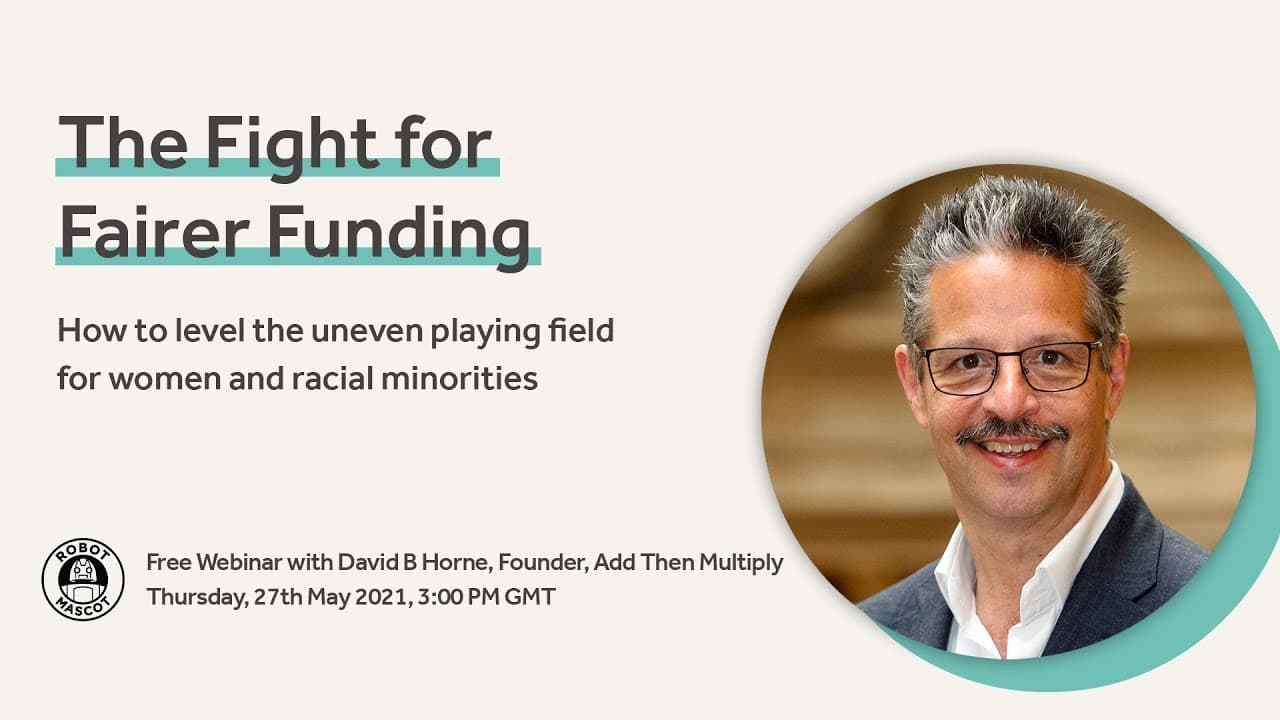
The Fight for Fairer Funding (with David B Horne)
Video from Robot Mascot.
Generated from the canonical interview transcript and validated against source data by Guests on Air.
How can female and ethnic minority founders improve their chances of raising investment?
David Horne advises founders to persevere, bring their core team and an experienced CFO into the raise, research the funds that already back female or ethnic minority founders, and tailor a pitch to a short list of likely investors. He also warns against conservative projections, because venture capital funds rely on a few large wins to return the whole fund.
Raising money is hard for any founder, and harder still when the investors across the table rarely look like you. In a Robot Mascot interview, David Horne, the CFO turned scale up adviser behind Add Then Multiply, set out what female and ethnic minority founders can do now, while the wider fight for fairer funding plays out.
His starting point is a set of numbers he could not ignore. A British Business Bank study of every UK venture capital deal in 2017 found that all female teams sent five percent of the pitch decks and received less than one percent of the money. All male teams sent 75 percent of the decks and took more than 89 percent.
Horne does not pretend founders can close that gap alone. He is working on it at the macro level through events, research and a parliamentary group. But his advice to the founders on the call was practical: build a team for the raise, find the investors who already back people like you, and pitch the ambition investors are paid to look for.
Key takeaways
- Fundraising is a second full time job, so bring your core team into the process instead of raising alone.
- An experienced CFO who has raised before can carry much of the load, even when hired on a contract basis.
- Research the funds that back founders like you and tailor the pitch to 20 investors, not hundreds.
- Do not pitch a conservative plan, because venture capital models need a few businesses to return the whole fund.
1. Build a team for the raise, not just the business
The first thing Horne tells founders is to persevere. The second, and in his view the more important, is to stop raising alone. Fundraising, he said, is hard work and a full time job on top of running the business. Whoever sits in the core team, whether a CTO, a COO or a CFO, should be brought into the discussion and the process so the burden is shared.
Horne trained as a chartered accountant with PwC and spent a decade as CFO of three companies that raised money and bought other businesses, so he admits he will always plug the finance role. His point is that a CFO who has been through a raise before is immensely helpful, and founders do not need one full time. Many can be hired on a contract basis.
The same thinking applies to early team members who say they will join once the money lands. Horne recommends offering key people the chance to buy a small stake, even at nominal value, so they put their own money in. People sitting on the sidelines waiting for equity and a salary, he warned, look less like a committed founding team and more like opportunists.
2. Find the investors who already back founders like you
Horne's third piece of advice is homework. There are a huge number of venture capital funds, and spraying a deck at hundreds of them and praying is, in his view, a poor use of a founder's time. Far better to research up front and tailor the pitch to 10, 15 or 20 investors who are much more likely to respond the way you want.
He showed how this works with a client he was raising for at the time, a female founded edtech business led by an ethnic minority founder and qualifying for EIS. An initial search produced a list of nearly 400 investors that fit the criteria and deal size. His team then went through every one systematically and drew up a heat map to see where the criteria overlapped.
The heat map also showed where not to go. Horne would steer a female or ethnic minority founder away from the big generalist EIS funds and toward funds that specifically back female, Black or Asian founders. At the angel stage the logic is similar, though angels often sit in syndicates, so the job becomes finding the gatekeeper and asking who in your network knows an angel.
3. Pitch the stretch investors are paid to look for
One pattern Horne has read about in numerous places, and saw again in a recent Management Today article, is that female founders tend to ask for less. Their plans are more conservative and more realistic, while male founders often pitch becoming a unicorn within months. He wants female founders to be bolder with their ask and their projections, and above all not to be conservative.
The reason lies in how venture capital works. Horne explained that out of 10 investments, a fund expects two to fail outright and six or seven to trundle along. One or two take off, and those are the businesses that return the fund and the profits to its investors. A plan that promises a modest return, however solid the business, does not fit that model.
He accepts this can feel perverse, since a founder who misses aggressive numbers faces a difficult conversation later. But at the first round, he said, a founder cannot be too conservative or the money simply will not come. The plan needs a stretch the founder genuinely believes in, and a founder who does not believe in it is probably better off looking beyond venture capital.