Addiction recovery
How Maria Power measures recovery capital after addiction
Maria Power argues that lasting recovery is built from resources a person can score and grow, from health and housing to purpose and support, and that the right role model speeds the climb.
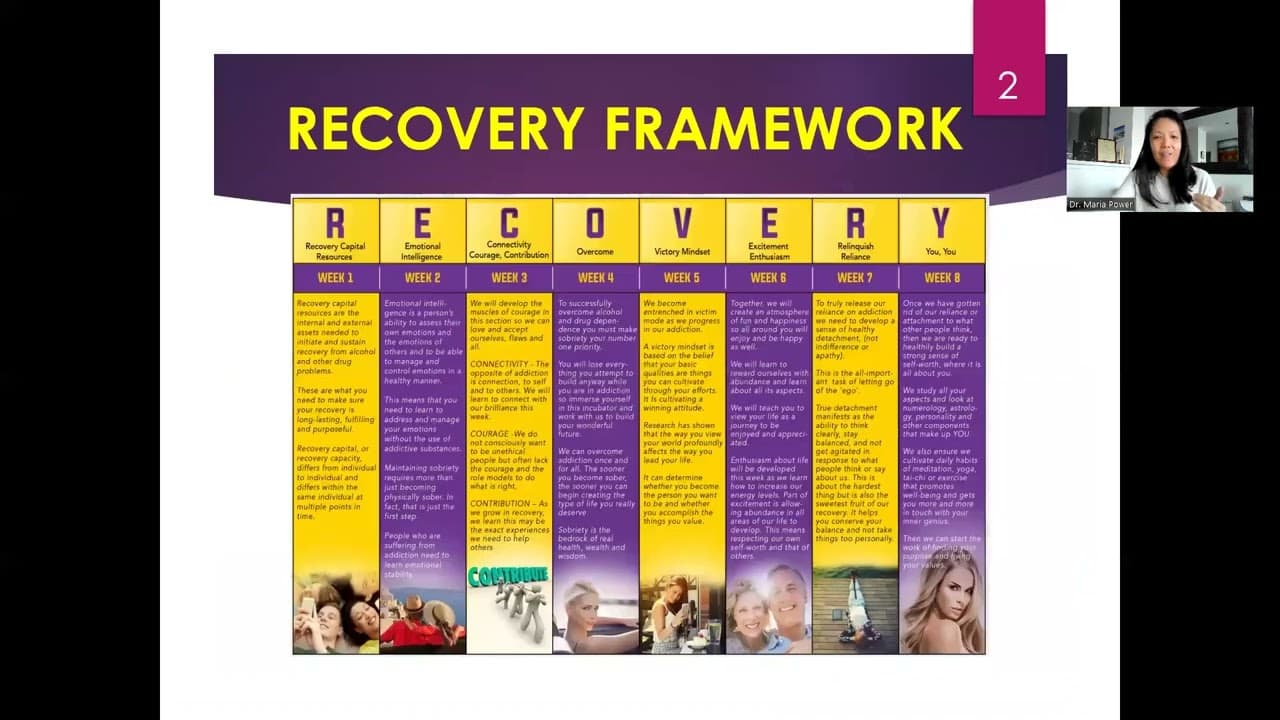
20 minute presentation by Dr M Power about the 8 Week Incubator Program
Video from Helping you create permanent transformation.
Generated from the canonical interview transcript and validated against source data by Guests on Air.
How can a person measure their recovery from addiction?
Maria Power measures recovery through recovery capital: the resources a person can draw on, such as psychological and physical health, housing, safety, meaningful activity and social support. She scores these out of 50, so a client and coach can see where a life has thinned out, plan the work week by week and track progress over time.
Most conversations about addiction recovery start and end with sobriety. Maria Power, an addiction specialist and recovery coach, treats sobriety as one resource among many. In a 20 minute presentation on her eight week incubator program, she explains how recovery capital, the set of assets a person can draw on, can be scored and rebuilt step by step.
Her case rests on both research and lived experience. For her doctorate she scored the recovery capital of 18 clients over a year, on a scale from 0 to 50. She also brings a history of psychiatric hospitalisations in four countries and many addictions, which she now uses to show clients that a different life is possible.
The presentation covers what recovery capital includes, why the scale of addiction and mental health problems makes it urgent, and what she sees as the fastest route out: a role model who has been through the same problems and come out the other side. Each idea points to practical changes a person can start making this week.
Key takeaways
- Recovery capital covers far more than sobriety, including health, housing, safety, meaningful activity and social support.
- Scoring recovery capital from 0 to 50 turns a vague goal into progress that a client and coach can track.
- In her doctoral research, clients who began with scores as low as 3 and 7 reached scores of 48 and 41 within a year.
- The quickest model for recovery is a person who has faced the same problems and overcome them.
1. What recovery capital actually measures
Maria Power describes recovery capital resources as the assets a person can lean on to stay well. Her list runs well beyond staying sober. It includes psychological and physical health, meaningful activities, citizenship and community, recovery experience, life functioning, housing and safety, social support and risk taking. Each area adds to, or takes away from, the chance of a lasting recovery.
Her framework scores these resources out of 50. A low score shows where a life has thinned out, whether that is unstable housing, poor health or no one to call. A high score, in her words, would set a person in good stead for a sustainable long term recovery. The number gives coach and client a shared starting point.
She builds her eight week program around the same idea. The word recovery becomes an acronym, with each letter standing for one week of work. Alongside the scoring, she brings in habits such as sleep, exercise, food, yoga, tai chi and qigong, and also money, which she frames as one more resource a person has to learn to manage.
2. What the research showed
Maria Power completed a doctorate in professional research studies on recovery capital. She plotted the scores of 18 clients across a one year period, using the same 0 to 50 scale. She describes the results as mind boggling for her supervisors: people who started with scores of 3, 7 and 18 were reaching scores of 48 and 41.
Her academic path ran alongside her own recovery. She earned a bachelor's degree in psychology and philosophy and a master of public health in the field of alcohol, tobacco and other drugs before the doctorate. She says her coaching work now includes around 1,600 recorded sessions of an hour each with people facing multiple addictions.
She places this work against a large problem. She cites Australian figures showing that 256,380 recipients of the disability support pension declared a psychological or psychiatric impairment. She also points to global burden of disease research that ranks alcohol, tobacco, drug and mental health problems fifth among 291 disease burdens.
3. Why a role model speeds recovery
For Maria Power, the solution starts with a role model. She argues that a person who wants to change their life has to raise their standards, and that the clearest way to do that is to copy the behaviour of people who are living well. Ideally, that person has faced addiction or mental health problems and found a way through.

Her own story is the reason she offers herself in that role. She arrived in Australia from the Philippines alone at 11, and later went through eleven psychiatric hospitalisations in four countries, eating disorders and many addictions. In 2012 she entered a monastery, shaved her head and spent four and a half years in daily meditation, qigong and yoga.
She also links the mind and the body. When people are not right in the head, she says, they will not be right in the body, so she treats physical care as part of recovery rather than an extra. She says she never knew how to look after her body before, and a recent health check put her heart age at 30 when she was 45.