Leadership
How Leaders Can Handle Pressure Without Burning Out
Psychotherapist Amar Dhall explains what stress does to a leader's body and judgment, and the habits that keep the best leaders steady when the pressure rises.
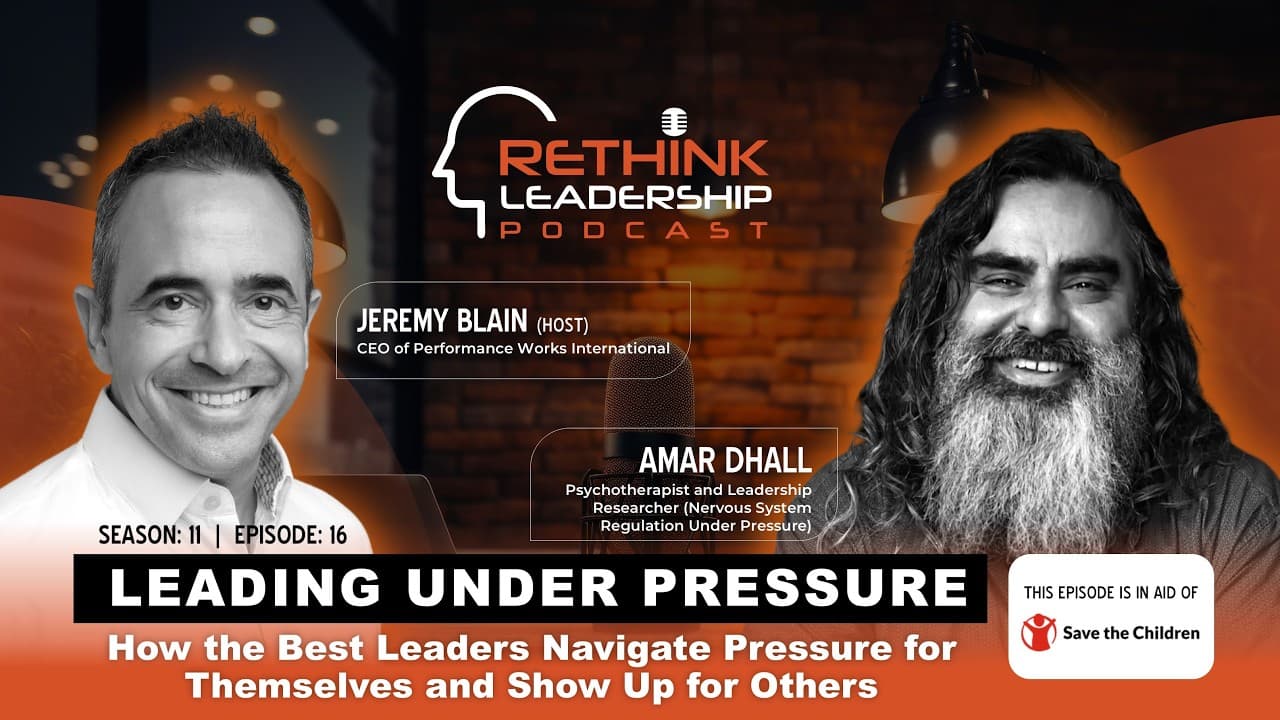
S11E16: Leading Under Pressure: How Best Leaders Navigate Pressure for Themselves & for Others
Video from Rethink Leadership Podcast with Jeremy Blain.
Generated from the canonical interview transcript and validated against source data by Guests on Air.
How can leaders handle pressure without burning out?
Leaders handle pressure best when they learn to read the signals in their own body, treat recovery as part of the job and stop overfunctioning for their teams. Amar Dhall says stress is something people metabolize, and the leaders who last are the ones who build enough support and capacity to absorb it before it turns into rigid, reactive behaviour.
Most leaders know what pressure feels like, but few have been taught what it is doing to them. Amar Dhall, a psychotherapist and leadership researcher, spends his working life on that gap. He founded the Neuro-Somatic Leadership framework, which treats leadership development as training a person's state under load so that clarity and judgment stay available.
Speaking with Jeremy Blain on the Rethink Leadership Podcast, he described how stress builds in stages. A little pressure sharpens attention. More of it narrows thinking into right and wrong. Keep going and people become anxious, short tempered and blind to the cues around them, until the nervous system can no longer cope and they tip into overwhelm.
His answer is not a list of productivity tricks. He argues that the leaders who hold up best have learned to listen to their bodies, built a web of support around themselves and made recovery a deliberate habit. Those choices, he says, shape the culture their teams work inside every day.
Key takeaways
- Most nerve fibres in the vagus nerve carry signals from the body to the brain, so reading your body is a learnable leadership skill.
- Rising stress first sharpens focus, then collapses thinking into binary choices, then shuts down the social cues leaders rely on.
- Leaders who become recovery experts can carry more pressure, because they metabolize stress instead of storing it as tension.
- Under strain, the best move is often to stop overfunctioning and shift focus from what you do to who you want to be.
1. What pressure does to a leader
Dhall starts with the body rather than the mind. He points out that 80 percent of the fibres in the vagus nerve carry information from the body up to the brain. That makes the body a kind of antenna, and he believes learning to interpret its signals is a skill anyone can build. He wants leaders to learn the obvious signals in themselves before they chase subtle ones in others.
He cited a 2021 Cambridge University study of share traders, a high pressure job with large consequences. It found that traders with stronger awareness of their internal body signals tended to last longer and earn more. For Dhall, that is evidence that sensing what is happening inside you is not a soft extra. It is part of performing well when the stakes are high.
When the pressure keeps rising, he sees a predictable slide. Early stress can be energising. Then thinking turns binary and outcome at any cost takes over. Anxiety, quick temper and unhealthy coping follow, and the social engagement system gradually switches off, so leaders miss cues from their teams. If nothing changes, the result is overwhelm, disengagement and eventually health problems.
2. Why recovery is part of the job
Dhall describes stress as something people metabolize. Handled well, experience is digested and turned into growth. Traumatic stress, in his framing, is what happens when that process fails and the load cannot be absorbed. Good leaders understand this and surround themselves with support, which may include an emotionally intelligent coach who helps them build self awareness and self management.
He uses a simple image to explain capacity. Put a few spoonfuls of salt into a cup and it will not dissolve. Put the same salt into a bucket and you get brine, and in a swimming pool you barely taste it. Leaders who live in their heads have a small container, and tension in the shoulders and body stops emotion from spreading out and settling.
At the practical level, the best leaders become recovery experts. One chief executive Dhall works with has a standing prescription of three hours of surfing a week. It is not a reward for hard work but his highest flow activity, the place where he reconnects with his body. Dhall encourages every leader to find whatever reliably puts energy back in and to protect it.
3. Three small shifts for leaders under load
Asked for small actions, Dhall first warned that there are no shortcuts to quality. His first suggestion is to resist overfunctioning. When times get hard, many leaders take on more work, pick up the slack and lead from the front. He invites them to stop, because that habit is one of the fastest routes to burnout and bitterness, and it closes them off from their people.
The second shift is to move attention from what you need to do to who you want to be. Once someone reaches senior leadership, he argues, who they are matters more than what they know. That is what invites loyalty, meaning and succession. He links it to psychological maturity, and to the idea that a good leader is humble rather than weak, with humility cultivated over time.
The third is to become a recovery expert for yourself, then look at your team through the same lens. That does not mean going soft on performance. It means building accountability and culture in a way people can sustain. Dhall compares it to the difference between climbing a mountain and learning to live at altitude, where shelter, water and support for others matter as much as the climb.