Leadership
Duncan Brand on Why People-First Leadership Beats Employee-Centric Management
The leadership advisor explains why slogans fail, why annual reviews backfire, and why the wrong promotions create a circle of misery.
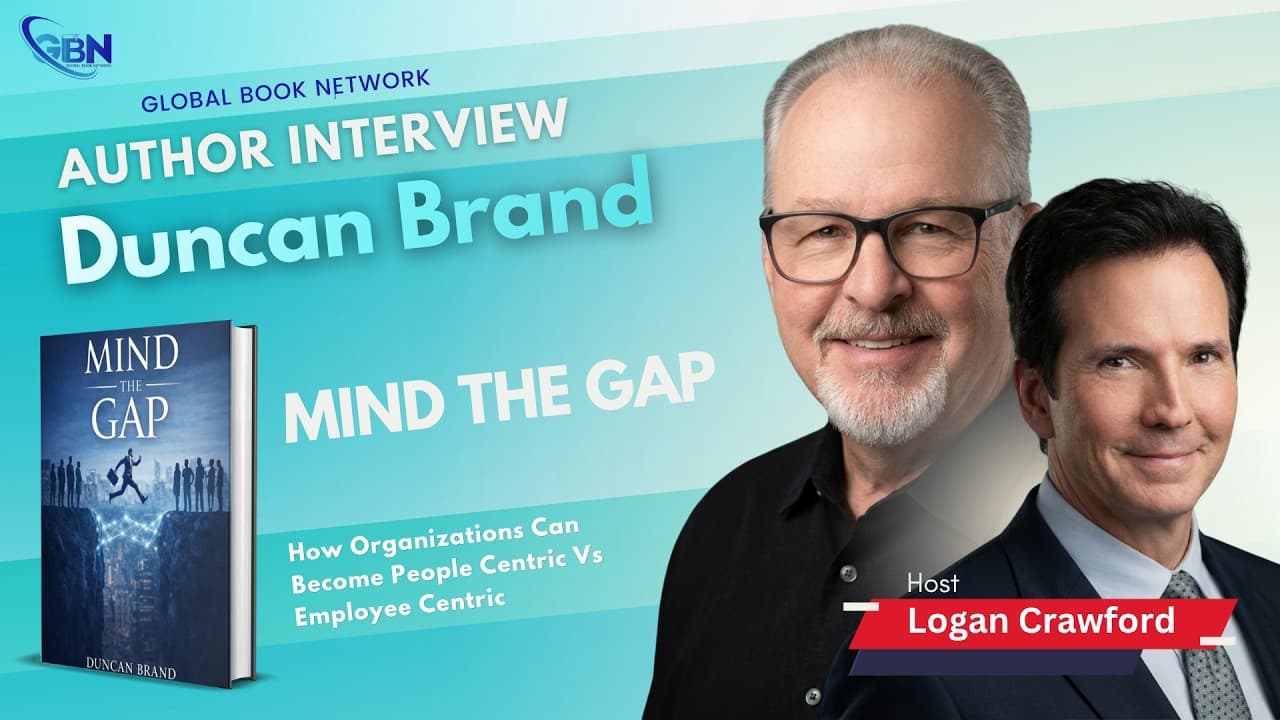
Global Book Network - Duncan Brand, Author of MIND THE GAP
Video from Global Book Network.
Generated from the canonical interview transcript and validated against source data by Guests on Air.
What is the difference between a people-centric and an employee-centric organization?
An employee-centric organization treats staff mainly as resources for output, managed through slogans and yearly reviews. A people-centric organization connects with them as human beings first, through regular and mindful conversations, ongoing coaching and careful choices about who becomes a manager. Duncan Brand argues the second approach lifts morale, productivity and retention, because results follow how people are treated.
Most organizations say they put people first. Duncan Brand, an author and leadership advisor, argues that very few actually do. In a Global Book Network interview with host Logan Crawford, he explained why the distance between company slogans and daily behaviour is costing employers their best people, and what leaders can change, starting with the conversations they hold every week.
Brand draws a sharp line between being employee centric and being people centric. An employee-centric company sees staff as tools for output. A people-centric company connects with people as human beings first, and treats performance as something that follows from that connection rather than something squeezed out through a single annual review.
His case is practical rather than sentimental. Disengagement is expensive, turnover is costly, and training budgets are already being spent. The question he poses is whether that money builds managers who keep good people, or whether it funds a system that quietly pushes them toward the exit.
Key takeaways
- Slogans and rallies do not make a company people centric; mindful one-on-one conversations between managers and staff do.
- Replace the dreaded annual review with an always-on performance mentality built on regular, growth-focused coaching conversations.
- Stop promoting people into management on technical skill alone; test their interest and aptitude before they lead a team.
- Develop people at the same pace as AI capability, or the productivity gains from new tools will soon plateau.
1. Why slogans do not make a company people first
Brand says many organizations are fooling themselves. They run upbeat meetings, publish values and talk a great game, yet the lived experience of employees tells a different story. The difference, in his view, shows up in the one-on-one conversation between a manager and the person in front of them, and whether that conversation treats them as a person or as a resource.
He links this directly to disengagement. When people do not feel valued, they dial out. Brand points to Gallup research showing that nearly 70 percent of employees are disengaged, and he believes much of that comes from a missing human connection at work. As AI takes over more tasks, that connection becomes more valuable to organizations, not less.
The fix starts with training leaders and managers to be more mindful of what they say and how they ask. Connecting with someone at a human level first builds morale. When morale rises, productivity and performance tend to follow, and the whole working environment turns more positive. For Brand, financial results are an outcome of how people are treated.
2. From annual reviews to always-on performance
Brand is blunt about the yearly performance review. For many people it is traumatic, a once-a-year verdict on what they did well and where they fell short. Managers dread it too. He describes it as a compliance system that works as an impediment rather than an enabler, and argues it rarely changes how anyone actually works day to day.
In its place he recommends an always-on performance mentality. That means regular coaching conversations that open with a genuine request, such as asking a team member to help the manager understand how things are going, followed by a real offer of help. The focus moves away from judging past results and toward development and growth, week by week.
This is how he describes turning compliance into commitment. Leaders set clear guard rails, coach within them, and relate to the whole person rather than only the slice of them that shows up at work. He adds that the training money is usually being spent already, so putting it into approaches that work costs the same and delivers a far better outcome.
3. Promote for people skills, not only technical skill
The mistake Brand has seen most often in his career is promoting people because of their technical skills rather than their people skills. A brilliant programmer is made manager of other programmers overnight, even though leading people is a different job entirely. He compares it to asking a bricklayer to become a veterinarian the next morning.
His alternative is to spot potential early and ask. A manager might tell someone they could be a great people leader and offer support and a trial run before any commitment. If the person thrives, the organization gains a leader. If not, they can grow as a high-performing individual contributor or technical expert instead, with a clear career path either way.
Brand wrote MIND THE GAP: How Organizations Can Become People Centric Vs Employee Centric to set out this shift for HR leaders, executives and managers alike. The title comes from the warning announced on British railway platforms, and it names the gap between treating people as employees and putting them first, a gap he believes any organization can close with intention.