Property Strategy
Certainty Over Hope: Deri Llewellyn-Davies on Property Strategy
Deri Llewellyn-Davies explains why property investors should trade hope for certainty, read the whole economic cycle, and choose a business model they can survive.
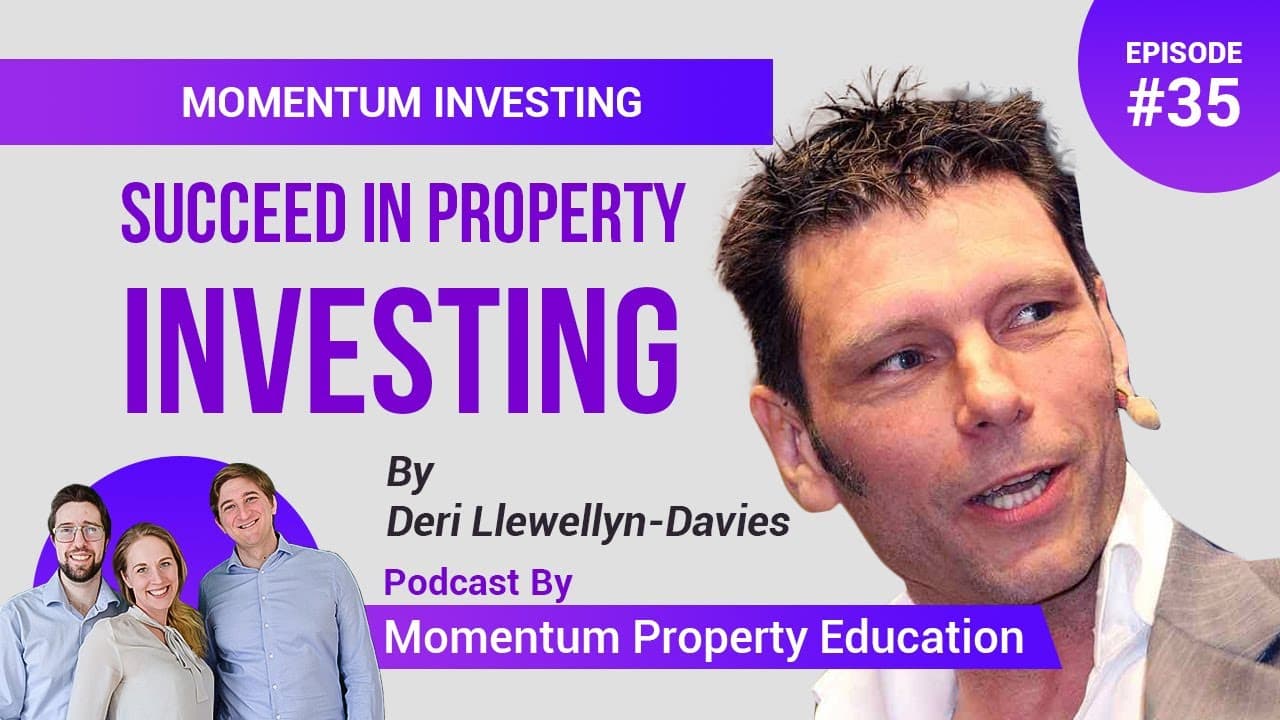
How to Succeed in Property Investing - Deri Llewellyn-Davies
Video from Momentum Property Education.
Generated from the canonical interview transcript and validated against source data by Guests on Air.
How should property investors build a strategy in an uncertain market?
Deri Llewellyn-Davies says investors should replace hope with certainty. That means studying the long economic cycle, checking every deal against real comparables, choosing a business model that suits the market rather than a guru's favourite, and buying well for the long play so a downturn cannot wipe them out. Being certain matters more than being right.
Deri Llewellyn-Davies has spent two and a half decades working on strategy and has sat on a number of property boards at senior level. In an interview on the Momentum Investing podcast with host Daniel Wood, who calls him an old mentor, he set out how investors should think when the market turns uncertain and the easy gains of a rising market disappear.
His starting point is blunt. In a boom, he argues, almost anyone can make money because rising prices lift everything, even a badly bought property. That success can give investors a false sense of their own skill. A rising market does not make someone a property investor or a strategist, and a harder market tends to flush the amateurs out.
What he offers instead is a discipline built on certainty. He wants investors to look at the whole economic cycle, test every deal against evidence rather than wishes, be honest about whether property is their passion or simply an investment, and pick strategies that will not blow them up on their first outing.
Key takeaways
- A rising market can make anyone look skilled, so early profits are not proof of a sound property strategy.
- Investors need certainty, not hope: every valuation should be backed by real comparables before a deal goes ahead.
- Property is often a freedom vehicle, but excitement is not passion, and many investors end up trapped in it.
- Choose a business model that suits the market, buy well for the long play, and never risk everything on one deal.
1. Read the whole cycle, not the moment
Deri Llewellyn-Davies says his work in strategy has taken him through booms and busts, and that he studies economic trends over long periods, citing Ray Dalio's research across hundreds of years. The present moment matters, but the important question for investors is where they sit in the bigger play, because certain strategies work in any market while others only work in some.
He warns that property investors in particular have short memories. In boardrooms he has watched people who were hurt in the 2008 crash behave a few years later as if it never happened. Economic cycles repeat, he says, and anyone new to the market can study that history now rather than learning it by losing money.
The hardest decisions sit with experienced developers running at scale. Once land is bought and a pipeline of homes is under way, the business behaves like a juggernaut. He recalls a boardroom where a developer asked for a growth strategy for the next five years, and his advice was to stop the party and move to cash while uncertainty was high.
2. Swap hope for certainty
Uncertainty, he says, is the main driving force of the entrepreneur, and hope is part of the job, because anyone without hope stops. The danger is letting hope run the numbers. Leaders need to be certain before they can stand up, set out a strategic vision with confidence and get everyone behind executing it.
Host Daniel Wood gave a small example from his own deals: a project that only works if the property is valued at 400,000 fails when careful due diligence shows it will not be valued above 280,000. Deri Llewellyn-Davies agreed that the word if is where hope creeps in, and admitted he had plenty of ifs in his twenties.
His answer is professional rigour. Investors should be strong on their numbers and demand a comparable that supports every assumption. The point is not to be right every time but to know that the decision rests on evidence. He compares property with medicine or law, where people train deeply and gain experience before running their own practice.

3. Passion, partners and the long play
Before any strategy, he asks whether property is truly someone's passion or an investment on the side. Many people treat it as a freedom vehicle and confuse the thrill of the first few deals with passion. He built a portfolio of shared houses for his own freedom and found the strategy made money but bored him, so it became one part of a larger plan.
He also sees too many solo investors trying to do everything. In a normal business, different directors cover marketing, sales, operations, cash and talent. In property, one person often runs the whole empire with only a power team of trades and advisers around them, and that is how burnout happens. Complementary partners, he says, are the fix.
For new investors his advice is to be ready, then move when certain enough, not perfect. Do not follow a single guru, understand the different strategies, and choose a business model that fits the market. Flips can work while prices rise and go badly when they fall. Buy well, in the right area, for the long play, and never throw everything at one or two deals.