Leadership Communication
Brooke Hargraves on Speaking Up Before Everything Is Perfect
The media strategist and former political adviser explains why confidence comes from being real, not from getting every word right.
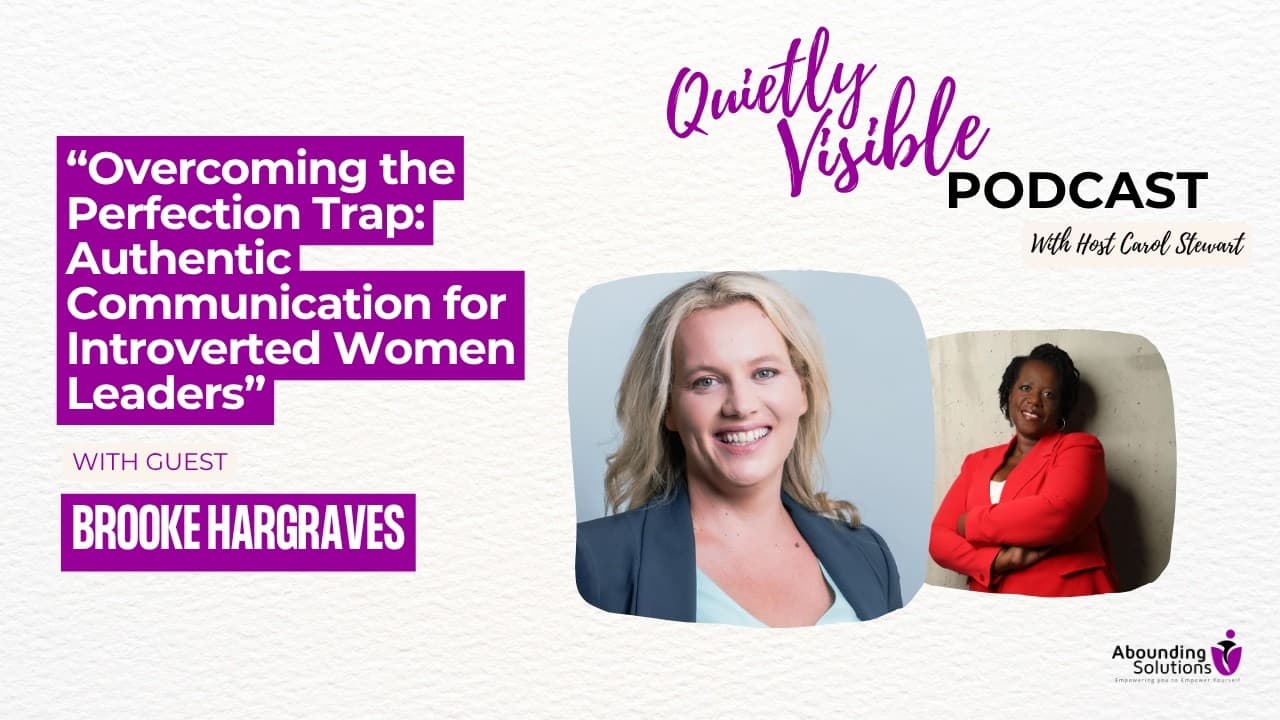
Overcoming the Perfection Trap: Authentic Communication for Introverted Women Leaders
Video from Carol Stewart.
Generated from the canonical interview transcript and validated against source data by Guests on Air.
How can introverted women leaders speak up without waiting to be perfect?
Brooke Hargraves says leaders should stop waiting for perfect words and focus on being real. Confidence comes from knowing you will be okay if something goes wrong, not from certainty. Audiences trust authentic speakers over polished scripts, so lowering expectation and practising speaking up builds the self-belief that perfectionism holds back.
Many capable leaders stay quiet in meetings, interviews and panels because they are waiting for the perfect words and the perfect moment. On the Quietly Visible podcast with host Carol Stewart, media and communications strategist Brooke Hargraves argued that this wait is the real problem, and that confidence comes from somewhere other than getting everything right.
Brooke spent her early career as a print journalist before working for around 15 years in political advisory roles across every level of government in Australia. She now runs her own firm, coaching people to tell their own story and share their own message in a way that feels genuinely authentic to them.
The conversation was aimed at introverted women leaders, who often feel put on the spot and short of time to process their thoughts before they speak. Her answer was practical rather than motivational: separate who you are from what you do, lower the weight of expectation, and treat speaking up as a skill that grows stronger with use.
Key takeaways
- Confidence means knowing you will be okay when things go wrong, not knowing that everything will be perfect.
- Audiences can tell when a speaker is performing, so a real voice earns more trust than a flawless script.
- Separating who you are from what you do takes much of the pressure out of speaking in public.
- Speaking up works like a muscle, and each attempt that goes better than feared builds self-belief.
1. Confidence is not the same as certainty
Brooke's biggest lesson from years of watching leaders up close is that confidence does not depend on certainty. As she put it, confidence isn't knowing that everything is going to be perfect. It is a mindset built over time, one in which a leader knows they will be okay even when a moment does not go to plan, and that knowledge frees them to speak.
Politics made the point vivid for her. When a political leader stands up to speak, they know an opposing group is ready to say it disagrees. That takes the courage of conviction, and it also takes acceptance that not everyone will agree with you on everything. Brooke sees that acceptance as something leaders in any field can build within themselves.
For introverted women who worry about how they will be perceived and judged, this reframing matters. Disagreement is not a verdict on a person's worth. When a leader can clearly state who they are, what they believe and what their message is, and stay comfortable with it, other views stop feeling like a threat and start feeling like part of a useful exchange.
2. Why a perfect script can undermine trust
Brooke warned that people tend to confuse confidence with trustworthiness and with strength. Audiences are wired to notice when someone is being performative or trying too hard, and body language gives it away quickly. That is part of why people can look stiff in front of a camera, because so much of what we convey is never actually spoken aloud.
She sees the same risk in AI tools that can produce an almost perfect script, email or speech on demand. Because people can sense when something is not authentic, polished words delivered without belief tend to fall flat. What grabs an audience is a speaker who genuinely believes what they are saying and whose passion comes through in their voice.
Her conclusion was that listeners are increasingly drawn to people who are not flawless. A stumble over a word, an imperfect presentation or an unplanned joke can make a speaker more relatable rather than less. Being real, in her view, is a sign of courage, and it is a skill that leaders will need to keep working on.

3. Lowering the weight of expectation
Brooke pointed to exit and concession speeches as a clear example of what changes when pressure lifts. Once the outcome has been accepted, the weight of expectation falls away, and audiences often see a warmer, clearer and more authentic person emerge. For her, those moments show how expectation can distort the way leaders believe they should behave.
Her advice is to pare back expectation and focus on what you can control. Some of the most powerful leaders she has seen are the first to admit they do not have all the answers and want input from their team. Being honest about that with the press or with colleagues removes the pressure to deliver every answer perfectly and on time.
She also urged leaders to separate who they are as people from what they do for a living, and to give themselves grace as they grow. Speaking up is a skill to build, not a trait someone is born with. Each time a leader speaks and finds the result better than they feared, that experience reinforces confidence and self-belief.
